It's a familiar story for many commercial beekeepers: you do everything by the book, yet the results are frustratingly inconsistent. One year, the honey flows are spectacular; the next, they're a fraction of the forecast. Mite treatments that worked before suddenly fail, leading to devastating winter losses. You invest in new queens, but the colonies still seem weak and unproductive.
You’re left trying to fix problems as they appear, feeling more like a firefighter than a strategic manager of your apiary.
The Vicious Cycle of Reactive Beekeeping
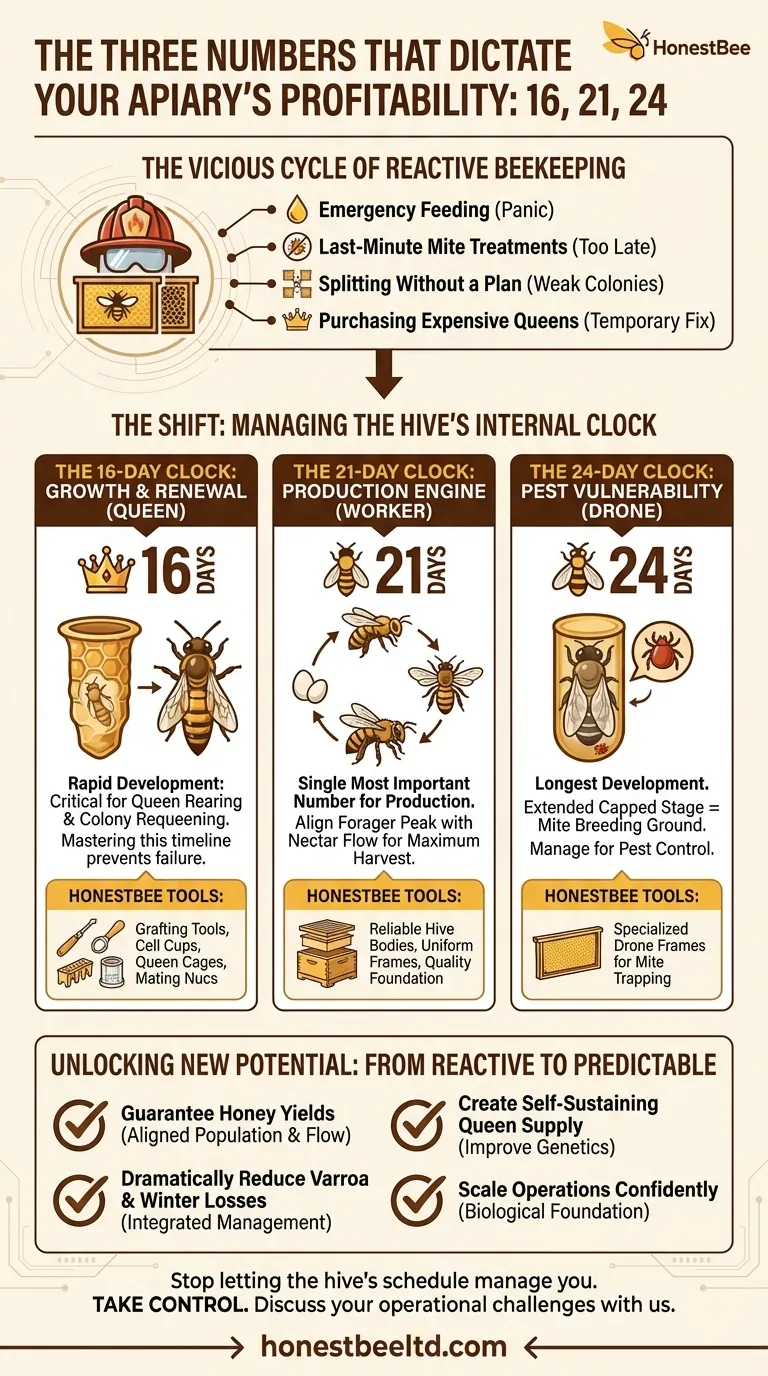
This reactive approach is incredibly common. When a hive underperforms, the typical response is a scramble:
- Emergency feeding to boost a weak population, often too late.
- Last-minute mite treatments after an infestation is already out of control.
- Splitting hives without a clear plan, weakening both the parent and daughter colonies.
- Purchasing expensive replacement queens mid-season to fix a problem that started months earlier.
These "solutions" are often just temporary fixes for deeper issues. For a commercial apiary, the consequences are severe: unpredictable honey yields that jeopardize contracts, high operational costs from emergency inputs, and unsustainable colony losses year after year. For distributors, this translates into frantic customers and unpredictable demand for supplies.
The problem isn't a lack of effort. It's that you're working against the most powerful force in your apiary: the hive's internal, non-negotiable biological clock.
The Root Cause: Fighting the Hive's Internal Clock
A honey bee colony doesn't operate on your schedule; it operates on a precise, genetically programmed rhythm. Nearly every outcome—from population size to pest vulnerability—is dictated by three unchangeable numbers. These numbers represent the total development time, from egg to adult, for each caste of bee.
Understanding these three timelines is the shift from reacting to problems to preventing them entirely.
The 21-Day Clock: Your Production Engine (Worker Bees)
A worker bee takes approximately 21 days to develop from egg to adult. This is the single most important number for honey production. To maximize a harvest, your peak forager population must coincide perfectly with your region's main nectar flow. If your timing is off by just a week or two, you'll have a massive army of bees with nothing to do, or a massive nectar flow with too few bees to collect it. Common hive management tactics fail when they ignore this 21-day cycle.
The 16-Day Clock: Your Key to Growth and Renewal (Queens)
A queen develops in just 16 days. This rapid cycle is the foundation of all queen rearing and colony requeening. If a colony goes queenless, you have a very short window to intervene before the hive is doomed. Trying to introduce a new queen or create a split without mastering this 16-day timeline leads to failed introductions, laying workers, and weak colonies that never reach their potential.
The 24-Day Clock: Your Greatest Pest Vulnerability (Drones)
A drone takes the longest to develop: 24 days. Crucially, the drone pupal stage (when the cell is capped) lasts about 14 days. This extended capped period is a perfect breeding ground for the destructive Varroa mite. The mite enters the cell just before it's capped and has more time to reproduce inside drone brood than worker brood. This makes your drone frames potential "mite bombs" that can overwhelm a colony. Applying chemical treatments without managing drone brood is like mopping the floor while the faucet is still running.
The Right Tools for a Time-Based Strategy
Once you understand that you're managing timelines, not just bees, your entire operational focus shifts. To execute this time-based strategy, you need equipment designed for precision and efficiency. Your tools are no longer just containers; they are instruments for manipulating the hive's clock to your advantage.
This is where HONESTBEE provides critical value. We supply the professional-grade equipment that enables you to act on this knowledge with precision and at scale.
- To Master the 21-Day Worker Cycle: You need reliable, uniform hive bodies, frames, and foundation to build strong, predictable colonies that peak exactly when you need them to. Our wholesale equipment ensures you can expand your apiary consistently to meet the nectar flow.
- To Master the 16-Day Queen Cycle: Successful queen rearing requires specialized tools. We provide high-quality grafting tools, cell cups, queen cages, and mating nucs that are essential for producing healthy, well-mated queens on a predictable schedule.
- To Master the 24-Day Drone Cycle: To turn the drone's lifecycle from a liability into a pest-management asset, you need specialized drone frames. These are used to "trap" Varroa mites, allowing you to remove and cull infested drone brood—a powerful, chemical-free pest control method.
Our products are not just supplies; they are purpose-built solutions designed from a deep understanding of the hive's fundamental biology.
Beyond Fixing Problems: Unlocking New Potential
When you stop fighting the hive's clock and start managing it, everything changes. The constant state of emergency disappears, replaced by a predictable, profitable rhythm.
With this control, you can:
- Guarantee honey yields by precisely aligning your forager population with peak nectar flows.
- Dramatically reduce Varroa mite loads and winter losses through integrated pest management.
- Create a self-sustaining supply of high-quality queens, reducing reliance on outside suppliers and improving your stock's genetics.
- Scale your operations confidently, knowing that your management practices are built on a solid, biological foundation.
For commercial apiaries, this means a more stable, profitable business. For distributors, it means supplying your clients with the strategic tools they need to truly succeed, transforming your role from a simple supplier to a vital partner in their success.
Stop letting the hive's schedule manage you. It’s time to take control. If you're ready to align your operations with the fundamental biology of the bee and improve your apiary's predictability and profitability, our team is here to help you get the right equipment for the job. Discuss your unique operational challenges with us and let's build a more successful future, together. Contact Our Experts.
Visual Guide