The Silence Before the Bloom
The late winter air is still, but for a commercial beekeeper, the clock is already ticking. Inside each hive is a dormant biological engine, waiting for a signal to roar to life. The first major nectar flow is weeks away, and the success of the entire season depends on a single, critical decision: how to fuel the population boom.
This isn't just about providing food. It's about sending a message. The choice between feeding methods—openly in a shared feeder or internally, hive by hive—is a choice between two fundamentally different management philosophies.
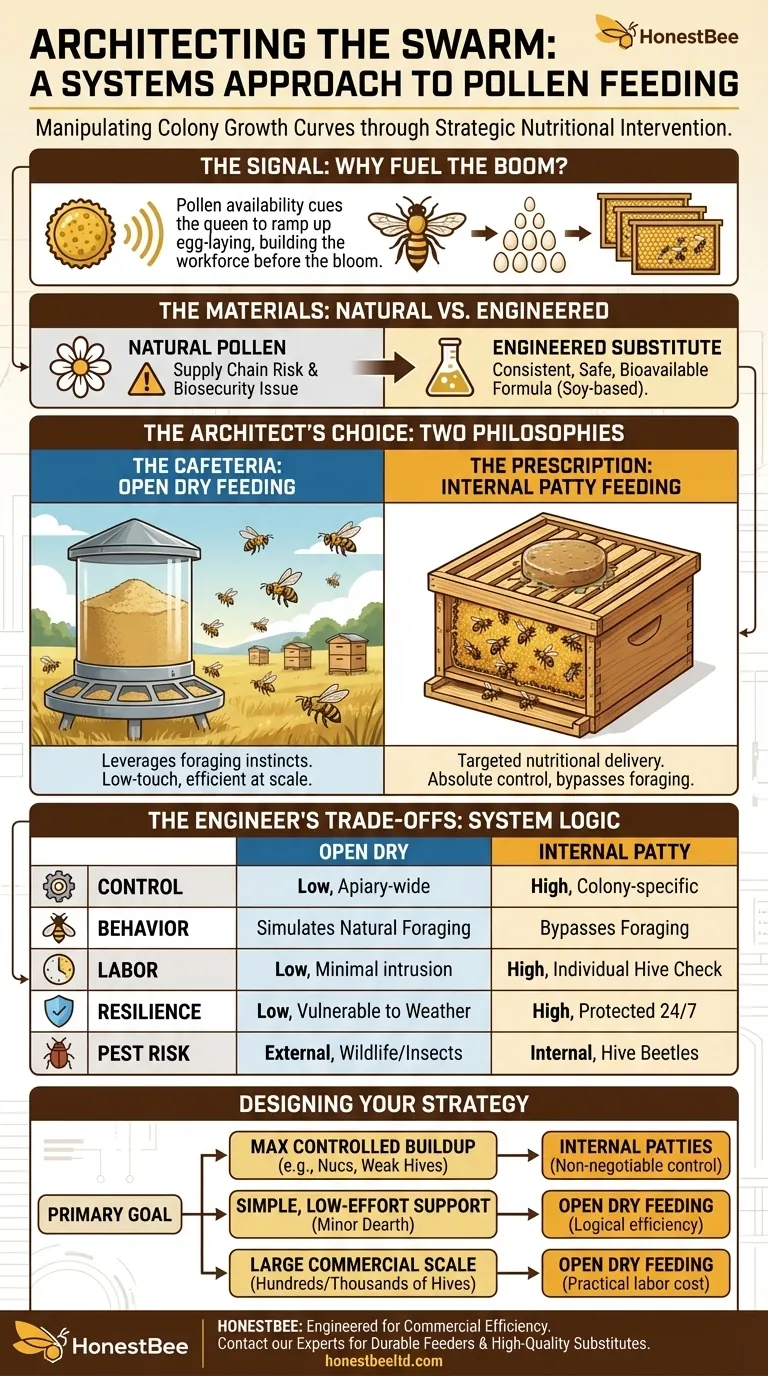
The 'Why' Is a Signal, Not Just Sustenance
A honey bee colony operates on environmental cues. The availability of pollen is the primary signal that tells the queen it's safe and advantageous to ramp up egg-laying.
By providing a protein source before nature does, you are intentionally manipulating this system. You are telling the colony that resources are abundant, triggering the brood-rearing that builds a powerful foraging workforce precisely when the flowers arrive.
You are, in essence, an architect of the colony's growth curve.
The Engineer's Materials: Natural Pollen vs. The Engineered Substitute
While natural pollen is the gold standard, it presents a supply chain problem. It can be costly and, more critically, carries the biosecurity risk of transmitting diseases between apiaries.
For this reason, commercial operations often rely on high-quality pollen substitutes. These are not just "fake food"; they are engineered nutritional formulas, typically soy-based, designed for safety, consistency, and bioavailability. They remove a variable from a complex equation.
Two Philosophies of Intervention
How you deliver this nutrition is where strategy truly comes into play. It boils down to a conflict between control and autonomy.
The Cafeteria Model: Open Dry Feeding
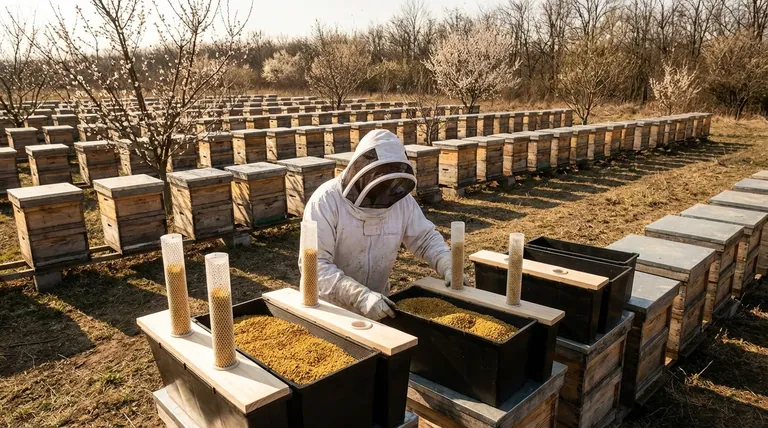
This method is elegant in its simplicity. Dry pollen or substitute powder is placed in a protected feeder some distance from the hives.
The bees discover it, pack it onto their corbiculae (pollen baskets), and fly it back to the hive. They process and store it just as they would natural pollen.
It's a "community cafeteria" that leverages the bees' own foraging instincts. It is low-touch, efficient at scale, and respects the natural behavior of the colony.
The Targeted Prescription: Internal Patty Feeding
The alternative is to mix the substitute with sugar syrup into a moist patty and place it directly on the frames inside the hive.
This is a targeted nutritional prescription. You know exactly which hive is getting the supplement and can monitor their consumption rate. It bypasses the need for foraging and delivers the protein directly where it's needed.
It is a method of absolute control.
The Engineer's Trade-Offs: Choosing Your System's Logic
Neither approach is inherently superior. They are tools for different jobs, each with a distinct set of operational trade-offs.
| Feature | Open Dry Feeding (The Cafeteria) | Internal Patty Feeding (The Prescription) |
|---|---|---|
| Control | Low. Feeds the entire apiary (and potentially neighbors). Stronger colonies may dominate. | High. Targeted nutrition for specific colonies. Consumption is easily monitored. |
| Behavior | Simulates natural foraging, reinforcing instinctual behavior. | Bypasses foraging. A direct, unnatural but effective intervention. |
| Labor | Low. Set up one feeder for many hives. Minimal hive intrusions. | High. Requires opening every individual hive to place and check patties. |
| Resilience | Low. Highly vulnerable to rain and even heavy dew, which can spoil the entire supply. | High. Protected from the elements. Available to bees 24/7, regardless of weather. |
| Pest Risk | External. Can attract wildlife, ants, and other insects to the feeder. | Internal. Old patties can attract and harbor small hive beetles inside the hive. |
Designing Your Feeding Strategy
Your choice is a direct reflection of your primary goal. There is no one-size-fits-all answer, only the right tool for the objective.
- Goal: Maximum, controlled buildup. You are building up nucleus colonies or ensuring weaker hives get their share. The control of pollen patties is non-negotiable.
- Goal: Simple, low-effort support. You need to bridge a minor pollen dearth across a generally strong apiary with minimal disruption. The efficiency of open dry feeding is the logical choice.
- Goal: Supporting a large commercial yard. When managing hundreds or thousands of hives, the labor cost of internal feeding is often prohibitive. Open dry feeding becomes the most practical system for delivering supplementary protein at scale.
For the commercial apiarist, efficiency isn't a luxury; it's a prerequisite for survival. Architecting a reliable open-feeding system requires equipment built for the realities of large-scale operations. At HONESTBEE, we focus on supplying commercial apiaries with durable feeders and high-quality pollen substitutes designed for precisely this purpose.
By matching your method to your objective, you move from simply feeding bees to strategically engineering a thriving apiary. To build a robust nutritional system for your operation, Contact Our Experts.
Visual Guide
Related Products
- Removable Plastic Pollen Trap With Ventilated Tray for Bees Pollen Collector
- Plastic Bee Pollen Trap Strips Comb Catcher Collector
- 30 cm Plastic Entrance Hole Bee Pollen Trap and Collector
- Stainless Steel Pollen Shovel with Wooden Handle
- HONESTBEE Entrance Bee Feeder Efficient Hive Front Liquid Feeding Solution for Beekeeping
Related Articles
- The Interface Problem: How Pollen Trap Design Shapes Colony Behavior and Harvest Quality
- How to Install Pollen Traps Without Stressing Your Hive: A Beekeeper’s Guide
- The Paradox of the Pollen Trap: Engineering for Harvest and Hive Health
- Beyond Honey: The Strategic Calculus of the Pollen Trap
- How Pollen Traps Transform Beekeeping: From Hive Health to Additional Income