You open a hive that should be booming, but the familiar sense of dread creeps in. The population is dwindling, the frames are a mess, and you see the tell-tale signs of Small Hive Beetles or a devastating Varroa mite infestation. You’ve followed the standard advice, applied the treatments, and set the traps. Yet, here you are again, facing another potential colony collapse and another hit to your bottom line. It feels like a frustrating, expensive game of whack-a-mole you can never win.
Chasing Symptoms: The Endless Cycle of Treatments and Traps
For commercial apiaries, this isn't just a hobbyist's disappointment; it's a critical business failure. Every lost colony represents lost revenue from honey production and unfulfilled pollination contracts. The common response is a reactive scramble: applying chemical miticides, setting more beetle traps, or cleaning up wax moth damage after the fact.
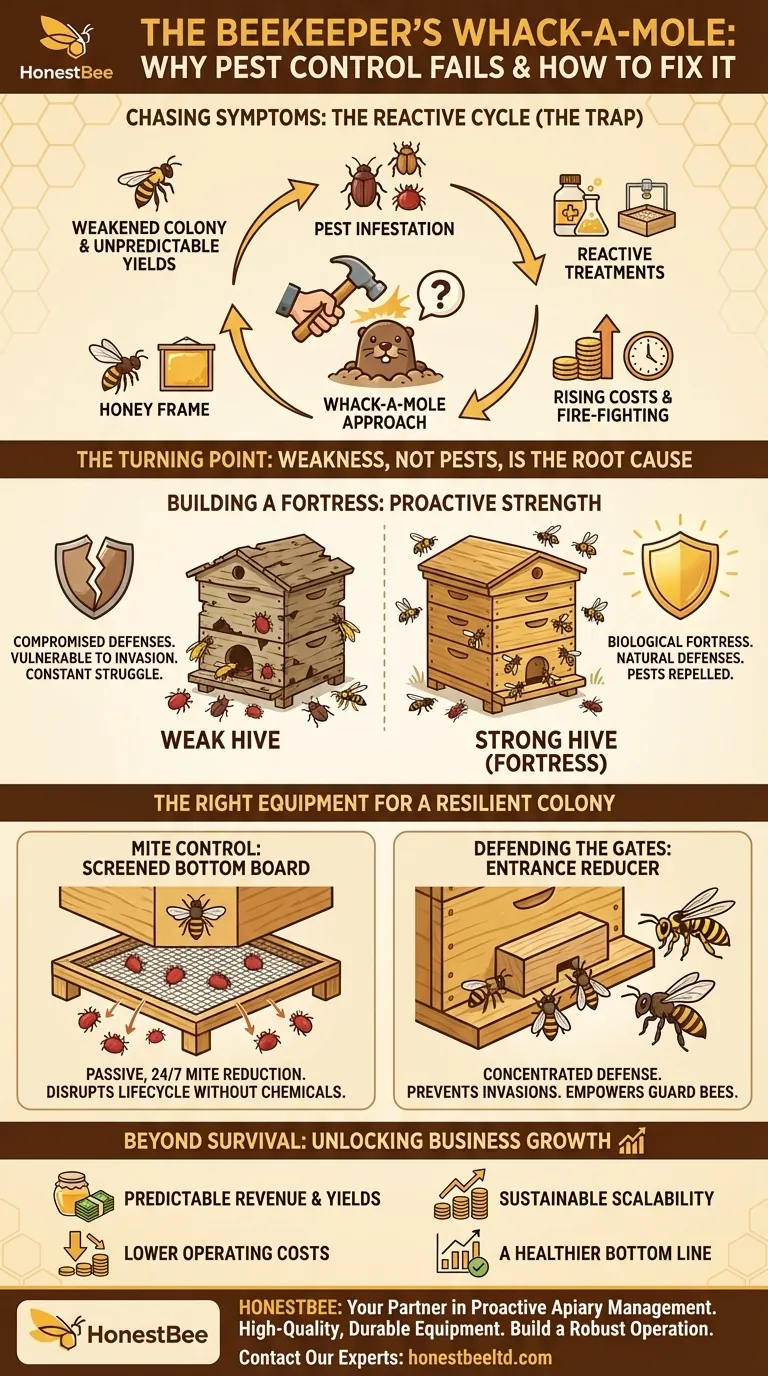
This approach creates a dangerous and costly cycle:
- Rising Costs: You spend more and more on chemical treatments, replacement bees, and the labor required to manage weak, struggling hives.
- Unpredictable Yields: It becomes impossible to forecast your honey production or guarantee the colony strength needed for pollination services, putting client relationships at risk.
- Constant Firefighting: Your time is consumed by treating sick hives instead of focusing on strategic growth and scaling your operation.
These "solutions" consistently fail because they are designed to address the symptoms, not the actual disease. You're trying to patch leaks in a fundamentally broken boat.
The Turning Point: Pests Don't Kill Hives, Weakness Does
Here is the fundamental truth that changes everything: A pest infestation is rarely the root cause of a colony’s collapse. It is the consequence of a pre-existing weakness.
Think of it like this: a healthy person with a strong immune system can easily fight off a common cold virus. But someone with a compromised immune system can develop a life-threatening case of pneumonia from that same virus.
Your beehive is no different. A powerful, populous colony is a biological fortress. It has a large workforce of guard bees to repel intruders, an army of nurse bees to identify and remove diseased brood (hygienic behavior), and enough bees to patrol every corner of the hive, leaving no space for pests to establish a foothold.
The reactive chemical treatments and traps you've been using are like giving cough syrup for pneumonia. They might offer temporary relief, but they do nothing to build the underlying strength required for long-term health. They fail because they ignore the real problem: the hive was too weak to defend itself in the first place.
Building a Fortress: The Right Equipment for a Resilient Colony
To truly solve the pest problem, you must shift your strategy from reactively killing pests to proactively empowering your bees. This means creating an environment and providing tools that amplify their natural defenses.
This isn't a vague philosophy; it's a practical, equipment-based approach. The right hive components are not just boxes to hold bees; they are strategic tools designed to solve specific biological challenges.
The Foundation of Mite Control: The Screened Bottom Board
Varroa mites are the single greatest threat, weakening a colony from the inside out. Instead of relying solely on chemicals, you can fundamentally disrupt their lifecycle. A Screened Bottom Board is a cornerstone of modern Integrated Pest Management (IPM). When mites naturally fall off their bee hosts, they drop through the screen and out of the hive, unable to climb back in. It’s a simple, passive, and incredibly effective tool that works 24/7 to lower the mite load without any chemical intervention.
Defending the Gates: The Entrance Reducer
A massive, undefended entrance is an open invitation for robber bees, yellow jackets, and other intruders, especially for smaller or developing colonies. An Entrance Reducer shrinks the "front door," allowing the colony's guard bees to mount a concentrated and effective defense. It gives a smaller army a defensible chokepoint, preventing the invasion that often precedes a total collapse.
These tools aren't magic. They are the logical hardware for a smarter strategy—a strategy built on the deep understanding that a strong, defensible colony is the ultimate form of pest control.
Beyond Survival: What a Proactive Apiary Unlocks for Your Business
When you stop playing whack-a-mole and start building hive fortresses, the entire dynamic of your business changes. The energy once spent on damage control is now freed up for growth.
By equipping your hives to defend themselves, you unlock:
- Predictable Revenue: Strong, healthy hives produce consistent, high-quality honey yields and provide reliable pollination services you can count on.
- Lower Operating Costs: Drastically reduce your expenses on chemical treatments and the constant need to buy replacement colonies.
- Sustainable Scalability: With a proven system for maintaining colony health, you can confidently expand your operation, knowing your foundation is solid.
- A Healthier Bottom Line: You shift from a business model of constant loss-mitigation to one of predictable profit and long-term asset growth.
Moving from reactive treatments to a proactive, defense-oriented system isn't just about saving bees; it's about building a more profitable, resilient, and predictable business. At HONESTBEE, we specialize in providing commercial apiaries and distributors with the high-quality, durable equipment that forms the foundation of this modern approach. If you're ready to break the cycle and build a more robust operation, let's talk. Our experts can help you select the right tools to meet the unique challenges of your apiary. Contact Our Experts
Visual Guide