The Paradox of a Booming Metropolis
Imagine a city-state at its absolute peak. The population is booming, warehouses are overflowing with goods, and the leader is incredibly productive. By every metric, it is a staggering success.
And then, half the population leaves. Led by the established ruler, they abandon their fortified home to build a new civilization from scratch.
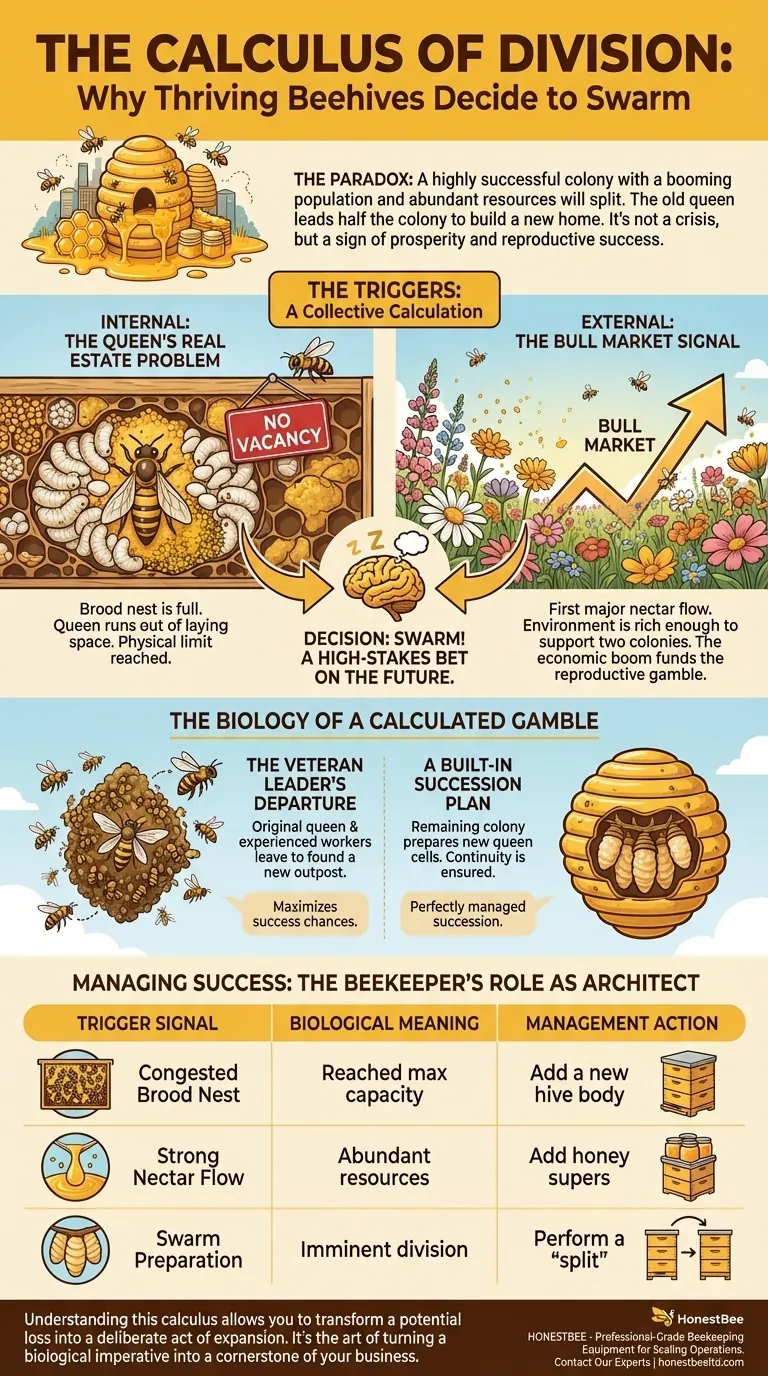
This sounds like a crisis, but it is the beautiful, calculated logic of a honeybee colony. Swarming is not an act of desperation or abandonment. It is a high-stakes expedition funded by prosperity, a sign that the colony is so successful it can afford to reproduce itself.
The Internal and External Triggers
A colony's decision to swarm is not made lightly. It is a collective calculation based on two powerful, converging signals.
The Queen's Real Estate Problem
The brood nest is the heart of the hive, the nursery where the queen lays thousands of eggs a day. It is the engine of the colony's growth.
When this area becomes congested—filled with eggs, larvae, pollen, and honey—a physical limit is reached. The queen, the single most vital individual, runs out of space to perform her function. This internal traffic jam is the first critical signal that the current home has reached maximum capacity.
The Bull Market Signal
Just as the hive feels the internal pressure of overcrowding, the outside world sends a message of abundance. The first major nectar flow of the season—a sudden, massive influx of resources—is the primary external trigger.
This is the colony's bull market. It signals that the environment is rich enough to support not just the existing population, but a new daughter colony as well. The timing is no accident; the colony waits for this economic boom to finance its reproductive gamble.
The Biology of a Calculated Gamble
From the perspective of the superorganism, swarming is a high-risk, high-reward strategy for genetic propagation. It's a bet on the future, executed with remarkable precision.
The Veteran Leader's Departure
A common misconception is that a new, untested queen leads the swarm. The opposite is true. The colony’s original, established queen departs, taking with her a massive contingent of the most experienced worker bees.
This is an enormous investment of talent and resources. The colony is sending its best and brightest to found the new outpost, maximizing its chances of success.
A Built-in Succession Plan
The parent hive is not left to chance. Before the old queen leaves, the workers meticulously prepare several queen cells. The colony that remains is equipped with everything it needs to raise and install a new leader, ensuring the original hive's continuity. It is a perfectly managed succession.
Managing Success: The Beekeeper's Role as Architect
For a commercial beekeeper, understanding this calculus is everything. The goal isn't to prevent success but to manage its consequences. Your role shifts from mere caretaker to a kind of colony architect or urban planner.
When a hive signals it's ready to swarm, it's telling you it needs to expand. Ignoring this signal leads to losing half your workforce. Responding to it, however, opens up opportunity.
This is where the quality of your equipment becomes paramount. Managing expansion requires giving the queen more "real estate" and the workers more "warehousing."
| Trigger Signal | Biological Meaning | Beekeeper's Management Action |
|---|---|---|
| Congested Brood Nest | Reached maximum internal capacity | Add a new hive body to give the queen more room to lay. |
| Strong Nectar Flow | Abundant external resources | Add honey supers to provide storage space and relieve pressure. |
| Swarm Preparation | Imminent division | Perform a "split" to create a new colony under your control. |
Effectively executing these maneuvers, especially at scale, requires durable, standardized, and reliable infrastructure. You need hive bodies, frames, and foundations that can withstand the demands of a booming population.
At HONESTBEE, we specialize in supplying the professional-grade beekeeping equipment that allows commercial apiaries to scale their operations efficiently. We provide the architectural tools you need to manage the powerful, natural impulse of your colonies to grow.
By understanding the triggers for swarming, you can transform a potential loss into a deliberate act of expansion. It is the art of turning a biological imperative into a cornerstone of your business. Whether you aim to prevent swarms or multiply your colonies, having the right infrastructure is what makes it possible. Contact Our Experts
Visual Guide