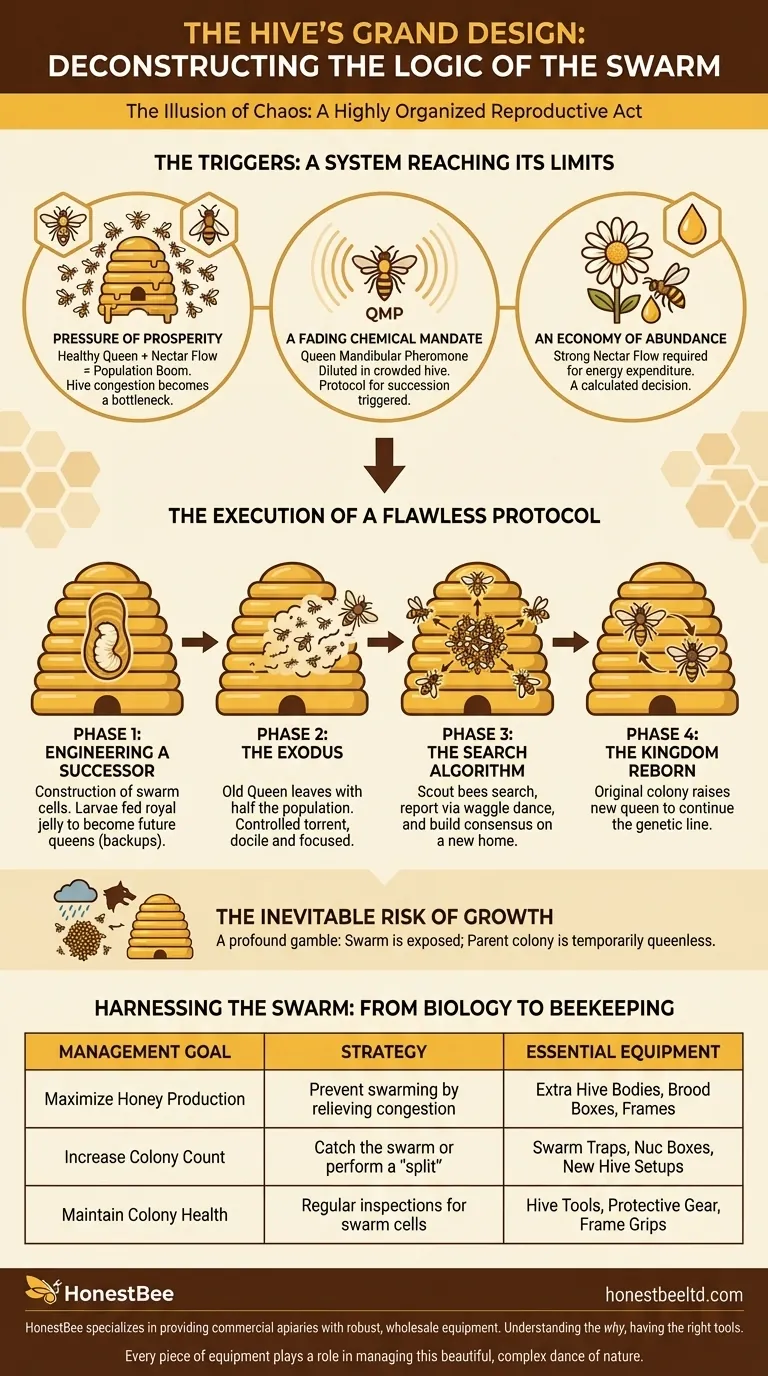
The Illusion of Chaos
To the uninitiated, a honey bee swarm is a terrifying vortex of chaos. A swirling, buzzing cloud of tens of thousands of insects moving as one.
But it is not chaos. It is the single most organized, high-stakes, and deliberate act a honey bee colony will ever perform. It's not an abandonment; it's a birth. The superorganism is reproducing.
The Triggers: A System Reaching its Limits
A colony doesn't decide to swarm on a whim. The decision is the logical outcome of a system reaching its predefined capacity, triggered by a confluence of clear, measurable signals.
The Pressure of Prosperity
The primary trigger is success. A healthy queen laying 2,000 eggs a day in the midst of a spring nectar flow leads to a population boom. Every cell in the hive becomes occupied—with brood, pollen, or nectar.
This congestion isn't just uncomfortable; it's a systemic bottleneck. The very success that defines a strong colony becomes the signal that its current home is no longer viable for growth.
A Fading Chemical Mandate
The queen maintains order through a chemical signature, the Queen Mandibular Pheromone (QMP). This pheromone is the colony's internal network, passed from bee to bee, constantly broadcasting the message: "The queen is here, she is healthy, do not raise another."
In a crowded hive, this signal becomes diluted. It can no longer reach the furthest workers effectively. For those bees on the periphery, the message fades, and the protocol to initiate a succession plan—building queen cells—is triggered.
An Economy of Abundance
A swarm is an enormous energy expenditure. The colony will only commit to this risky venture when the economic conditions are perfect. The trigger is a strong nectar flow.
This ensures the departing swarm has the fuel to build a new home from scratch and that the parent colony has enough resources to recover and support its new queen. It's a calculated decision based on resource availability.
The Execution of a Flawless Protocol
Once the decision is made, the colony executes a pre-programmed sequence of events with remarkable precision.
Phase 1: Engineering a Successor
The first tangible sign is the construction of special swarm cells, vertical and peanut-shaped. The queen deposits eggs into them, and the workers feed the larvae a diet of pure royal jelly, programming them to become future queens. They are not just creating one successor; they are creating backups.
Phase 2: The Exodus
On a warm, bright day, the exodus begins. The old queen, having been put on a diet by her workers to become flight-worthy, leaves with roughly half the population. They pour from the hive in a controlled torrent, a living river that temporarily takes to the air.
The bees are surprisingly docile, their stomachs full of honey and their minds focused on a single task: protecting their queen and finding a new home.
Phase 3: The Search Algorithm
The swarm settles in a temporary cluster, or bivouac, nearby. From this base, hundreds of scout bees execute a sophisticated search algorithm. They fly out, find potential new cavities, and return to report their findings.
They communicate the location, size, and quality of a site through a "waggle dance." Other scouts investigate the most promising options, and through a democratic process of consensus, a final decision is reached. It is decentralized decision-making at its most elegant.
Phase 4: The Kingdom Reborn
Back in the original hive, life continues. The first virgin queen emerges, eliminates her rivals, and embarks on a perilous mating flight. Upon her successful return, she becomes the new heart of the parent colony, ensuring the survival of its genetic line.
The Inevitable Risk of Growth
This act of reproduction is a profound gamble. The swarm is exposed, with limited food and at the mercy of the weather. The parent colony is left with a reduced workforce and is queenless for a critical period. If their virgin queen fails to return from her mating flight, the colony is doomed.
Swarming is a testament to the fact that in nature, survival and growth always involve calculated risk.
Harnessing the Swarm: From Biology to Beekeeping
For a commercial beekeeper, understanding this biological imperative is the difference between a successful season and a lost one. A swarm represents half your workforce—and your honey crop—flying away. Yet, it's also a sign of a colony so healthy it's ready to multiply. Managing this instinct is key.
Effective swarm management isn't about stopping a colony's natural impulse but redirecting it. It requires foresight, timing, and the right equipment to provide space and simulate conditions that keep the hive's "decision engine" from triggering the swarm protocol.
| Management Goal | Strategy | Essential Equipment |
|---|---|---|
| Maximize Honey Production | Prevent swarming by relieving congestion. | Extra Hive Bodies, Brood Boxes, Frames |
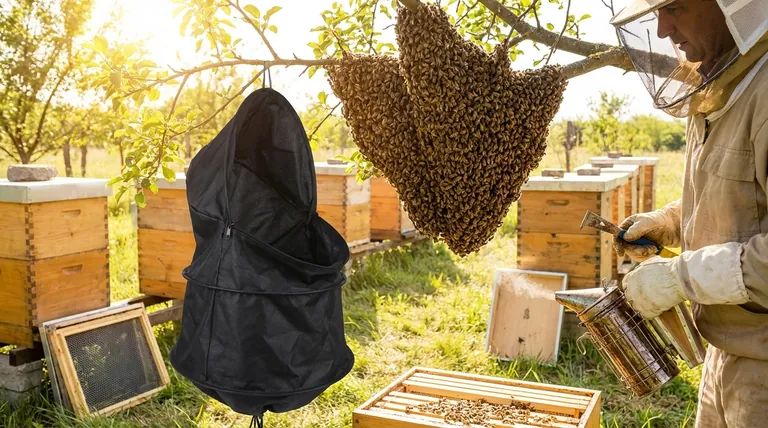
| Increase Colony Count | Catch the swarm or perform a "split." | Swarm Traps, Nuc Boxes, New Hive Setups |
| Maintain Colony Health | Regular inspections for swarm cells. | Hive Tools, Protective Gear, Frame Grips |
This level of proactive management is impossible without reliable, high-quality apiary supplies. Having extra hive bodies on hand before they're needed, or the right nuc box to capture a valuable swarm, is fundamental. This is where a partnership with a dedicated supplier becomes critical. HONESTBEE specializes in providing commercial apiaries with the robust, wholesale equipment needed to translate an understanding of bee biology into a thriving operation.
Understanding the why behind the swarm is the first step. Having the right tools to act on that knowledge is the second. From durable hive components to the protective gear needed for confident inspections, every piece of equipment plays a role in managing this beautiful, complex dance of nature. Contact Our Experts
Visual Guide