You’ve invested in the best instrumental insemination (AI) equipment. You've spent countless hours practicing a steady hand. You follow the CO2 anesthesia protocol to the letter. So why do a frustrating number of your expensive, carefully inseminated queens still fail—either by not laying, laying poorly, or becoming drone layers within months?
It’s a scenario that plays out in apiaries everywhere: a significant investment in time, training, and technology that yields inconsistent, unpredictable results.
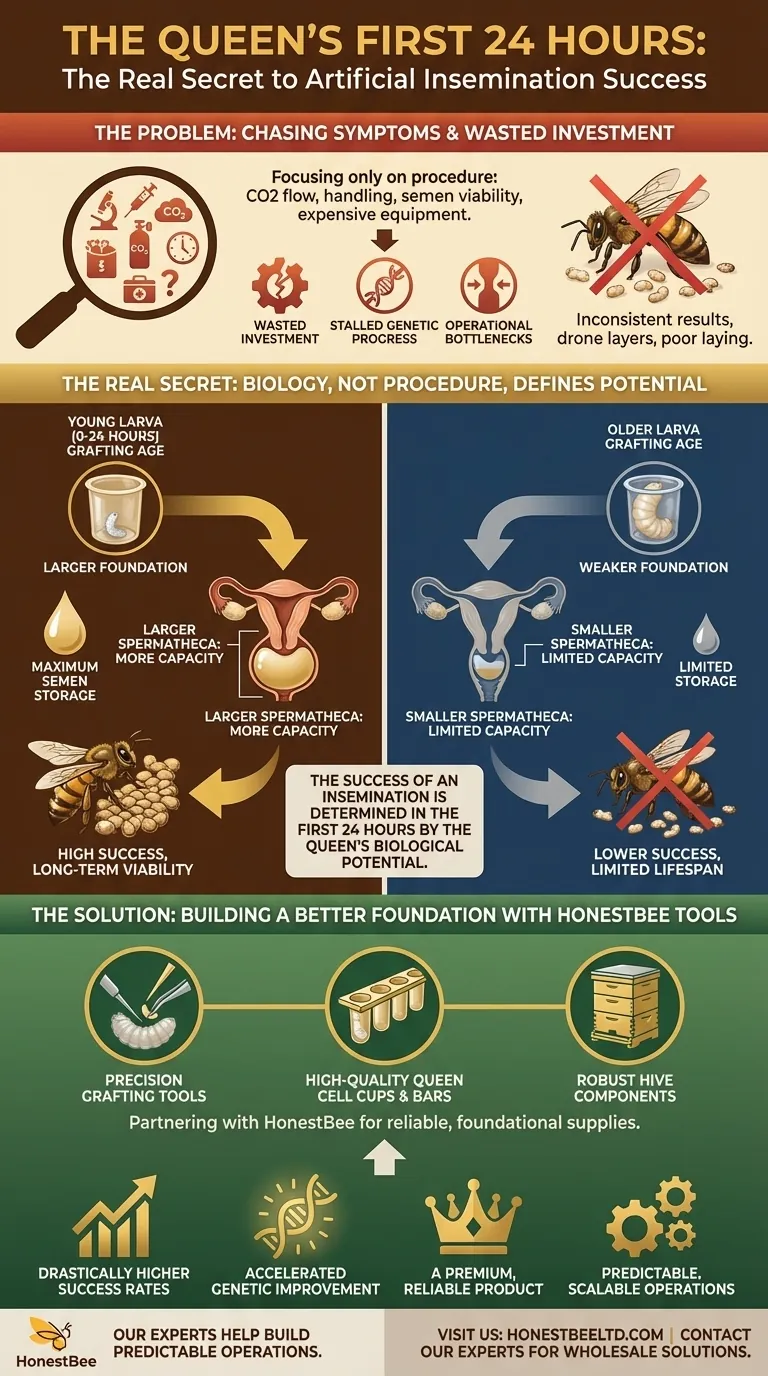
Chasing Symptoms: The High Cost of Misdiagnosing the Problem
When an inseminated queen fails, the immediate impulse is to blame the procedure. We ask ourselves:
- "Was the CO2 flow incorrect?"
- "Did I handle her too roughly?"
- "Was the semen viability off today?"
- "Do I need an even more expensive microscope?"
This leads to a cycle of endlessly tweaking technique, re-calibrating equipment, and second-guessing your skills. While procedural excellence is important, focusing on it exclusively often misses the real culprit.
For a commercial apiary or queen breeder, this isn't just a technical frustration; it's a significant business problem:
- Wasted Investment: Every failed queen represents a sunk cost in labor, specialized equipment, and drone-rearing resources.
- Stalled Genetic Progress: The primary goal of AI—propagating superior genetics—is undermined. Your best stock fails to reproduce, halting your breeding program in its tracks.
- Operational Bottlenecks: Unreliable queen production creates unpredictability across your entire operation, delaying nuc creation and colony expansion.
You are stuck troubleshooting the final step of a long process, when the critical error may have occurred weeks earlier.
The Root Cause: A Queen's Fate is Sealed in Her First 24 Hours
Here is the fundamental truth that transforms insemination programs from a gamble into a science: The success of an insemination is determined more by the queen's biological potential than by the technical perfection of the procedure.
And that potential is established the moment you select the larva for grafting.
Biology, Not Procedure, Defines Potential
Think of it like building a skyscraper. You can have the most advanced cranes and the most skilled construction crew in the world (your AI technique and equipment). But if that skyscraper is built on a weak and undersized foundation, it is destined to fail.
For a queen bee, that foundation is her reproductive system. And the quality of that foundation is determined by her age at grafting.
Scientific studies and the experience of top breeders are unanimous: queens raised from the youngest possible larvae (ideally 0-24 hours post-hatch) develop significantly larger and more robust reproductive systems. Specifically, they have:
- Larger Ovaries: For higher egg-laying capacity.
- A Larger Spermatheca: This is the critical factor for AI.
A larger spermatheca can physically hold more semen. It's that simple. When you try to inseminate a queen raised from an older larva, you are attempting to fill a small tank. No matter how perfectly you perform the procedure, you are limited by a physical container that is too small to hold enough sperm for long-term viability.
This is why tweaking your insemination technique yields diminishing returns. You're perfecting the art of filling a bucket that was built too small from the start.
The Right Tools for the Real Problem: Building a Better Foundation
Once you understand that the battle is won or lost at the grafting stage, your focus shifts. The goal is no longer just to perfect the final act of insemination, but to master the first act of queen rearing.
To consistently produce these biologically superior queens, you must be equipped for precision from the very beginning. This is not about flashy technology; it's about uncompromising quality in the foundational tools of the trade. Success requires:
- Precision Grafting Tools: To delicately handle the tiniest, most fragile 0-24 hour old larvae without damage.
- High-Quality Queen Cell Cups & Bars: To provide a stable and optimal environment for these future super-queens to be raised.
- Robust Hive Components: To effectively manage the powerful cell-builder colonies that are essential for nurturing high volumes of quality queen cells.
This is where HONESTBEE supports professional beekeepers. We don't sell a magic bullet for insemination. We provide the high-quality, reliable, wholesale supplies that enable you to execute the correct methodology from day one. Our products are designed for serious operators who understand that success is built on a foundation of biological excellence.
Beyond Troubleshooting: Unlocking the True Potential of Your Breeding Program
When you stop fighting inconsistency and start building quality from the larval stage, the entire dynamic of your operation changes. You move from a reactive state of constant troubleshooting to a proactive state of predictable growth.
Solving this foundational problem unlocks what you set out to achieve in the first place:
- Drastically Higher Success Rates: Your insemination "take rate" skyrockets, delivering an immediate and measurable return on your investment in AI equipment and training.
- Accelerated Genetic Improvement: You can now reliably propagate queens from your most valuable genetic stock, making rapid progress on traits like Varroa resistance, gentleness, and honey production.
- A Premium, Reliable Product: You can market and sell instrumentally inseminated queens with confidence, knowing they have the biological foundation for long-term performance. Your reputation for quality grows.
- Predictable, Scalable Operations: Queen production becomes a reliable, repeatable part of your business, allowing you to plan expansions and sales with certainty.
Fixing your AI program isn't just about a better technique; it's about adopting a better strategy. By focusing on the queen's first 24 hours, you set the stage for success that lasts for years.
Building a world-class breeding program requires a deep understanding of bee biology and a partner who can reliably supply the tools you need to execute your vision. We help commercial apiaries and distributors build more predictable and profitable operations, one well-raised queen at a time. To discuss the specific challenges and goals of your project, we encourage you to reach out. Contact Our Experts.
Visual Guide