The Allure of a False Precision
A new beekeeper asks, "How many bees are in this hive?"
The veteran beekeeper replies, "Enough."
This isn't a curt dismissal. It's the core psychological shift from being a bee-haver to a beekeeper. The amateur seeks a precise number, an easily digestible data point. The professional looks for a signal within a complex system. Estimating the bee population isn’t about a census; it’s about reading the vital signs of a superorganism.
Just as a physician checks your pulse not to count the total number of heartbeats in your lifetime but to assess your health right now, a beekeeper assesses population to diagnose the colony's present condition and anticipate its future.
The Colony as a Single Organism
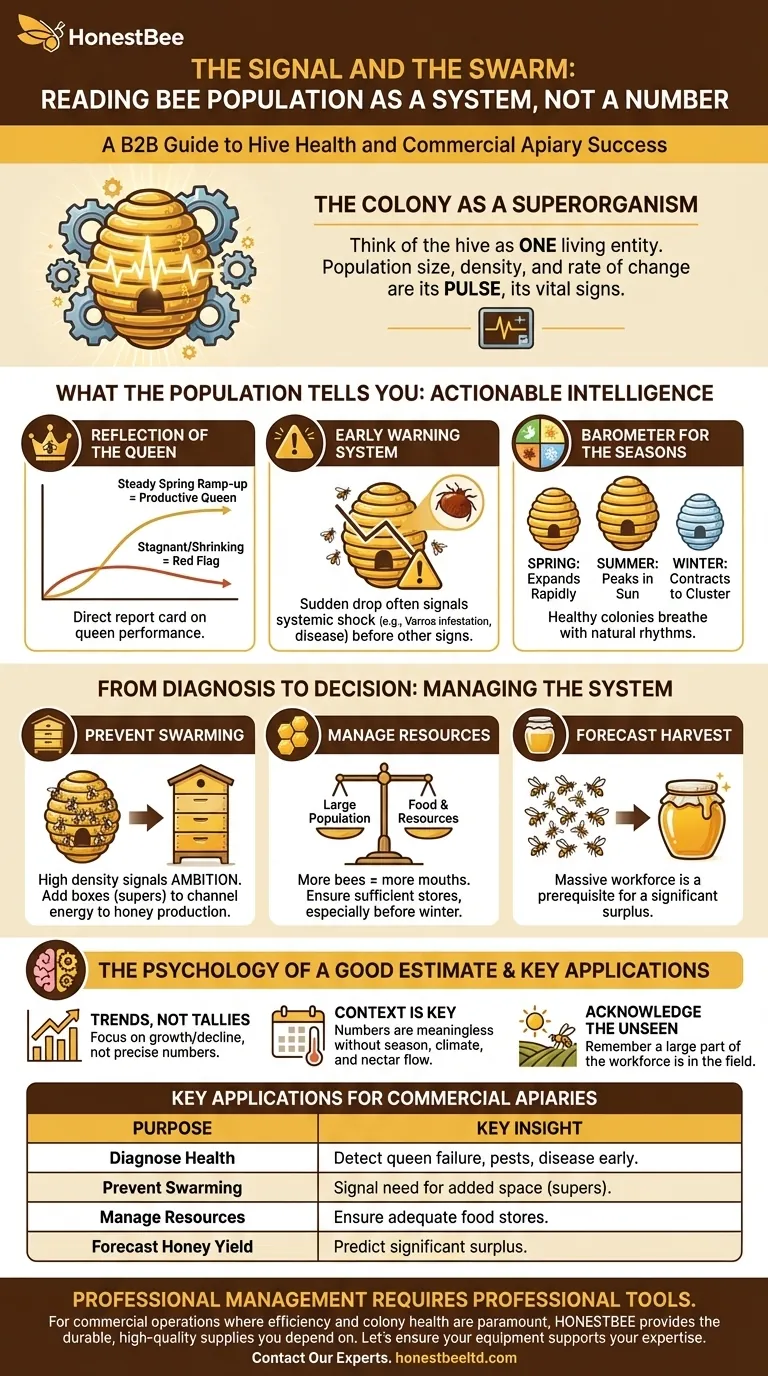
Think of the hive not as a box of 50,000 individual insects, but as one living entity. The population—its size, density, and rate of change—is its pulse, its temperature, its breath. It's the most direct indicator of its overall well-being.
Every management decision, from feeding to harvesting, hinges on understanding this single, dynamic metric. It allows you to shift from reacting to emergencies to proactively shaping the colony's success.
What the Population Tells You
A visual assessment of the bees on a frame is a dense stream of information. With practice, you learn to translate that visual into actionable intelligence.
A Reflection of the Queen
The colony's population is a direct report card on the queen's performance. A steady, powerful ramp-up of bees in the spring is the clearest sign of a well-mated, productive queen.
A stagnant or shrinking population is a red flag. It’s an unemotional signal that the engine of the hive is failing, requiring immediate investigation before the entire colony collapses.
An Early Warning System
A sudden, unexplained population drop is often the first visible symptom of a systemic shock. A severe Varroa mite infestation or a brood disease can cripple a hive's workforce long before other signs become obvious.
By tracking population trends, you gain the invaluable gift of foresight. You spot the decline early and can intervene when the colony is still strong enough to be saved.
A Barometer for the Seasons
A healthy colony breathes with the seasons. It expands rapidly in spring, peaks in the summer sun, and contracts into a tight, efficient cluster for winter.
Your population estimate confirms the hive is in sync with this natural rhythm. A colony that fails to build in spring is a clear sign it's out of step and needs support.
From Diagnosis to Decision
Information is useless without action. The population estimate is the critical data point that drives almost every major beekeeping task.
Managing Ambition: Space and Swarming
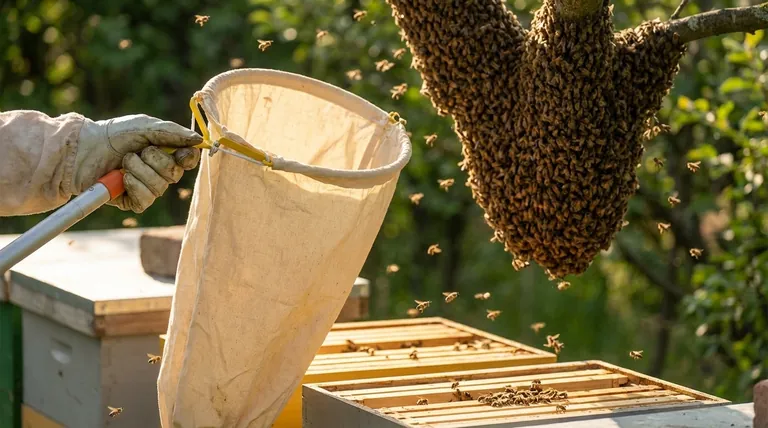
A strong, dense population in a crowded hive signals one thing: ambition. The colony’s natural impulse is to reproduce by swarming.
This is the beekeeper's critical decision point. By recognizing the signs of high population density, you know it's time to add more boxes (supers). This channels the colony’s energy away from swarming and toward the shared goal of honey production. It requires having durable, well-fitting equipment ready at a moment's notice.
Balancing the Books: Food and Resources
More bees mean more mouths to feed. A large population is an asset, but it's also a liability if resources are scarce.
Your estimate helps you balance this biological checkbook. It tells you if the colony's honey stores are sufficient for its size, especially heading into winter or during a nectar dearth. It informs the decision to provide supplemental feeding before starvation becomes a risk.
Forecasting the Harvest
Honey production is a simple equation: a massive workforce is required for a massive surplus. Only strong, populous colonies have enough foragers to bring in nectar far beyond their own needs.
For a commercial apiary, estimating bee numbers is a core part of business forecasting, helping you allocate resources and plan for the harvest.
The Psychology of a Good Estimate
The skill is not in the counting, but in the interpretation. It requires resisting our natural cognitive biases.
- It’s About Trends, Not Tallies: The human brain loves precise numbers. But in beekeeping, the exact number is less important than the trend. Is the population growing, stable, or declining since your last inspection? That is the real story.
- Context is the Canvas: A population of 20,000 bees is fantastic in April but may be a sign of impending failure in July. The number is meaningless without the context of the season, local climate, and nectar flow.
- Acknowledge What You Can't See: On a warm, sunny day, a third of your workforce is in the field. An inspection then will always underestimate the colony's true strength. A good estimate acknowledges the unseen variables.
Key Applications of Population Estimates
| Purpose of Estimation | Key Insight for Beekeepers |
|---|---|
| Diagnose Health | Detects queen failure, pests (e.g., Varroa mites), and disease early. |
| Prevent Swarming | High population density signals the need to add space (supers). |
| Manage Resources | Ensures adequate food stores for large populations, especially in winter. |
| Forecast Honey Yield | A large, strong workforce is the prerequisite for a significant surplus. |
Managing your apiary as a system requires not just skill, but also reliable, professional-grade tools that perform consistently under pressure. For commercial operations where efficiency and colony health are paramount, the quality of your equipment—from hive bodies to extractors—is the foundation of your success. HONESTBEE provides the durable, high-quality supplies that successful commercial apiaries and distributors depend on.
Let's ensure your equipment supports your expertise. Contact Our Experts
Visual Guide