The Silence is Deceptive
In beekeeping, the quiet of winter is not a sign of peace. It's the silent hum of a high-stakes survival engine running at maximum capacity.
Your role as a beekeeper undergoes a profound psychological shift. You are no longer a manager of production, harvesting nature’s surplus. You become a systems engineer, responsible for a living machine whose sole purpose is to outlast the cold.
The primary cause of winter failure isn't disease or exposure; it's starvation. It's a preventable failure of logistics, and your primary job is to monitor the fuel gauge.
The Winter Cluster: A Marvel of Thermal Engineering
To grasp why monitoring is so critical, you must first appreciate the physics of the winter cluster. Bees don't heat their hive; they heat themselves.
The Living Furnace
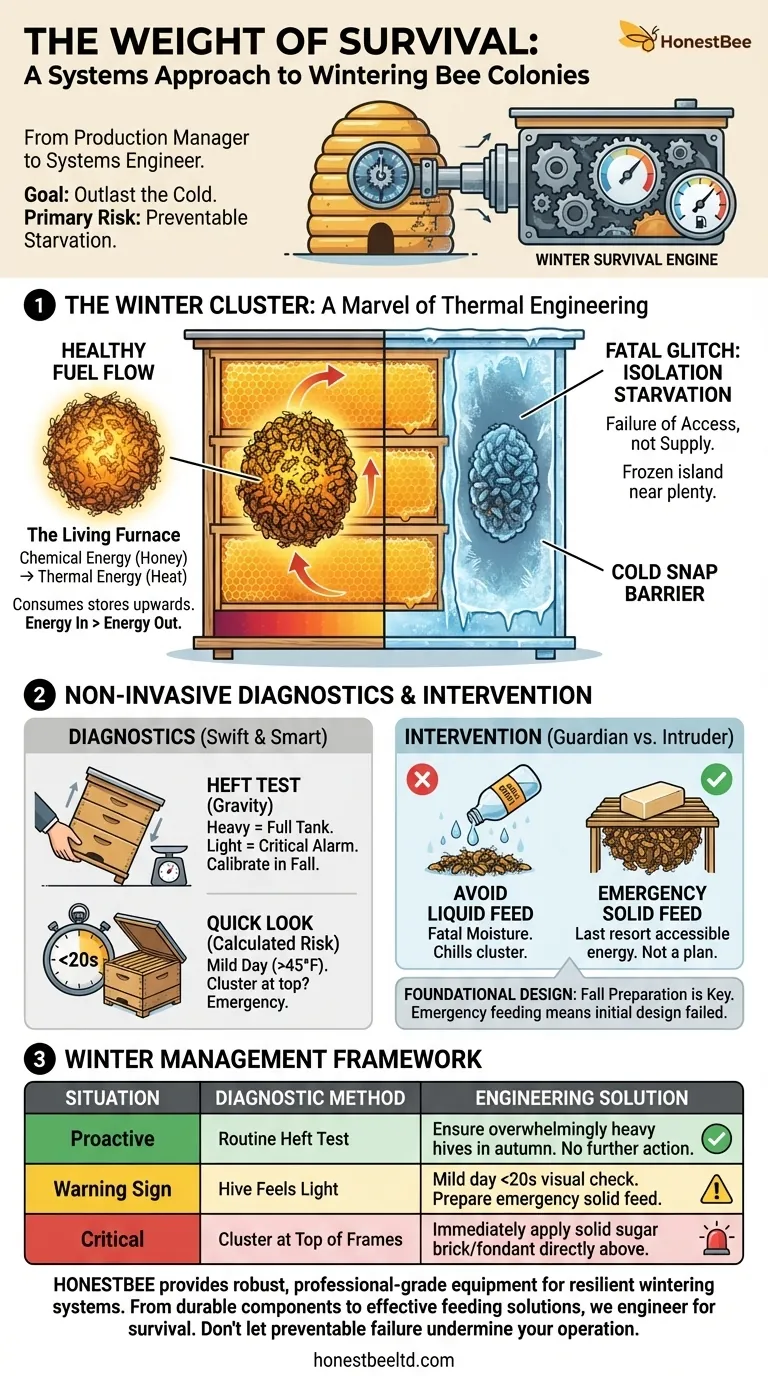
The colony forms a tight sphere, a living blanket insulating a core of furious activity. Inside, bees vibrate their wing muscles, converting the chemical energy of honey directly into thermal energy. This biological furnace maintains a stable, warm core, even as the world outside freezes.
It is a beautiful, self-regulating system. But like any engine, it is entirely dependent on its fuel source.
Honey as High-Octane Fuel
Honey is the high-carbohydrate fuel that powers this intense metabolic process. The colony methodically consumes its stores, typically moving upwards through the hive as winter progresses.
If the fuel runs out, the engine stalls. The vibration ceases, heat production stops, and the cluster freezes. It’s a simple, brutal equation of energy in versus energy out.
A Fatal System Glitch: Isolation Starvation
The most heartbreaking failure mode is isolation starvation. This is where a colony starves to death with frames of honey just inches away.
During a sudden cold snap, the cluster can become so tightly contracted to conserve heat that it is unable—or unwilling—to break formation to move to the next frame of honey. They become a frozen island in a sea of plenty.
This isn't a failure of supply; it's a failure of access. It highlights that survival depends not just on having resources, but on having an uninterrupted path to them.
The Art of Non-Invasive Diagnostics
Opening a hive in winter is like opening a window on a submarine. It breaks the propolis seals, releases critical heat, and can be fatal. Your diagnostics must be swift and smart.
The Heft Test: Reading the Fuel Gauge
The most reliable tool is the simplest: gravity. By gently tilting the hive forward from the back, you can assess its weight. A heavy hive is a full fuel tank. A light hive is a critical alarm.
Practicing this in the fall on a fully provisioned hive calibrates your hands and your mind. It transforms a subjective feeling into a reliable data point. This is the core of proactive winter management.
The Quick Look: A Calculated Risk
If the heft test raises concerns, a visual inspection may be necessary. But it must be done with surgical precision on a mild day (above 45°F / 7°C).
The goal is to gather one piece of information in under 20 seconds: where is the cluster? If they are at the very top of the frames, they have consumed everything below them. They are on their last reserves, and emergency intervention is required.
Intervention: The Fine Line Between Guardian and Intruder
The temptation to "help" can sometimes do more harm than good. A systems engineer knows that poorly planned intervention can destabilize the entire operation.
The Fallacy of Liquid Feed
Never feed sugar syrup in the dead of winter. It's a common mistake born from good intentions. The bees cannot process it effectively, and the excess moisture it introduces will condense on the cold inner surfaces of the hive. This condensation drips back down on the cluster, chilling them in a fatal rain of cold water.
Emergency Protocols vs. Foundational Design
The best winter strategy is designed in the fall. Ensuring colonies are packed with sufficient honey before the first frost is the only reliable path to success. Emergency feeding with solid sugar bricks or fondant is a last-resort rescue mission, not a plan.
Relying on emergency feeding means the initial system design was flawed. For commercial apiaries and serious beekeepers, system reliability is paramount.
| Situation | Diagnostic Method | Engineering Solution |
|---|---|---|
| Proactive | Routine Heft Test | Ensure hives are overwhelmingly heavy in autumn with proper fall feeding and management. No further action needed. |
| Warning Sign | Hive Feels Light | On a mild day, perform a <20-second visual check to locate the cluster. Prepare emergency solid feed. |
| Critical | Cluster at Top of Frames | Immediately apply a solid sugar brick or fondant directly above the cluster to provide an accessible energy source. |
At a professional scale, you cannot leave this to chance. The tools used for fall preparation and the materials for emergency intervention must be reliable and effective. HONESTBEE provides the robust, professional-grade equipment that commercial apiaries and distributors depend on to build resilient wintering systems. From durable hive components that minimize heat loss to effective feeding solutions, our supplies are engineered for colony survival.
Don't let a simple, preventable system failure undermine your operation this winter. Contact Our Experts
Visual Guide