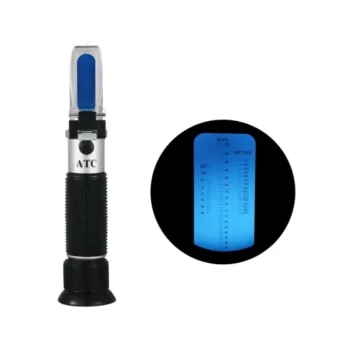
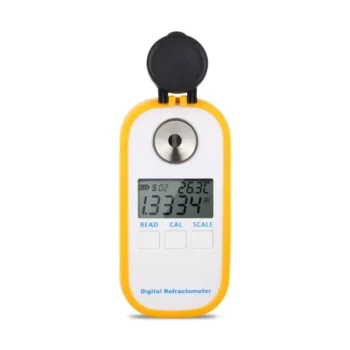
Laboratory refractometers are essential precision instruments used to quantify the sugar concentration—or Brix value—of Phacelia tanacetifolia nectar. By measuring the refractive index of light passing through a nectar sample, these devices provide the critical data needed to calculate the honey-producing capacity and overall economic value of a plant population.
Core Takeaway: Laboratory refractometers serve as the definitive tool for grading nectar quality, allowing professionals to convert raw refractive index data into actionable insights regarding honey yield and crop attractiveness.
Quantifying Economic Value Through Precision
Measuring Sugar Concentration and Brix
Laboratory refractometers determine the percentage of dissolved solids, primarily sucrose, within the nectar of Phacelia tanacetifolia. This measurement, often expressed as a Brix value, is the primary indicator of the nectar’s energy density and nutritional quality.
Calculating Honey-Producing Capacity
By combining sugar concentration data with nectar volume measurements, researchers apply mathematical formulas to estimate total honey yield. This allows commercial honey producers to evaluate the economic viability of specific land tracts or seed varieties.
Determining the Carbohydrate Index
The refractive index is used to establish a carbohydrate index, which serves as a scientific benchmark for comparing different plant varieties. For B2B stakeholders, this index is a vital tool for certifying the quality of honey-source plants for their clients.
Enhancing Pollination Efficiency and Attraction
Assessing Attractiveness to Pollinators
High sugar concentration is a key physicochemical indicator that directly influences how attractive a plant is to honey bees and other pollinators. Refractometers allow for the selection of plant strains that optimize pollination efficiency, leading to better crop yields.
Monitoring Energy Compensation Values
Nectar acts as a "reward" for pollinators, and its energy value dictates the frequency of bee visits. Using a refractometer ensures that the Phacelia tanacetifolia being cultivated provides sufficient energy to sustain healthy, productive hives.
Field vs. Laboratory Analysis
While digital laboratory refractometers offer the highest precision, handheld portable models allow for rapid field testing of nectar carried by returning bees. This versatility ensures that quality control can happen at every stage of the production cycle, from the field to the processing facility.
Understanding the Trade-offs
Precision vs. Portability
Digital laboratory refractometers provide unmatched accuracy but require a stable environment and careful calibration. In contrast, handheld devices offer immediate field results but may have a slightly higher margin of error depending on ambient temperature and light.
Measurement Range Requirements
Phacelia nectar can vary significantly in concentration, requiring a refractometer with a wide measurement range (often 0-80% Brix). Using a device with a narrow range can lead to "clipping" data, resulting in an incomplete understanding of the nectar's true potential.
Environmental Sensitivities
Refractive index readings are highly sensitive to temperature fluctuations. High-end laboratory models often include integrated temperature compensation (ATC), which is a critical feature for ensuring data consistency across different batches and testing conditions.
Selecting the Right Tool for Your Supply Chain
As a professional distributor or wholesaler, your goal is to provide your clients with the exact tool required for their specific operational scale. Our full-spectrum product portfolio ensures you can source everything from high-precision digital units to rugged field-ready handhelds.
- If your primary focus is high-volume laboratory grading: Prioritize digital refractometers with integrated temperature compensation and high-resolution displays for maximum data integrity.
- If your primary focus is field research and rapid assessment: Opt for portable, handheld refractometers with a wide Brix range (0-80%) to handle diverse nectar samples in real-time.
- If your primary focus is honey processing and quality control: Select models capable of measuring both Brix and moisture content to evaluate honey maturity and shelf-life stability.
By leveraging our deep professional industry expertise and ultra-fast delivery, you can ensure your customers have the precision instruments they need to maximize the value of their honey-producing assets.
Summary Table:
| Application | Key Measurement | Benefit for Professionals |
|---|---|---|
| Yield Estimation | Brix Value (Sugar %) | Quantifies honey-producing capacity of land. |
| Variety Comparison | Carbohydrate Index | Benchmarks nectar quality across different strains. |
| Pollination Strategy | Energy Value | Evaluates crop attractiveness to honey bee populations. |
| Quality Assurance | Refractive Index | Ensures consistency for B2B certification and trading. |
| Field Monitoring | Real-time Brix Data | Allows rapid assessment of nectar quality in the field. |
Scale Your Beekeeping Supply Business with HONESTBEE
Empower your B2B operations with HONESTBEE, your premier partner for high-precision beekeeping technology. We offer a comprehensive wholesale portfolio tailored for commercial apiaries and distributors, covering everything from precision refractometers to honey-filling machinery and specialized consumables.
Why Partner with Us?
- One-Stop Sourcing: Access a full-spectrum product line including hive-making machines and cultural merchandise.
- B2B Growth Support: Benefit from competitive profit margins, OEM/ODM capabilities, and deep professional industry expertise.
- Rapid Fulfillment: Rely on our ultra-fast delivery and exceptional customer service to keep your supply chain moving.
Ready to elevate your inventory with industry-leading tools? Contact our expert team today for a custom quote!
References
- А. N. Astashov, В.С. Плаксина. Features of the Nectar Formation and Honey Productivity of the ‘‘Natalia’’ Phacelia Tanacetifolia, Depending on Agrotechnical Techniques. DOI: 10.34736/fnc.2023.123.4.010.68-73
This article is also based on technical information from HonestBee Knowledge Base .
Related Products
- Precision Honey Refractometer Instrument for Quality Assessment
- Digital Honey Refractometer for Precision Measurement of Optimal Honey Quality
People Also Ask
- How do professional scientific instruments contribute to honey quality testing? Ensure Purity and Market Compliance
- What is the appropriate Brix scale for a refractometer used to measure honey? Find the Perfect Range for Your Hive
- What environmental conditions are suitable for operating a honey refractometer? Expert Tips for High Accuracy
- How should honey from a large container be tested with a refractometer? Mastering Bulk Sampling and Accuracy
- How should a honey refractometer be cleaned for reliable results? Essential Maintenance for Precision