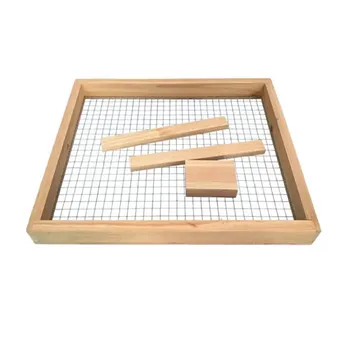
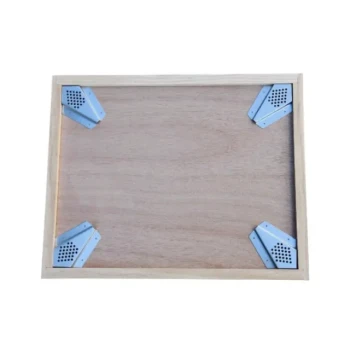
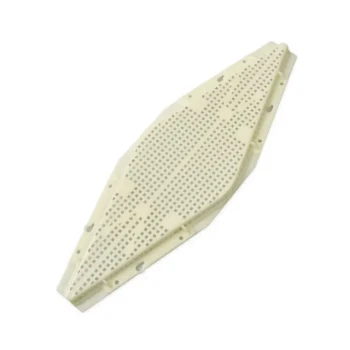
The crown board must be installed with its framed tray side facing downward on a bottom bee-space beehive. This orientation creates the designed clearance between the crown board and the top bars of the frames, allowing bees to move through the space without sealing the components together.
In a bottom bee-space hive, orientation is part of the hive’s functional design. Fit the framed side of the crown board downward to preserve the correct bee space and prevent propolis bonding or unwanted comb construction.
Why Crown Board Orientation Matters
It creates the required bee space
In a bottom bee-space hive, the tops of the frames sit flush with the rim of the hive box. The crown board’s downward-facing frame or tray provides the necessary clearance above those frame tops.
This clearance is typically within the bee-space range of approximately 6–9 mm, depending on the hive design and manufacturing standard.
It prevents the board from being glued to the frames
If the crown board is installed upside down, the required space may be lost. Bees can then fill the narrow contact area with propolis, their natural resin-like adhesive.
During inspections, the beekeeper may struggle to separate the crown board from the frames. Excessive force can damage the board, break frame components, or disturb the colony.
It helps avoid burr and bridge comb
Bee space is not simply a minimum gap. If the gap becomes too large, bees may construct burr comb or bridge comb between the frame tops and the crown board.
That comb can physically connect multiple components, making the hive difficult to open and increasing the time required for inspection and maintenance.
How Bottom Bee Space Works
The clearance is built into the hive system
A bottom bee-space hive is designed so that the correct bee passage is maintained below the frame tops, while the crown board must supply the appropriate clearance above them.
The crown board therefore cannot be treated as a reversible, neutral panel. Its profile and orientation determine whether the internal dimensions remain correct.
The design supports easier hive management
When the bee space is maintained, the crown board can be lifted with a hive tool and the frames can be removed individually. This reduces comb damage, bee crushing, and disruption during routine inspections.
For commercial apiaries and distributors, consistent dimensional performance is especially important because interchangeable boxes, frames, and covers must work together reliably.
Precision manufacturing supports correct assembly
The crown board, hive box, and frames must be manufactured to compatible tolerances. Even a well-made component can perform poorly if it is paired with parts designed for a different bee-space configuration.
Clear product specifications, consistent component sizing, and accurate assembly instructions help prevent avoidable field failures.
What Happens When It Is Installed Incorrectly
Propolis makes removal difficult
A crown board placed upside down may sit too close to the frame tops. Bees commonly seal undersized spaces with propolis, effectively bonding the cover to the frames.
The result is slower inspections and a greater risk of damaging equipment when the beekeeper attempts to break the seal.
Burr comb creates a structural connection
If the incorrect orientation creates an oversized gap, bees may fill it with irregular comb. This can connect the crown board to the frames or join adjacent hive components.
Such comb must be cut away, creating mess, wasted time, and potential damage to stored honey or brood.
Incorrect orientation undermines product performance
A crown board may be made from durable plywood, framed timber, or another suitable material, but material quality cannot compensate for incorrect installation.
For wholesalers and resellers, orientation instructions are therefore part of the product’s practical value—not merely an assembly detail.
Understanding the Trade-offs
Bee space must be precise
A gap that is too narrow encourages propolis buildup, while a gap that is too wide encourages burr comb. Both conditions interfere with independent component movement.
The exact target should follow the hive manufacturer’s specification, since frame dimensions and crown-board profiles vary between hive systems.
“Flush” does not mean “direct contact”
Because the frame tops are flush with the hive-box rim, it can appear that the crown board should sit directly on them. That interpretation is incorrect for a bottom bee-space design.
The framed underside of the crown board is what preserves the operating clearance above the frames.
Components are not always interchangeable
A crown board intended for a top bee-space hive may not function correctly on a bottom bee-space hive, even if the overall dimensions appear similar.
Mixing components from different standards can create the same propolis and burr-comb problems as installing the correct board upside down.
How to Apply This to Your Project
Use the hive manufacturer’s specified orientation and confirm that all supplied components follow the same bee-space standard.
- If your primary focus is correct assembly: Install the crown board with its framed tray side facing downward so the required clearance remains above the top bars.
- If your primary focus is commercial hive supply: Source crown boards, boxes, and frames as a compatible system with clearly documented dimensions and orientation instructions.
- If your primary focus is easier inspections: Maintain the specified bee space to minimize propolis bonding, burr comb, and damage during component removal.
- If your primary focus is product quality: Verify manufacturing tolerances and component compatibility before ordering large quantities for apiary or resale use.
Correct crown-board orientation preserves bee space, protects the equipment, and keeps hive management efficient.
Summary Table:
| Factor | Correct Orientation (Framed Side Down) | Incorrect Orientation (Framed Side Up) |
|---|---|---|
| Bee Space | Maintains 6–9 mm clearance above frames | Loses clearance; bees may fill gaps with propolis |
| Propolis Buildup | Minimal; easy to separate components | Excessive; bonds crown board to frames |
| Burr Comb | Avoided; proper gap discourages comb building | May occur; oversized gaps invite bridge comb |
| Inspection Efficiency | Quick and damage-free opening | Slow and risky; may damage equipment |
Ensure your hives are assembled correctly with HONESTBEE's precision-manufactured beekeeping equipment. Our full-spectrum product line includes crown boards, hive boxes, and frames designed to meet exact bee-space standards for seamless integration. As a leading wholesale supplier to commercial apiaries and distributors, we offer reliable supply, fast delivery, and expert support to keep your operations running smoothly. Need assistance with hive assembly or sourcing? Contact us today and discover why HONESTBEE is your trusted partner for quality beekeeping tools and equipment.
Related Products
- Heavy-Duty Candy Board with Galvanized Mesh for Beekeeping
- Solid Bottom Board Australian Pine Wood Langstroth Bottom Board for Wholesale
- HONESTBEE Durable Frame Wiring Board with Integrated Tensioner
- Langstroth Solid Bottom Board for Beekeeping
- Langstroth Screen Bottom Board for Beekeeping Wholesale
People Also Ask
- Why is feeding bees considered a last resort by beekeepers? To Protect Honey Purity and Colony Health
- How much sugar does a bee consume daily? Fueling the Hive's Incredible Energy Needs
- Which physical properties of powdered sugar are used in the sugar shake method? Master Varroa Mite Assessment
- What is the mechanism by which Powdered Sugar assists in removing varroa mites? Natural Varroa Control Explained
- What is the recommended sugar-to-water ratio for spring feeding? Use a 1:1 Ratio to Stimulate Hive Growth