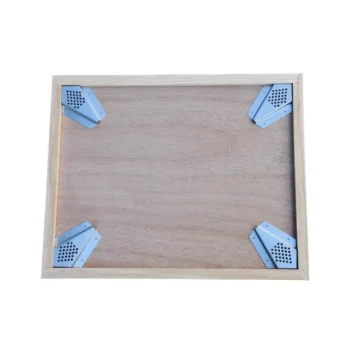
Movable division boards serve as a dynamic volume control mechanism within the hive. By sliding these boards to expand or contract the available living space, beekeepers can precisely match the hive's interior volume to the current colony size. This physical partitioning is essential for managing density, specifically to separate passive bees from active workers during artificial swarming procedures, thereby reducing the overcrowding stress that triggers natural swarming.
The primary function of a division board is density management. By mechanically adjusting the hive's internal volume, it mitigates the root cause of swarming—overcrowding—allowing for controlled artificial separation rather than uncontrolled natural swarming.
The Mechanics of Space Management
Adjusting Hive Capacity
The division board functions as a movable wall, allowing you to flexibly adjust the hive's spatial capacity.
Rather than forcing a colony to adapt to a fixed box size, you adapt the box to the colony. You can contract the living area for smaller populations or expand it as the colony grows.
Regulating Colony Density
Swarming is often a reaction to perceived overcrowding.
By properly positioning the division board, you ensure the bees have enough room to work without excessive empty space. This balance prevents the stress accumulation that signals the colony to split.
Utilization During Artificial Swarming
Physical Partitioning
During an artificial swarm procedure, the division board provides a necessary physical barrier.
It allows you to divide the hive into distinct sections. This facilitates the physical separation of different segments of the bee population within the same structure.
Separating Passive and Active Bees
A critical aspect of swarm management is controlling the distribution of the workforce.
The division board is used to separate passive bees (nurse bees or those inside the hive) from active workers (foragers). This separation disrupts the congestion feedback loop that typically leads to swarming behavior.
Eliminating Overcrowding Stress
The ultimate goal of using the board is stress reduction.
By manipulating the density and distribution of the bees, you artificially replicate the conditions of a swarm event without losing the bees. This precise control eliminates the biological pressure caused by overcrowding.
Understanding the Trade-offs
The Risk of Miscalculation
While movable boards offer control, they require precise judgment.
If the board is not moved frequently enough to match the colony's rapid growth, the board itself becomes the cause of the overcrowding it is meant to prevent.
Complexity of Management
Using division boards converts a static hive into a dynamic one.
This increases the management burden on the beekeeper. You must actively monitor colony size and adjust the partition manually; it is not a "set and forget" solution.
Making the Right Choice for Your Goal
To effectively utilize movable division boards, you must align your actions with the specific state of the colony.
- If your primary focus is General Colony Growth: Expand the division board incrementally to match population increases, ensuring density remains optimized to prevent early swarming triggers.
- If your primary focus is Active Swarm Prevention: Use the board to physically segregate active workers from passive bees, immediately reducing the density pressure in the brood nest.
Success relies on proactive adjustment; the board is a tool to dictate the hive's environment, not just a passive wall.
Summary Table:
| Feature | Function in Swarm Management | Impact on Colony |
|---|---|---|
| Volume Control | Adjusts hive capacity to match population | Reduces overcrowding stress triggers |
| Physical Partitioning | Creates distinct sections within one hive | Facilitates controlled artificial swarming |
| Density Regulation | Separates passive bees from active foragers | Disrupts the congestion feedback loop |
| Growth Matching | Incremental expansion as colony grows | Maintains optimal working environment |
Maximize Your Apiary Productivity with HONESTBEE
Managing colony density is the key to preventing swarm loss and ensuring a high-yield season. At HONESTBEE, we understand the complex needs of commercial apiaries and distributors. We provide a comprehensive range of professional-grade beekeeping tools, from precision-engineered movable division boards and hive-making machinery to advanced honey-filling equipment.
Whether you are looking to optimize your hive management with durable hardware or seeking essential industry consumables, our wholesale solutions are designed to scale your operations. Contact us today to discuss how our full-spectrum beekeeping equipment can add value to your business and help you maintain stronger, more manageable colonies.
References
- Г. М. Гречка. НАПРАВЛЕНЕ ВИКОРИСТАННЯ БДЖОЛИНИХ СІМЕЙ ЗІ ЗМІНЕНИМ ФІЗІОЛОГІЧНИМ СТАНОМ. DOI: 10.31210/visnyk2014.02.14
This article is also based on technical information from HonestBee Knowledge Base .
Related Products
People Also Ask
- How do bee escape boards compare with solar fume boards when clearing bees from honey supers? Speed vs. Simplicity for Commercial Apiaries
- How do bee escape boards and fume boards assist in honey harvesting? Optimize Your Harvest with Low-Stress Tools
- What types of bee escape boards are available? Clear Your Supers Fast and Stress-Free
- How is a bee escape board used to clear a hive body for honey harvesting? Optimize Your Chemical-Free Harvest
- What are the advantages of using a bee escape board? Ensure a Chemical-Free and Sting-Free Honey Harvest