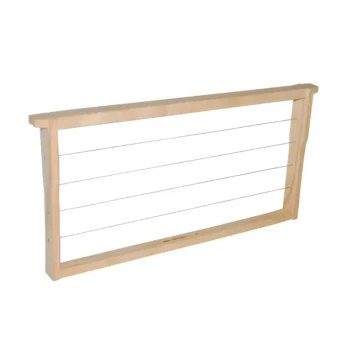
Morphology determines compatibility: Differences in body size, natural cell dimensions, and caste anatomy directly affect the correct wax foundation, frame dimensions, hive-body proportions, and queen-excluder spacing. Equipment designed for Apis mellifera should not automatically be used for smaller species such as Apis cerana, because oversized components can produce poor comb construction, inefficient brood rearing, and increased colony stress.
The correct principle is to match every comb-contacting and passage-limiting component to the managed species or subspecies. Foundation cell size, frame geometry, hive-body dimensions, and queen-excluder spacing should be selected as one compatible system—not as interchangeable products.
Why Bee Morphology Matters to Equipment Selection
Body size affects the entire hive interface
Honeybee species and subspecies differ in worker body size, thorax width, wing length, and overall proportions. Those differences influence the size of the cavities bees occupy, the spacing they maintain between combs, and the dimensions of cells they naturally construct.
For distributors and commercial apiaries, this means that “standard” equipment is only standard within a particular beekeeping system. A component optimized for European Apis mellifera may be unsuitable for Apis cerana or other smaller-bodied bees.
Natural comb dimensions are the key reference
Worker-cell widths vary among honeybee species and populations. The reference material identifies values as small as approximately 2.91 mm in black dwarf bees, while Apis cerana and Apis mellifera generally use larger cell dimensions, with variation between populations and subspecies.
These differences affect the embossed pattern on wax foundation. If the cell imprint is too large, bees may modify the sheet extensively, produce irregular comb, or reject the intended construction pattern.
Subspecies variation also matters
Even within one species, body dimensions and comb characteristics can differ. For example, Apis cerana cerana is described as larger than Apis cerana indica, so a single “Apis cerana” specification may not be sufficiently precise for every operation.
The practical requirement is to identify the species, subspecies, local ecotype, and existing comb standard before selecting foundation and frames.
Selecting the Correct Wax Foundation
Match foundation cell size to natural worker comb
Wax foundation primarily guides worker bees in constructing straight, uniform comb. Its embossed cell dimensions should be close to the natural worker-cell dimensions of the managed colony.
For smaller bees such as Apis cerana, foundation intended for Apis mellifera can be oversized. The consequences may include:
- Irregular or incomplete comb buildout
- Excessive bee modification of the embossed cells
- Poor brood-nest organization
- Reduced usable comb area
- Greater stress during hive establishment
Correctly scaled foundation gives bees a more compatible starting point and improves the probability of rapid, uniform acceptance.
Do not treat worker foundation as a universal caste solution
Worker foundation is not a substitute for all brood-cell types. Drones require larger cells, while queen cells are larger, vertically oriented structures that are not normally produced as ordinary embossed worker cells.
Commercial operations requiring drone production or queen rearing should therefore use dedicated drone foundation, queen-cell cups, or queen-rearing systems rather than attempting to achieve every caste through one worker-cell sheet.
Foundation thickness and rigidity still require system compatibility
Cell dimensions are the primary morphological consideration, but the sheet must also fit the selected frame and withstand handling, transport, and extraction.
A suitable product specification should therefore confirm:
- Embossed cell dimension
- Sheet length, width, and thickness
- Wax purity and flexibility
- Compatibility with frame grooves or channels
- Suitability for wiring, embedding, or foundationless use
- Resistance to deformation during hive operation
The correct cell size cannot compensate for a sheet that does not physically fit the frame.
Choosing Frames and Hive Hardware
Frame dimensions must match the hive body
Frame hardware is governed by more than bee body size. The frame must fit the hive body, maintain the intended bee-space, support the selected foundation, and permit inspection or extraction without damaging comb.
When adapting equipment for Apis cerana, smaller frames or specially proportioned hive components may be necessary because standard Apis mellifera frames and hive bodies can be too large for the colony’s natural nesting pattern.
A complete specification should define the inside frame dimensions, outside frame dimensions, top-bar and bottom-bar geometry, side-bar spacing, and hive-body compatibility.
Frame spacing affects comb quality
The distance between frames determines whether bees build a single straight comb, attach comb to neighboring components, or leave excessive gaps. Morphological differences in bee size and natural comb construction make frame spacing especially important when moving between species.
Frame spacers, castellated separators, or manually established spacing should be selected for the intended bee and hive format. A spacing system designed around larger Apis mellifera colonies should be validated before being used with smaller Apis cerana colonies.
Hive-body dimensions influence colony retention
Cavity-nesting species such as Apis cerana may respond poorly to hive cavities that are excessively large, poorly proportioned, or difficult to defend. Oversized hive bodies can create a management environment that does not resemble the colony’s preferred nesting conditions.
For equipment manufacturers and resellers, this creates demand for species-specific hive bodies, frames, covers, entrances, and internal partitions, rather than a single universal woodenware range.
Hardware must support the operating method
High-volume Apis mellifera operations commonly depend on standardized frames and mechanical extraction. Their frames must withstand repeated lifting, transport, uncapping, and centrifugal extraction.
Smaller or differently structured comb systems may require gentler handling, alternative frame formats, or extraction equipment designed around different dimensions. Hardware selection should therefore consider both bee morphology and the customer’s harvesting process.
Queen Excluders Require Careful Calibration
Thorax size determines passage control
Worker bees, drones, and queens differ substantially in body size and thorax width. Queen excluders use openings that allow workers to pass while restricting the larger queen from entering honey supers.
However, the appropriate opening dimension depends on the managed bee population. An excluder designed for one species or strain should not be assumed to provide the same selectivity for another.
Avoid a universal-spacing assumption
A gap that is too narrow may obstruct workers, reduce traffic, and discourage use of the honey super. A gap that is too wide may allow the queen to pass through, defeating the purpose of the excluder.
Suppliers should specify the intended species or hive standard and encourage field validation with the customer’s actual colonies. Measured compatibility is more reliable than a generic “universal” label.
Excluder material and construction also matter
The grid should be dimensionally stable, smooth, and accurately manufactured. Rough edges, warped bars, or inconsistent openings can injure bees or create uneven movement through the excluder.
For B2B buyers, quality control should include opening consistency, flatness, corrosion resistance where applicable, and compatibility with the hive-body dimensions.
Distinguishing Morphology From Behavior
Behavioral traits influence equipment demand differently
Italian, Carniolan, Russian, German, and other honeybee populations differ in swarming tendency, brood production, overwintering ability, defensiveness, and productivity. These traits affect the quantity, durability, and management style of equipment required.
They do not necessarily justify a different foundation cell size unless the colony’s physical dimensions or natural comb dimensions also differ. A highly productive strain may require more supers and stronger frames, but productivity alone does not establish a new cell specification.
Colony pressure can expose equipment mismatches
Active colonies that build rapidly may reveal weaknesses in frame spacing, foundation rigidity, hive-body capacity, or excluder throughput. Defensive or absconding-prone colonies may also react poorly to excessive disturbance or unsuitable cavity proportions.
This is why equipment recommendations should combine:
- Species and subspecies identity
- Colony size and productivity
- Local climate
- Hive format
- Comb-management practices
- Harvesting method
- Replacement and maintenance requirements
Understanding the Trade-offs
Standardization versus biological fit
Standardized Apis mellifera equipment offers major commercial advantages. It supports automated extraction, simpler inventory control, easier frame interchangeability, and broad availability.
Species-specific equipment provides better biological compatibility but increases the number of product variants that distributors must stock and customers must manage.
Smaller equipment is not automatically better
Scaling a frame or hive body down proportionally is a useful starting principle, but it does not guarantee success. Bee space, comb attachment, entrance design, ventilation, inspection access, and local nesting behavior must also be considered.
The final specification should be based on validated comb measurements and field performance, not body size alone.
Mixing standards creates operational risk
Combining a small-cell foundation with oversized frames, or a species-specific frame with an incompatible hive body, can create cascading problems. These may include poor alignment, excessive burr comb, damaged comb during inspection, and incompatibility with extraction equipment.
Distributors should sell compatible packages rather than isolated components wherever possible.
Overprecision can be misleading
Cell dimensions naturally vary among colonies and populations. A catalog should provide a clear nominal specification while acknowledging the relevant species or subspecies range and recommending confirmation for unusual ecotypes.
The objective is not to force every colony into one exact measurement. It is to avoid a major mismatch between the bees’ natural construction pattern and the equipment supplied.
Building a Reliable B2B Product Specification
Create species-specific product categories
A practical product portfolio can distinguish between:
- Apis mellifera foundation and frames
- Apis cerana foundation and frames
- Smaller-bodied or specialized regional bee systems
- Worker-cell and drone-cell foundation
- Queen-rearing components
- Species-compatible queen excluders
- Matching hive bodies and woodenware
This structure helps wholesalers and resellers reduce ordering errors and communicate compatibility clearly.
Confirm the full equipment interface
Before quoting or manufacturing, verify:
- Managed species and subspecies
- Natural or preferred worker-cell dimensions
- Hive-body and frame standard
- Foundation sheet dimensions and thickness
- Frame spacing and bee-space requirements
- Queen-excluder opening specification
- Inspection and extraction method
- Climate, transport, and storage conditions
This checklist is more dependable than relying on common product names such as “standard frame” or “universal foundation.”
Prioritize manufacturing precision
Species-specific equipment only delivers value when it is manufactured consistently. Suppliers should control wax embossing, frame dimensions, bar alignment, grid spacing, wood moisture, and surface finish.
For commercial buyers, responsive technical support, rapid sample confirmation, dependable inventory, and fast fulfillment are as important as the nominal product specification.
How to Apply This to Your Project
Select the equipment system first, then purchase foundation and hardware that are dimensionally compatible with it.
- If your primary focus is Apis mellifera commercial production: Use the established Apis mellifera frame, foundation, queen-excluder, and extraction standards, while confirming that all components support high-volume handling.
- If your primary focus is Apis cerana or another smaller-bodied species: Avoid assuming that standard Apis mellifera equipment will work; source reduced or species-specific foundation, frames, hive bodies, and excluders.
- If your primary focus is queen or drone production: Use dedicated queen-rearing components or larger drone-cell foundation rather than relying solely on worker-cell sheets.
- If your primary focus is distribution and wholesale supply: Build a clearly labeled, full-spectrum portfolio organized by species, hive standard, cell dimension, and hardware compatibility.
- If your primary focus is custom manufacturing: Confirm colony measurements and field requirements before finalizing tooling, because subspecies and local ecotype differences can make a nominal standard unsuitable.
The most reliable sourcing strategy is to match bee morphology, comb dimensions, hive hardware, and operating workflow as one integrated specification.
Summary Table:
| Factor | Impact on Equipment Selection |
|---|---|
| Body size | Determines frame spacing, hive cavity size, and excluder gap |
| Natural cell dimensions | Must match foundation cell size for proper comb construction |
| Subspecies variation | Requires precise identification for correct product specification |
| Caste differences | Worker vs. drone foundation distinct; queen-rearing needs specialized systems |
| Hive body proportions | Must suit species' nesting preference to ensure colony acceptance |
| Frame spacing | Affects comb quality and ease of inspection |
| Queen excluder openings | Must allow worker passage while restricting the queen; specificity needed |
| Behavioral traits | Influence equipment quantity and durability, not necessarily cell size |
| Operating method | Hardware must support extraction or gentle handling based on comb structure |
| Standardization vs. fit | Trade-off between commercial efficiency and biological compatibility |
At HONESTBEE, we supply the full spectrum of beekeeping tools, machinery, and equipment, including species-specific wax foundation, frames, hive bodies, and queen excluders. Our expertise ensures you get the right system for your bees—improving colony health and operational efficiency. Connect with us today for tailored solutions and rapid delivery. Contact us to discuss your requirements!
Related Products
- Beeswax Foundation Sheets Beehive Foundation for Wholesale
- Beeswax Machine Press Embosser Wax Foundation Mold Printer Bee Hive Equipment Making Sheet
- Notebook Style Beeswax Foundation Mould Wax Foundation Mold
- Colorful Silicone Beeswax Foundation Mold Mould for Beekeeping
- Manual Beeswax Comb Foundation Machine Wax Foundation Mill Embossing Machine
People Also Ask
- What are the technical advantages of beeswax foundations and feeding tools? Optimize Your Bee Breeding Phase
- Why is the regular exchange and replacement of beeswax foundations encouraged? Boost Honey Yield & Hive Biosafety
- What are the negative consequences of using old or contaminated beeswax in foundations? Protect Your Hive Today
- Why is high-purity natural beeswax essential for foundations? Prevent Larval Mortality & Boost Colony Health
- What are the specific advantages of regular comb replacement? Boost Hive Health with New Beeswax Foundations