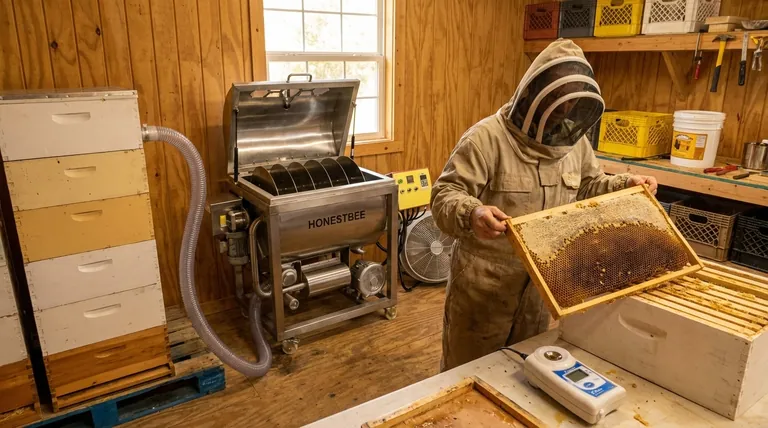
Yes, you can extract uncapped honey, but it requires a critical preliminary step to prevent it from fermenting. The core issue is high water content, which must be reduced before extraction. This is typically done by placing the frames in a small, warm, and dry room with a dehumidifier and a fan to circulate the air, effectively mimicking the final curing process that bees do inside the hive.
The challenge with uncapped honey isn't the physical act of extraction, but its chemical instability. Uncapped honey has excess moisture that will lead to fermentation, so you must first cure the honey by reducing its water content to below 18.6% before you spin it out.
Why Uncapped Honey Poses a Risk
Honey bees are meticulous. They only seal a cell with a wax capping when the nectar has been processed and dehydrated to the ideal moisture content, typically between 17-18%. This low water level makes honey shelf-stable indefinitely.
The Problem: High Moisture Content
Uncapped honey is often called "nectar" or "unripe honey" because the bees haven't finished this dehydration process. Its moisture content can be well over 20%.
The Consequence: Fermentation
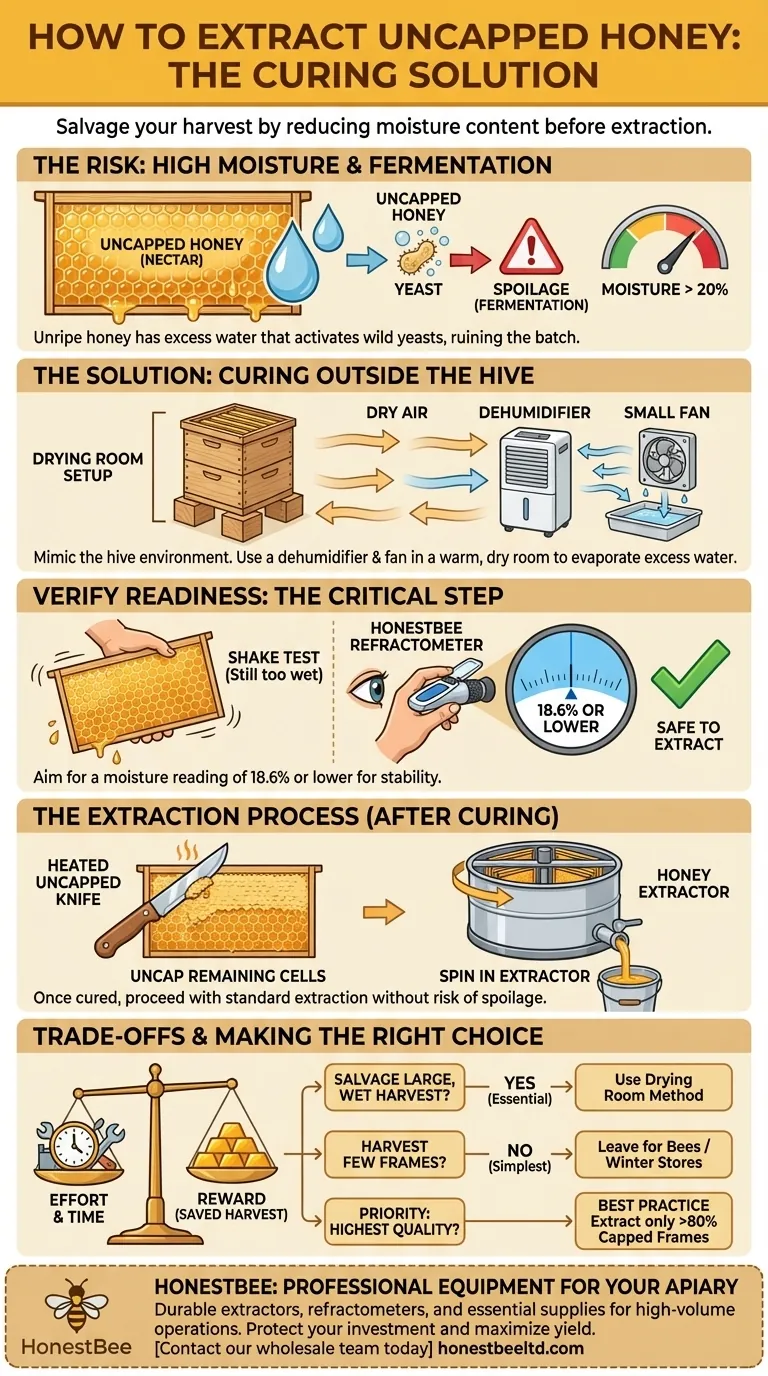
Wild yeasts are naturally present in honey. In low-moisture (capped) honey, these yeasts are dormant. However, in high-moisture (uncapped) honey, they become active and begin to ferment the sugars, spoiling the entire batch.
The Solution: Curing Your Honey Outside the Hive
To safely extract uncapped honey, you must finish the bees' job for them. The goal is to create an environment that evaporates the excess water from the frames before you extract.
Setting Up a Drying Room
You can create a small, airtight "drying room." This could be a closet, a small bathroom, or any sealable space.
Stack your honey supers with the uncapped frames inside. Place the stacks on blocks of wood (like two-by-fours) to allow for crucial airflow underneath the bottom box.
The Key Tools for Curing
The most effective method is to place a dehumidifier and a small fan in the room. The fan circulates the air across the frames, and the dehumidifier pulls the moisture out of that air.
Knowing When It's Ready
The traditional "shake test" is a good indicator: hold a frame horizontally over a clean surface and give it a sharp shake. If honey flies out, it is still too wet.
For a precise measurement, use a honey refractometer. This tool measures the moisture content instantly. You are aiming for a reading of 18.6% or lower before you can consider the honey safe to extract.
The Extraction Process (After Curing)
Once your honey is properly cured to a safe moisture level, the rest of the extraction process is standard.
Uncapping the Remaining Cells
Your frames will likely have a mix of capped and now-cured uncapped cells. You must still remove the wax cappings from the sealed cells.
Common tools for this include a heated uncapping knife, which melts through the wax, or a serrated cold knife, which cuts through it.
Spinning in an Extractor
Place the uncapped frames into a honey extractor. This device uses centrifugal force to spin the honey out of the comb without destroying it.
The Pressing Method Alternative
Another, less common method is using a honey press. This tool crushes the comb to force the honey out. This method is destructive to the comb but does not require an extractor.
Understanding the Trade-offs
Extracting uncapped honey is a salvage operation, not a standard practice, and it comes with important considerations.
The Primary Risk is Spoilage
If you misjudge the moisture content and extract the honey while it is still too wet, it will ferment. There is very little margin for error here.
Effort vs. Reward
Setting up a drying room and monitoring the frames takes time and effort. For a few frames, it may not be worth it. For saving a large harvest that couldn't be completed by the bees (e.g., due to a sudden end to the nectar flow), it is absolutely essential.
Quality Considerations
Honey that is fully cured by bees in the hive is generally considered the highest quality. While you can achieve the correct moisture content manually, the flavor profile may differ slightly.
Making the Right Choice for Your Goal
Ultimately, the decision to extract uncapped honey depends on your objective and willingness to manage the risks.
- If your primary focus is salvaging a large, wet harvest: Implementing the drying room method with a dehumidifier and fan is your best course of action to prevent a total loss.
- If your primary focus is harvesting just a few partially uncapped frames: The simplest and safest choice is often to leave those frames in the hive for the bees to finish or use as winter stores.
- If your primary focus is ensuring the highest possible quality and shelf life: Adhere to the best practice of only extracting honey from frames that are at least 80% capped by the bees.
Your success hinges on one critical factor: ensuring the final moisture content is low enough to guarantee stability.
Summary Table:
| Step | Key Action | Goal/Tool |
|---|---|---|
| 1. Assess Risk | Identify uncapped frames with high moisture content (>18.6%). | Understand the risk of fermentation. |
| 2. Cure Honey | Place frames in a warm, dry room with a dehumidifier and fan. | Reduce moisture content to below 18.6%. |
| 3. Verify Readiness | Use a honey refractometer for an accurate moisture reading. | Ensure honey is stable (≤18.6% moisture). |
| 4. Extract | Uncap remaining cells and spin frames in an extractor. | Harvest honey without spoilage. |
Salvage Your Harvest with the Right Equipment
Successfully curing and extracting uncapped honey requires reliable, professional-grade tools. HONESTBEE supplies durable honey extractors, refractometers, and other essential beekeeping supplies to commercial apiaries and distributors. We help you protect your investment and maximize your yield with equipment built for high-volume, efficient operations.
Contact our wholesale team today to discuss your apiary's needs and ensure your harvest is a success.
Visual Guide
Related Products
- 0.5T Capacity Honey Dehumidifier Dryer with Vacuum Heating and Thickening Filtering Machine
- High Quality Honey Dehumidifier Dryer Thickening Machine for Beekeeping
- Honey Concentrating and Filtering Dehumidifier Machine 2T Capacity for Honey
- Precision Honey Refractometer Instrument for Quality Assessment
- Honey Concentrating Vacuum Heating Thickening Machine Dehumidifier for Honey
People Also Ask
- What is the primary function of professional dehumidification equipment in honey processing? Stability & Quality
- How to dry up honey? The Safe Guide to Stabilizing Honey and Preventing Fermentation
- What is the process for using a dehumidifier to lower honey's moisture content? Expert Drying Techniques
- How to decrease moisture in honey? Prevent Fermentation and Ensure Long-Term Quality
- How to remove humidity from honey? Protect Your Harvest from Fermentation