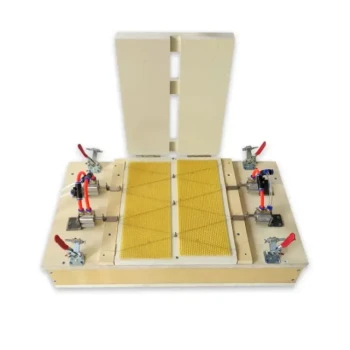
Foundation sheets with increased cell diameters serve as a high-precision template that fundamentally alters colony development. By forcing bees to construct combs with cells larger than their natural instinct dictates (e.g., 5.4mm), you induce the growth of physically larger and stronger worker bees. This physiological change translates directly into technical advantages: wider foraging radiuses and increased nectar-carrying capacity per bee, ultimately boosting colony productivity.
Core Insight: The use of larger cell foundation is not just about structure; it is a physiological optimization tool. It leverages the correlation between cell volume and bee body mass to maximize the biological "horsepower" of the colony for superior honey production.
Optimizing Colony Physiology
The Template Effect
Bees naturally construct cells measuring between 4.6 and 5.1 millimeters. High-precision foundation sheets act as a structural guide, overriding this instinct and ensuring the construction of uniform, larger cells (typically 5.4mm). This serves as a standardized substrate that dictates the architecture of the hive.
Enhanced Worker Development
The primary technical advantage is biological: a larger cell allows for a larger developing pupa. This optimization of the brood environment results in the emergence of physically stronger worker bees compared to those raised in natural-sized comb.
Improving Collection and Production
Expanded Foraging Range
Larger, stronger bees possess the physical capability to fly further distances. This widens the foraging footprint of the entire colony, allowing access to nectar sources that might otherwise be out of range for a naturally sized colony.
Higher Payload Capacity
Beyond distance, the physical size of the bee correlates with its carrying capacity. These enhanced workers can return to the hive with heavier nectar loads per trip, significantly improving the honey collection efficiency of the workforce.
Increased Storage Volume
The geometric advantage extends to storage as well. Larger cells naturally offer a greater volume for honey storage per square inch of comb, further supporting high-production goals.
Structural and Operational Benefits
Mechanical Stability
Foundation sheets, particularly those reinforced with wiring, provide essential structural integrity. This added strength prevents comb collapse and allows for high-speed centrifugal honey extraction without destroying the comb.
Inspection and Management
Foundation serves as a rigid guide for comb alignment, preventing bees from building "burr comb" or irregular structures outside the frame. This ensures frames remain movable and easy to inspect, which is critical for efficient hive management.
Understanding the Trade-offs
Natural vs. Artificial Dynamics
It is critical to recognize that implementing 5.4mm cells is a deviation from the natural 4.6mm–5.1mm range found in wild hives. You are prioritizing production efficiency over the colony's natural architectural instincts. While this boosts honey yield, it effectively creates an artificial environment designed for specific output metrics rather than natural emulation.
Making the Right Choice for Your Goal
To select the correct foundation strategy, align the technical properties with your operational objectives:
- If your primary focus is Maximum Honey Yield: Prioritize foundation with 5.4mm cell sizing to maximize worker bee size, foraging range, and per-cell storage volume.
- If your primary focus is Mechanical Extraction: Ensure your foundation sheets are wired or structurally reinforced to withstand the centrifugal forces of extraction equipment.
- If your primary focus is Inspection Efficiency: Use foundation sheets to enforce straight comb construction, minimizing cross-combing and simplifying frame manipulation.
By manipulating the fundamental geometry of the honeycomb, you effectively upgrade the physical capacity of your workforce to achieve higher operational efficiency.
Summary Table:
| Feature | Standard Cell (4.6-5.1mm) | Increased Cell (5.4mm) | Technical Benefit |
|---|---|---|---|
| Bee Physiology | Natural-sized workers | Larger, stronger workers | Increased physical horsepower per bee |
| Foraging Range | Standard radius | Expanded radius | Access to distant nectar sources |
| Payload Capacity | Standard nectar load | Higher nectar load | Improved collection efficiency per trip |
| Storage Volume | Standard volume | Greater volume/sq inch | Maximized honey storage capacity |
| Comb Structure | Natural/Irregular | Uniform/Standardized | Easier inspections and faster extraction |
Scale Your Honey Production with HONESTBEE Precision Equipment
At HONESTBEE, we specialize in empowering commercial apiaries and distributors with the high-precision tools needed to optimize colony output. From high-precision foundation sheet machines that ensure perfect 5.4mm cell geometry to robust honey-filling and extraction machinery, we provide the full spectrum of beekeeping hardware and consumables.
Whether you are looking to upgrade your hive-making capabilities or source durable wholesale supplies, our experts are ready to assist you in maximizing your operational efficiency.
Partner with HONESTBEE today – Contact us to discuss your wholesale needs
References
- Volodymyr Pоstоienkо, Ihor Peliukhnia. ONE HUNDRED YEARS OF SCIENTIFIC RESEARCH IN THE FIELD OF BEEKEEPING. DOI: 10.46913/beekeepingjournal.2022.8.08
This article is also based on technical information from HonestBee Knowledge Base .
Related Products
- Beeswax Foundation Sheets Beehive Foundation for Wholesale
- Food Grade Plastic bee Foundation for Bee Frames
- Beeswax Machine Press Embosser Wax Foundation Mold Printer Bee Hive Equipment Making Sheet
- Colorful Silicone Beeswax Foundation Mold Mould for Beekeeping
- Notebook Style Beeswax Foundation Mould Wax Foundation Mold
People Also Ask
- What are the technical advantages of beeswax foundations and feeding tools? Optimize Your Bee Breeding Phase
- Why is the regular exchange and replacement of beeswax foundations encouraged? Boost Honey Yield & Hive Biosafety
- What are the negative consequences of using old or contaminated beeswax in foundations? Protect Your Hive Today
- Why is high-purity natural beeswax essential for foundations? Prevent Larval Mortality & Boost Colony Health
- What are the specific advantages of regular comb replacement? Boost Hive Health with New Beeswax Foundations