
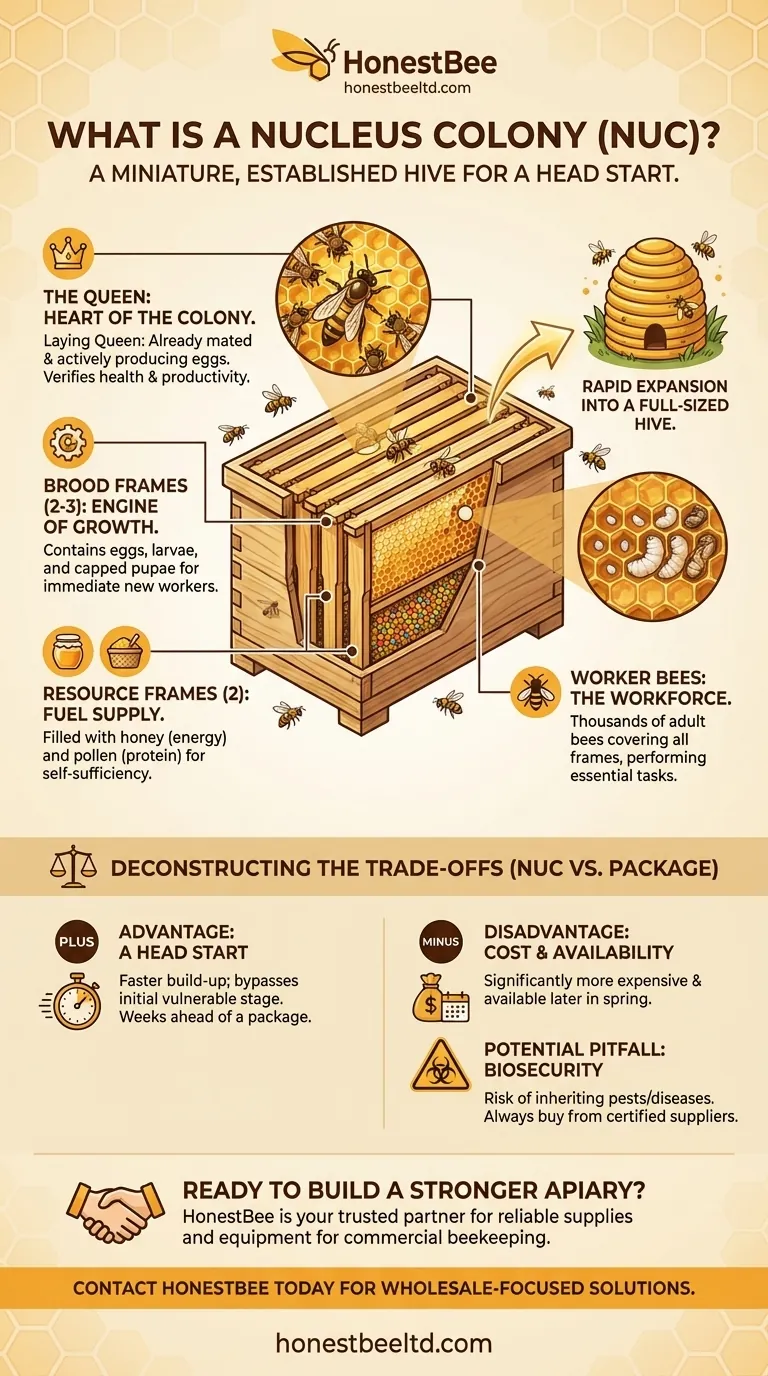
At its core, a nucleus colony, or "nuc," is a small, fully-functioning bee colony. It typically contains five frames of bees, which include a laying queen, two to three frames of developing bees (brood), and the remaining frames filled with food resources like honey and pollen.
A nucleus colony is not just a collection of bees; it is a miniature, established hive. Its specific composition is designed to give a new beekeeper a significant head start by providing a proven queen, an active workforce, and the next generation of bees already in development.
Deconstructing the Nucleus Colony
To understand the value of a nuc, you must understand the function of each component. It is a balanced, self-contained ecosystem designed for rapid expansion once moved into a full-sized hive.
The Queen: The Heart of the Colony
Every viable nuc is built around a single queen. Her presence and performance are paramount. In most purchased nucs, she is a laying queen, meaning she is already mated and actively producing eggs.
This is a critical advantage. Seeing her brood pattern allows you to verify her health and productivity from day one. Some nucs may be started with a queen cell (an unhatched queen), but these are less common for commercial sale as they carry more risk.
The Brood Frames: The Engine of Growth
The two or three frames of brood are the clearest indicator of a colony's health and momentum. These frames contain bees in every stage of development: eggs, larvae, and capped pupae.
This pre-existing brood means thousands of new worker bees are scheduled to emerge within days or weeks of installation. This creates an immediate and continuous supply of new workers to build out the colony, whereas other methods require waiting weeks for the first generation to develop.
The Resource Frames: The Fuel Supply
The remaining two frames are dedicated to food stores. One frame is typically filled with honey (carbohydrates for energy), and the other contains pollen (protein for feeding larvae).
These resources ensure the colony is self-sufficient during the transition into its new hive and can continue feeding its developing brood without interruption, even if outside foraging conditions are poor.
The Worker Bees: The Workforce
Finally, all frames are covered with thousands of adult worker bees. These bees perform all the essential tasks: caring for the queen and brood, managing food stores, defending the hive, and foraging for new resources. They are the engine that keeps the entire operation running.
Understanding the Trade-offs
While a nuc offers a powerful start, it's essential to understand its trade-offs compared to other methods of starting a hive, such as buying a bee "package."
The Advantage: A Head Start
The primary advantage is speed. A nuc can build up to a full-sized, productive colony weeks faster than a package of bees. This is because a package is just loose bees and a queen; they must build all the comb, and the queen must start laying from scratch. A nuc bypasses this initial, vulnerable stage.
The Disadvantage: Cost and Availability
Because you are buying established comb, brood, and resources, nucs are significantly more expensive than packages. They are also typically available later in the spring, as the provider needs time for the colonies to build up enough to be split.
Potential Pitfall: Biosecurity
This is the most critical consideration. You are inheriting used equipment (the frames and comb) from another beekeeper's operation. This carries a small but real risk of transferring pests and diseases, such as Varroa mites or American Foulbrood. Always purchase nucs from a reputable, certified local supplier to minimize this risk.
Making the Right Choice for Your Goal
Understanding the composition of a nucleus colony empowers you to decide if it aligns with your beekeeping objectives.
- If your primary focus is a reliable start with lower risk: A nucleus colony is the superior choice, as it provides a proven, functioning colony from day one.
- If your primary focus is minimizing initial cost: A package of bees is cheaper, but be prepared for a slower build-up and more intensive early management.
- If your primary focus is expanding your own apiary: Learning to create your own nucs by splitting strong, established hives is the most sustainable and cost-effective method.
By understanding these fundamental components, you are no longer just buying bees; you are investing in the foundation of a successful and productive hive.
Summary Table:
| Component | Role & Key Details |
|---|---|
| Laying Queen | Mated and actively laying eggs; the heart of the colony. |
| Brood Frames (2-3) | Contains eggs, larvae, and capped pupae for rapid colony growth. |
| Resource Frames (2) | Filled with honey and pollen for immediate self-sufficiency. |
| Worker Bees | Adult bees covering all frames; the active workforce. |
Ready to build a stronger, more productive apiary?
As a commercial beekeeper or equipment distributor, your success depends on reliable, high-quality supplies. A nucleus colony is a powerful start, and HONESTBEE is your trusted partner for everything that follows.
We supply the durable beekeeping equipment and wholesale supplies that commercial apiaries need to manage and expand their operations efficiently. From hive components to protective gear, our products are built to support your growth and profitability.
Contact HONESTBEE today to discuss your specific needs and discover how our wholesale-focused solutions can benefit your business.
Visual Guide
Related Products
- 5 Frame Wooden Nuc Box for Beekeeping
- 5 Frame Langstroth Poly Nuc Corrugated Plastic Nuc Boxes
- Automatic Heat Preservation 6 Frame Pro Nuc Box for Honey Bee Queen Mating
People Also Ask
- What are the options for adding frames to a nuc after taking two frames from the parent colony?
- What frames should be moved into the queenless hive when requeening with a nuc? Ensure a Successful Queen Introduction
- What roles do five-frame nucleus boxes and ten-frame Langstroth hive boxes play in colony standardization?
- What is the primary function of five-frame nuclei boxes? Master Early Colony Establishment for Stronger Hives
- What is the typical composition of frames in a nuc? A 5-Frame Blueprint for a Thriving Hive


