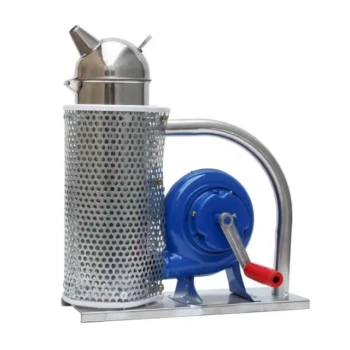
The primary function of a manual pressure sprayer is to generate and deliver a finely atomized mist of aqueous plant extracts, such as those derived from Artemisia or Yarrow, throughout the beehive. This mechanism ensures that the liquid is distributed evenly across the hive frames and the bee brood, maximizing the coverage of plant-based phytoncides to trigger the detachment of Varroa mites.
Effective Varroa control using plant extracts relies on the physics of atomization rather than sheer volume. The manual pressure sprayer transforms the liquid into a fine mist, allowing scent-based active ingredients to penetrate the colony and dislodge mites without saturating the bees.
The Mechanics of Effective Application
To understand why a manual pressure sprayer is the tool of choice for this method, we must look at how it interacts with both the solution and the hive environment.
Achieving Fine Atomization
The core advantage of a pressure sprayer is its ability to break the liquid extract into microscopic droplets.
This fine atomization is critical because it creates a fog-like consistency rather than a heavy rain.
Heavy droplets tend to roll off surfaces, whereas a fine mist adheres to the bees and the comb, ensuring the active ingredients stay where they are needed.
Ensuring Comprehensive Coverage
For the treatment to be effective, the extract must reach the areas where mites congregate.
The sprayer allows the beekeeper to direct the mist specifically onto the hive frames and the bee brood.
Uniform distribution ensures that there are no "safe zones" where mites can hide from the treatment.
Leveraging Scent Stimulation
The treatment mechanism relies on phytoncides, the volatile organic compounds found in the plant extracts.
These compounds utilize scent stimulation to irritate the Varroa mites.
By covering the colony thoroughly, the sprayer ensures the scent is pervasive enough to trigger the mites to detach from the bees' bodies.
Understanding the Trade-offs
While manual pressure sprayers are effective tools for this specific application, they introduce certain variables that must be managed.
Consistency Depends on the Operator
Unlike automated systems, a manual sprayer relies entirely on the user to maintain pressure and direction.
If the pressure drops, the mist may turn into a coarse spray, leading to uneven distribution.
Potential for Hive Disturbance
To coat the frames and brood thoroughly, the hive must be opened and manipulated.
This process is invasive and can temporarily stress the colony.
Furthermore, applying any liquid inside the hive increases humidity, which must be monitored to prevent chilling the brood.
Maximizing Treatment Efficacy
When using a manual pressure sprayer for Varroa control, your technique determines the outcome.
- If your primary focus is maximum mite detachment: Ensure the sprayer is fully pressurized to create the finest possible mist, targeting the brood area where mites are most prevalent.
- If your primary focus is colony health: Move quickly to coat the frames evenly without soaking them, ensuring the moisture can evaporate before it chills the bees.
Precision in application turns a simple plant extract into a potent tool for hive hygiene.
Summary Table:
| Feature | Function in Varroa Control | Benefit to Hive Health |
|---|---|---|
| Fine Atomization | Creates a microscopic mist of plant extracts | Ensures better adhesion to bees and comb without soaking |
| Targeted Delivery | Directs mist onto hive frames and bee brood | Reaches mite congregation areas for maximum exposure |
| Pressure Control | Regulates the flow and droplet size | Prevents heavy saturation and ensures uniform distribution |
| Scent Stimulation | Disperses volatile phytoncide compounds | Triggers mite detachment through scent-based irritation |
Elevate Your Beekeeping Operations with HONESTBEE
Are you looking to supply your clients with the highest quality tools for sustainable hive management? HONESTBEE specializes in serving commercial apiaries and distributors with a comprehensive range of professional beekeeping solutions.
From durable manual pressure sprayers designed for precise mite treatment to advanced honey-filling machines and specialized hive-making hardware, our wholesale portfolio is built to support your business growth. We provide everything from essential consumables to honey-themed cultural merchandise to help you stand out in the industry.
Partner with the industry experts today. Contact us at HONESTBEE to receive our latest product catalog and discover how our wholesale offerings can enhance your efficiency and profitability.
References
- Rukhkyan, Oganesyan. REPELLENT EFFECT OF PLANTS ON MITES VARROA JACOBSONI (OUD., 1904) IN ARMENIA. DOI: 10.31016/978-5-9902341-5-4.2020.21.341-345
This article is also based on technical information from HonestBee Knowledge Base .
Related Products
- Stainless Steel Manual Honey Press with Guard for Pressing Honey and Wax
- Easy Use Manual Stainless Steel Honey Press for Honey Comb
- Heavy Duty Manual Bee Smoker Blower for Beekeeping
- Manual Beeswax Flat Sheet Machine for Beeswax Processing
- Manual Honey Filling Machine Bottling Machine for Honey
People Also Ask
- What other functions can a honey press serve besides honey extraction? Discover Versatile Multi-Purpose Uses
- How does the honey press preserve the quality of honey during extraction? Maintain Pure Enzymes and Flavor
- What materials are used to construct the honey press? Choose Durable, Food-Grade Solutions for Your Apiary
- What are the fundamental differences between manual honey presses and centrifugal honey extractors? A Guide for Pros
- What are some general features of a honey press? Maximize Your Yield with Durable Extraction Tools