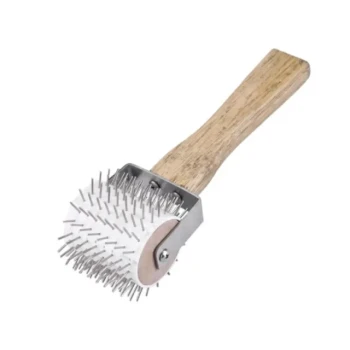
The honey press preserves quality through a specific low-pressure mechanism that drastically reduces mechanical stress. By employing a slow, gentle compression technique, the press extracts honey without the high-velocity friction or heat generation often associated with industrial processing. This ensures the honey retains its original chemical structure immediately upon leaving the comb.
Core Takeaway While faster methods exist, the honey press prioritizes the biological integrity of the product. By eliminating the need for high-speed rotation and heat, this method serves as a safeguard for heat-sensitive enzymes and volatile flavor compounds that define high-grade raw honey.
The Mechanics of Preservation
The value of a honey press lies in its ability to separate liquid honey from wax solids without altering the liquid's properties. This process relies on two fundamental principles: minimal agitation and temperature control.
Minimizing Thermal Damage
The primary enemy of raw honey is heat. The honey press utilizes a physical "squeezing" action rather than high-speed friction.
Because the system operates under low pressure and low speed, it generates negligible friction-based heat. This is critical for preventing the rise of Hydroxymethylfurfural (HMF), a compound that indicates heat damage and aging in honey. By keeping the extraction temperature ambient, the press protects heat-sensitive nutrients that would otherwise degrade.
Reducing Physical Agitation
Vigorous mechanical stirring or spinning introduces air bubbles and physically disrupts the honey's structure.
The pressing method avoids the intense shearing forces found in high-speed mechanical separation. This lack of agitation preserves the delicate enzyme activity, specifically diastase and invertase, which are markers of biological activity in honey. It ensures the texture remains dense and the oxidation rate remains low.
Retention of Volatile Aromatics
Flavor profiles in honey are composed of volatile organic compounds derived from floral nectar.
High-velocity extraction can cause these subtle aromatic compounds to dissipate into the air. The closed, slow-moving nature of a press keeps these aromatics bound within the liquid, resulting in a product that tastes more distinctively like the original nectar source.
Understanding the Trade-offs
While the honey press is exceptional for maintaining nutritional density, it presents specific operational challenges compared to centrifugal extractors. It is essential to weigh the chemical benefits against physical limitations.
Comb Destruction and Impurities
Unlike centrifugal extractors that leave the comb intact for reuse, a honey press crushes the honeycomb entirely to release the liquid.
This results in a mixture heavily laden with wax particles and debris. Consequently, the honey requires immediate and thorough straining to remove these impurities. If not filtered correctly, the presence of excess organic matter can affect the clarity of the final product.
Exposure Risks
While the press minimizes friction heat, the manual nature of the process can introduce other risks if not managed strictly.
Because pressing is often slower and more manual than automated centrifugation, there is a potential for prolonged air contact if the workflow is inefficient. Furthermore, because the comb is destroyed, the filtration process must be managed carefully to prevent secondary contamination or oxidation during the final straining phase.
Making the Right Choice for Your Goal
Selecting the right extraction method depends entirely on whether your priority is biological purity or production efficiency.
- If your primary focus is Maximum Nutritional Value: Use a honey press to ensure the highest retention of pollen, enzymes, and volatile aromatics without heat damage.
- If your primary focus is Clarity and Volume: Opt for a centrifugal extractor, as it separates honey cleanly without destroying the comb, resulting in clearer honey with less filtration required.
- If your primary focus is Equipment Longevity: Choose centrifugal extraction, as it preserves the drawn comb structure, allowing bees to refill frames immediately rather than rebuilding wax.
Ultimately, the honey press is the superior tool for small-batch, artisanal production where the chemical integrity of the honey is valued above visual clarity or speed.
Summary Table:
| Feature | Honey Press Preservation | Centrifugal Extraction |
|---|---|---|
| Mechanism | Gentle slow compression | High-speed rotation |
| Heat Generation | Negligible (Low friction) | Potential friction-based heat |
| Enzyme Integrity | Maximum retention | Moderate retention |
| Aromatic Profile | Fully preserved | Potential dissipation |
| Comb Outcome | Comb is crushed | Comb remains intact |
| Best For | Artisanal & Raw honey | High-volume production |
Elevate Your Honey Quality with HONESTBEE
At HONESTBEE, we understand that for commercial apiaries and professional distributors, the integrity of your product is your brand's greatest asset. Whether you are producing high-grade artisanal raw honey or scaling up industrial distribution, our comprehensive wholesale offering provides the precision tools you need. From specialized honey-filling machines to advanced beekeeping machinery and essential consumables, we empower your business to deliver superior quality.
Ready to optimize your extraction process and scale your operations? Contact our experts today to discover how our premium equipment can enhance your productivity and product value.
Related Products
- Stainless Steel Manual Honey Press with Guard for Pressing Honey and Wax
- Stainless Steel Honey Press Wax Press with Tank
- Electric Honey Press Machine for Squeezing Honey Comb Press Equipment
- Easy Use Manual Stainless Steel Honey Press for Honey Comb
- 10L Stainless Steel Electric Honey Press Machine
People Also Ask
- What other functions can a honey press serve besides honey extraction? Discover Versatile Multi-Purpose Uses
- What materials are used to construct the honey press? Choose Durable, Food-Grade Solutions for Your Apiary
- What are the fundamental differences between manual honey presses and centrifugal honey extractors? A Guide for Pros
- What are some general features of a honey press? Maximize Your Yield with Durable Extraction Tools
- Why are honey presses considered valuable for beekeepers? Maximize Honey & Wax Yield Efficiently