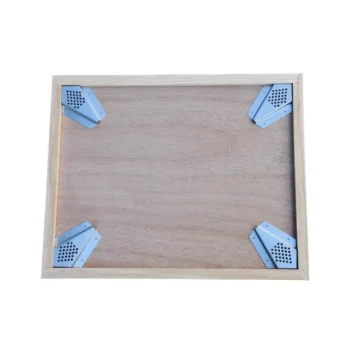
Standardizing Varroa mite monitoring requires high-precision hardware and specific adhesive consumables to ensure data integrity. Metal bottom board inserts and edible oil coatings function as a unified diagnostic system that captures, immobilizes, and protects fallen mites for accurate mortality assessment. This combination prevents external factors—such as hive airflow, bee hygiene, and scavengers—from skewing the results of parasitic pressure evaluations.
Core Takeaway: Metal inserts and edible oil coatings transform a standard hive bottom into a high-fidelity collection tray, ensuring that every fallen mite is recorded without interference from biological or environmental variables.
Enhancing Diagnostic Accuracy with Specialized Hardware
The Precision Surface of Metal Inserts
Metal bottom board inserts provide a perfectly smooth, flat surface that is superior to textured materials for mite collection. This uniformity allows for an even application of adhesives and facilitates rapid, clear visual inspection during the counting process.
The Adhesive Power of Edible Oil
A thin layer of edible oil functions as a non-toxic adhesive that securely fixes Varroa mites upon contact. This chemical-free approach ensures that the capture process does not introduce harmful residues into the hive environment or the honey crop.
Facilitating Research and Treatment Assessment
By providing a reliable "sticky board" mechanism, these components allow beekeepers to calculate the natural mite fall or the "knockdown rate" following a chemical treatment. This data is critical for determining whether a colony requires immediate intervention or if a treatment was successful.
Safeguarding Data Integrity in Field Conditions
Preventing Interference from Hive Hygiene
Honey bees are instinctively hygienic and will typically remove debris, including dead mites, from the hive floor. The use of a screened bottom board in conjunction with an oiled insert prevents worker bees from accessing and clearing the fallen mites before they can be counted.
Mitigating Environmental Factors
Airflow generated by bee wing-fanning or external wind can easily displace light-weight mites from a dry surface. The oil coating provides the necessary surface tension to keep mites in place, even in high-airflow environments, preserving the accuracy of the sample.
Protection Against Scavenger Insects
Scavengers such as ants or necrophagous beetles often enter hives to remove dead organic matter. The adhesive nature of the oiled insert immobilizes these scavengers or makes the mites difficult to remove, ensuring the final count reflects the true mortality rate over the monitoring period.
Understanding the Trade-offs
Maintenance and Reapplication Requirements
While highly effective, oil-coated inserts require regular maintenance to remain functional. Over time, hive debris (cappings, pollen, and dust) can cover the oil layer, reducing its stickiness and requiring the insert to be cleaned and recoated for continued accuracy.
Temperature and Viscosity Considerations
The performance of edible oil coatings can vary based on ambient temperature. In extreme heat, some oils may become too thin and run, while in cold weather, they may lose their adhesive "tack," potentially impacting the capture rate if not monitored closely.
Strategic Sourcing for Professional Beekeeping Operations
As a distributor or wholesaler, providing a full-spectrum product portfolio—including both the hardware (metal inserts) and the necessary consumables—positions your business as a comprehensive solution provider. Leveraging deep professional industry expertise ensures your clients receive products that meet rigorous field standards for biosecurity monitoring.
- If your primary focus is treatment efficacy testing: Prioritize metal inserts with high-contrast grids and premium edible oil coatings to ensure the most accurate knockdown counts possible.
- If your primary focus is long-term colony health monitoring: Invest in high-durability screened bottom boards that allow for rapid insertion and removal of collection trays without disrupting the colony.
- If your primary focus is supply chain efficiency: Partner with a one-stop sourcing provider that offers ultra-fast delivery of both metal hardware and non-toxic adhesive consumables to meet seasonal demand spikes.
Precise Varroa monitoring is the foundation of modern apiculture, and the right combination of inserts and coatings provides the data reliability professional beekeepers demand.
Summary Table:
| Component | Key Function | Benefit for Monitoring |
|---|---|---|
| Metal Inserts | Smooth, flat collection surface | Facilitates rapid, clear visual inspection and counting |
| Edible Oil | Non-toxic adhesive layer | Securely immobilizes mites; prevents loss from airflow |
| Screened Board | Physical debris barrier | Prevents hygienic bees from clearing mites before counting |
| System Integration | Diagnostic hardware set | Ensures high-fidelity data for treatment efficacy testing |
Scale Your Beekeeping Inventory with HONESTBEE
As a leading one-stop sourcing partner for commercial apiaries and B2B resellers, HONESTBEE understands that precision diagnostics drive customer loyalty. We provide a full-spectrum product portfolio, including premium metal bottom boards, honey-filling machines, and specialized monitoring hardware designed for professional field standards.
Why Partner with HONESTBEE?
- Comprehensive Wholesale Offering: Access everything from specialized machinery to essential industry consumables.
- Unmatched Supply Reliability: Benefit from ultra-fast delivery, rapid response times, and efficient order fulfillment.
- B2B Growth Support: We offer competitive profit margins and deep professional expertise to support your distribution network and OEM/ODM needs.
Ready to enhance your product lineup with high-quality beekeeping equipment? Contact our expert team today for a customized quote and discover how our premium trading services can streamline your supply chain.
References
- Marko Ristanić, Zoran Stanimirović. Formic Acid-Based Preparation in Varroa destructor Control and Its Effects on Hygienic Behavior of Apis mellifera. DOI: 10.3390/insects16121236
This article is also based on technical information from HonestBee Knowledge Base .
Related Products
- Langstroth Solid Bottom Board for Beekeeping
- Solid Bottom Board Australian Pine Wood Langstroth Bottom Board for Wholesale
- Langstroth Screen Bottom Board for Beekeeping Wholesale
- Australian Pine Wood Langstroth Screen Bottom Board for Wholesale
- HONESTBEE 4-Way Metal Corner Wooden Bee Escape Board
People Also Ask
- What are the functions of solid bottom boards for a beehive? Essential Thermal Protection and Winter Survival Tips
- What is the purpose of a solid bottom board for bee hives? Enhance Hive Health and Winter Survival
- How does climate influence the choice between a solid and screened bottom board? Optimize Your Hive for Local Weather
- What is the primary function of a bottom board in a modern modified beehive system? Essential Foundation Guide
- What are the characteristics of a solid bottom board for a beehive? Boost Colony Health and Thermal Insulation