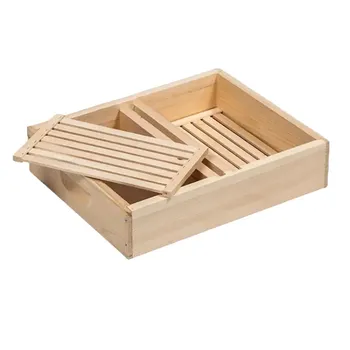
Commercial top-lid syrup feeders improve large-scale apiary efficiency by turning hive feeding into a fast, low-disturbance pumping operation. Their integrated, high-capacity syrup cavities can be refilled through external fill ports using pump nozzles connected to truck-mounted tanks, so operators do not need to remove hive covers during routine feeding. Because bees access the syrup from inside the hive, the design also reduces outside access to feed and helps limit robbing pressure.
The central advantage is controlled access: external filling reduces labor and colony disruption, while internal bee access makes the syrup less exposed to foreign bees and other robbing threats.
How Top-Lid Feeders Reduce Feeding Labor
External filling removes unnecessary hive opening
Traditional feeding often requires an operator to remove the hive cover, expose the colony, and position a feeder manually. Across hundreds or thousands of colonies, these repeated steps create a major labor burden.
A top-lid feeder allows syrup to be added through an external port. The operator can keep the hive closed while connecting a pump nozzle and transferring syrup directly into the integrated reservoir.
High-capacity cavities reduce refill frequency
The feeder’s built-in syrup cavity is designed for commercial-scale use rather than small, frequent manual additions. A larger working capacity means crews can service more colonies before stopping to reload equipment or repeat individual handling tasks.
The operational benefit is greatest when feeders are paired with truck-mounted syrup tanks and an organized route through the apiary.
Pump-based filling supports faster workflows
Using a pump nozzle converts feeding from a manual lifting and pouring task into a repeatable fluid-transfer process. This makes the workflow easier to standardize across crews, apiary locations, and service schedules.
For distributors and B2B resellers, compatibility with commercial pumping routines is an important product value: the feeder supports the broader equipment system rather than functioning as an isolated accessory.
How Feeders Protect Colony Stability
Closed-hive feeding minimizes disturbance
Removing a hive cover interrupts the colony’s internal environment and may provoke defensive behavior. It also requires additional time for opening, feeding, and resealing each hive.
Because top-lid feeders can be filled externally, routine syrup replenishment can be completed with less direct interference. Reduced handling helps crews maintain a calmer, more consistent feeding process.
Internal access limits syrup exposure
The bees reach the syrup through an internal route, while the syrup remains enclosed within the feeder assembly. Foreign bees cannot directly reach the syrup from outside the hive.
This arrangement helps reduce the conditions that encourage robbing, particularly when multiple colonies are being managed in close proximity. It does not eliminate every possible cause of robbing, but it provides a meaningful physical barrier against direct outside access to the feed.
More consistent feeding supports management discipline
A faster, less disruptive feeding method makes it easier for operators to follow planned feeding schedules. Consistency matters in commercial apiaries because missed or delayed service across many colonies can create uneven colony conditions and complicate field management.
The feeder therefore contributes not only through its physical design, but also by making correct operating procedures easier to execute at scale.
Why the System Matters for Commercial Apiaries
It increases labor productivity
Large apiaries are constrained by the number of hives that a crew can service in a working period. Eliminating cover removal and manual pouring allows workers to spend more time on higher-value tasks such as inspections, health management, relocation, and harvest preparation.
The efficiency gain comes from reducing repetitive handling at every hive, not from one dramatic mechanical feature.
It supports standardized operations
Commercial beekeeping benefits from repeatable equipment dimensions and workflows. Standardized hive structures and frames make components more interchangeable, while accurate hive construction helps preserve correct Bee Space and simplifies inspection and maintenance.
A top-lid feeder fits this same operational philosophy: each unit provides a consistent feeding method that crews can apply across standardized colonies and apiary sites.
It integrates with mobile service infrastructure
Truck-mounted syrup tanks and pump systems allow feeding supplies to move with the operation. External feeder ports provide a practical interface between that mobile infrastructure and the individual hive.
For commercial buyers, this integration can be more important than the feeder’s standalone capacity. The relevant question is whether the product improves the complete route—from syrup transport to transfer, hive servicing, and return to the next colony.
What Distributors and Resellers Should Evaluate
Compatibility with the customer’s equipment
A feeder should be assessed against the customer’s hive format, lid configuration, syrup delivery equipment, and operating procedures. Port accessibility and nozzle compatibility are especially important for customers using truck-mounted tanks.
A product that cannot fit existing equipment may create more handling work rather than less.
Durability under repeated handling
Commercial hives and feeders are frequently moved, stacked, serviced, and transported between regions. Product selection should therefore consider structural durability and the ability to withstand repeated operational use.
This is also where reliable hive manufacturing matters. Precisely made hive components improve equipment interchangeability and support compatibility with downstream systems such as extractors and filling equipment.
Service, availability, and fulfillment
For B2B customers, product performance is only part of the purchasing decision. Consistent supply, rapid response times, technical guidance, and efficient order fulfillment directly affect the customer’s ability to equip or expand an apiary.
A strong commercial supplier should be able to provide a broad product portfolio, confirm compatibility quickly, and coordinate orders without creating delays between feeders, hive components, and related equipment.
Understanding the Trade-offs
Higher-capacity systems require appropriate handling
A large syrup cavity improves productivity, but the supporting tank, pump, hose, and vehicle arrangement must be suitable for the operation. Buyers should evaluate the complete transfer process rather than judge capacity alone.
The feeder delivers its full benefit only when the rest of the filling workflow can keep pace.
Closed-hive feeding does not replace inspection
External filling reduces disturbance during syrup replenishment, but it does not remove the need for scheduled colony inspections. Feeding equipment improves one management task; it is not a substitute for health monitoring, equipment checks, or appropriate apiary practices.
Internal access reduces robbing risk but is not absolute security
The internal-entry design prevents foreign bees from directly reaching exposed syrup from outside the hive. However, overall robbing pressure also depends on colony conditions, apiary management, and other environmental factors.
The correct commercial claim is improved feed security and reduced exposure, not total elimination of robbing.
Standardization must be verified
Even a well-designed feeder may not suit every hive model or lid system. Dimensions, installation requirements, access points, and cleaning procedures should be confirmed before a large purchase.
For wholesale and distributor orders, sample validation or specification checks can prevent costly incompatibility across an entire shipment.
How to Apply This to Your Apiary or Product Line
Top-lid feeders are most valuable when they are selected as part of a complete, standardized commercial beekeeping workflow.
- If your primary focus is labor efficiency: Choose high-capacity feeders with accessible external fill ports and confirm that they work with your pump, hose, and truck-mounted syrup system.
- If your primary focus is hive security: Prioritize internal bee access and enclosed syrup storage to reduce direct outside access and limit robbing opportunities.
- If your primary focus is colony stability: Use a closed-hive feeding process to reduce unnecessary cover removal while retaining a separate schedule for inspections and health management.
- If your primary focus is apiary expansion: Standardize feeder, hive, and frame specifications so equipment remains interchangeable across colonies and locations.
- If your primary focus is procurement reliability: Work with a supplier that combines technical product knowledge, broad inventory, rapid communication, and dependable order fulfillment.
The right commercial top-lid feeder converts feeding from a labor-intensive hive-by-hive task into a faster, more controlled, and more secure operating process.
Summary Table:
| Feature | Benefit |
|---|---|
| External fill port | No need to remove hive covers; faster refilling |
| High-capacity cavity | Fewer refills; more colonies serviced per trip |
| Pump-based filling | Standardized workflow; less manual labor |
| Internal bee access | Reduces robbing risk; minimal disturbance |
| Durable construction | Withstands repeated commercial use |
Ready to upgrade your feeding efficiency and protect your hives? HONESTBEE offers top-lid syrup feeders designed for commercial apiaries. Our comprehensive wholesale portfolio includes everything you need—from feeders to hive components—with rapid delivery and dedicated support. Contact us today to discuss your bulk requirements and discover how we can streamline your operations.
Related Products
- HONESTBEE Round Hive Top Bee Feeder for Syrup
- HONESTBEE Professional Hive Top Bee Feeder Feeding Solution
- Professional Hive Top Bee Feeder for Beekeeping
- Premium Wood Hive Top Feeder with Floating Rafts for Langstroth Hives
- HONESTBEE Square Top Hive Bee Feeder Top Bee Feeder
People Also Ask
- What can the round hive top feeder be used for? A Guide to Efficient, Safe Bee Feeding
- What types of hive boxes is the round hive top feeder compatible with? Universal Fit for 8 & 10-Frame Langstroth Hives
- What is the capacity of the round hive top feeder for syrup and pollen? A Guide to Targeted Apiary Support
- What types of feed can be used with the round hive top feeder? Versatile Feeding for Optimal Apiary Health
- What are the different types of top feeders for bees? Choosing the Best Feeder for Your Apiary