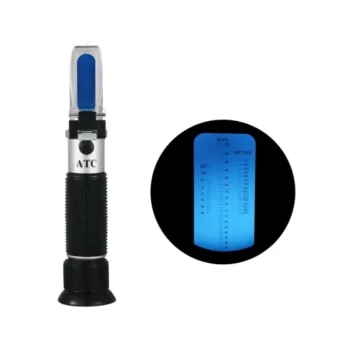
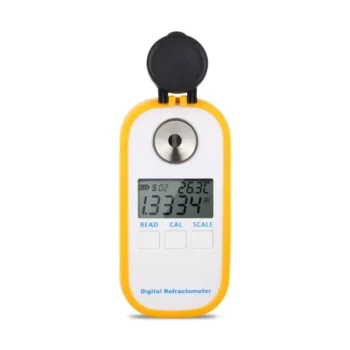
High-precision refractometers determine honey moisture by measuring how light bends as it passes through a sample. This physical measurement, known as the refractive index, is converted into a precise water percentage using standardized scales like the Wedmore table or the Chataway chart. For distributors and wholesalers, this process provides a fast, non-destructive method to verify honey maturity and ensure long-term storage stability.
Core Takeaway: By utilizing the refractive index at a standardized temperature (typically 20°C), high-precision refractometers allow traders to instantly identify fermentation risks and ensure every batch meets international moisture standards for premium shelf life.
The Technical Mechanism of Moisture Detection
Measuring the Refractive Index
Honey is a supersaturated sugar solution, meaning its density and composition directly affect how light travels through it. The refractometer measures the specific angle at which light refracts, which corresponds strictly to the concentration of dissolved solids versus water.
Temperature Standardization and Conversion
Precision is highly dependent on temperature, as the density of honey changes with heat. Most high-precision devices are calibrated to 20°C or feature Automatic Temperature Compensation (ATC) to ensure that readings remain accurate regardless of ambient warehouse conditions.
Utilizing Professional Data Tables
Once the refractive index is captured, the device or the operator uses the Wedmore table or Chataway chart to translate that index into a moisture percentage. This data-driven approach removes guesswork, providing a definitive value that can be documented for quality assurance and regulatory compliance.
Impact on Commercial Quality and Stability
Assessing Honey Maturity and Maturity
Moisture content is the primary indicator of honey maturity. Honey with high moisture (typically above 20-21%) is considered "unripe" and contains higher levels of active yeast, which can lead to rapid spoilage.
Preventing Fermentation and Spoilage
By ensuring moisture levels remain below the critical threshold—often 18% to 20% depending on the variety—distributors can guarantee that the honey will not ferment during transit or storage. This technical oversight prevents the reproduction of yeast that causes sensory degradation and gas buildup in sealed containers.
Compliance with International Trade Standards
High-precision refractometry is the industry standard for meeting global regulations, such as GOST 31774-2012. Accurate moisture data is essential for cross-border trade, where specific moisture limits are strictly enforced to protect the reputation of the supply chain.
Understanding the Trade-offs
Calibration and Maintenance Requirements
While refractometers offer rapid results, their accuracy depends entirely on regular calibration with standard reference fluids. Failure to maintain the prism surface or calibrate the device can lead to "drift," resulting in inaccurate readings that risk the acceptance of sub-standard batches.
Limitations of Indirect Measurement
Refractometry is an indirect measurement of moisture; it assumes the honey’s non-water components are primarily sugars. In rare cases where honey has unusual mineral or ash content, the refractive index may vary slightly, requiring expert interpretation and potentially secondary testing for high-value specialty honeys.
Applying This Data to Your Sourcing Strategy
Strategic Quality Decisions
Integrating high-precision testing into your procurement process ensures that you only source honey capable of surviving long-lead-time shipping and extended shelf display. This technical rigor protects your margins and reduces the risk of costly product recalls or insurance claims due to fermented stock.
- If your primary focus is global distribution: Prioritize devices that offer digital logging and 20°C standardization to meet international trade documentation requirements.
- If your primary focus is rapid warehouse intake: Utilize handheld high-precision refractometers with ATC to allow for quick "pass/fail" testing directly at the loading dock.
- If your primary focus is premium brand positioning: Use the moisture data to categorize your inventory, marketing lower-moisture batches as "premium grade" with superior shelf stability.
Reliable moisture detection is the technical foundation of a stable, professional honey supply chain that eliminates the unpredictability of natural fermentation.
Summary Table:
| Feature/Metric | Role in Quality Control | Impact on Wholesale Trade |
|---|---|---|
| Refractive Index | Measures dissolved solids vs. water | Verifies maturity and shelf stability |
| ATC (20°C) | Compensates for temperature shifts | Ensures accuracy in various warehouse climates |
| Moisture <18% | Prevents yeast growth & fermentation | Qualifies honey for "Premium Grade" status |
| Digital Logging | Captures precise batch data | Simplifies compliance for international export |
Elevate Your Honey Quality with HONESTBEE
As a dedicated partner for distributors, wholesalers, and B2B resellers, HONESTBEE provides a comprehensive one-stop sourcing solution for professional beekeeping. From high-precision testing tools to advanced honey-filling machines and essential consumables, we empower your business with:
- Deep Professional Expertise: Access full-spectrum product portfolios designed for commercial apiaries.
- Optimized Profit Margins: Benefit from our premium trading services, OEM/ODM support, and competitive wholesale offerings.
- Rapid Fulfillment: Experience ultra-fast delivery and efficient order processing to maintain a reliable supply chain.
- Exceptional Support: Our team provides dedicated service and rapid response times to meet your technical and logistics needs.
Ready to secure a more stable and profitable supply chain? Contact our experts at HONESTBEE today for a tailored quote!
References
- M. Homrani, M. Carmen Seijo. Botanical Origin, Pollen Profile, and Physicochemical Properties of Algerian Honey from Different Bioclimatic Areas. DOI: 10.3390/foods9070938
This article is also based on technical information from HonestBee Knowledge Base .
Related Products
- Precision Honey Refractometer Instrument for Quality Assessment
- Digital Honey Refractometer for Precision Measurement of Optimal Honey Quality
People Also Ask
- How do professional scientific instruments contribute to honey quality testing? Ensure Purity and Market Compliance
- What should be considered when choosing a honey refractometer? Key Factors for Accurate Moisture Testing
- Why is it important to understand the basics before using a honey refractometer? Ensure Honey Quality & Prevent Spoilage
- What is the role of a honey refractometer in harvesting? Prevent Fermentation & Ensure Quality
- How should a honey refractometer be stored? Ensure Long-Term Accuracy and Protect Your Investment