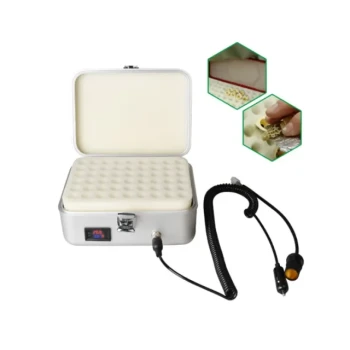
A constant temperature and humidity incubator functions as a surrogate hive, creating a precise microclimate essential for the survival and normal behavior of honey bees and Varroa destructor mites in a laboratory setting. By maintaining stable conditions—typically 33°C and 60% relative humidity—the equipment supports accurate toxicity observations and bioassays.
The Core Value of Stability In biological experiments, environmental stress is a confounding variable that can invalidate results. An incubator eliminates this variable, ensuring that mortality or physiological changes are due to your experimental treatment, not temperature shock or desiccation, thus guaranteeing data reproducibility.
Replicating the Hive Microclimate
Precision Environmental Control
Honey bees regulate their hive environment strictly; a laboratory setting must mimic this to yield valid data.
The incubator typically maintains a temperature of 33°C and a relative humidity of 60% for standard bioassays.
Physiological Maintenance
Both the honey bee host and the parasitic Varroa destructor rely on these specific conditions to maintain normal metabolic and physiological functions.
Without this stabilization, the organisms may enter a state of stress that alters their biology, rendering them unsuitable for testing.
Ensuring Data Integrity
Minimizing Background Mortality
Fluctuations in temperature or humidity can cause "control mortality"—death unrelated to the experiment.
By keeping the environment constant, the incubator minimizes stress-induced death, ensuring that survival rates reflect the actual toxicity of the substance being tested.
Reproducibility Across Batches
Scientific rigor requires that an experiment performed today yields comparable results to one performed next month.
The incubator ensures that every batch of bees and mites experiences the exact same environmental baseline, allowing for the reliable comparison of data over time.
Understanding the Nuances and Trade-offs
Context-Specific Settings
While 33°C/60% RH is standard for general bioassays, it is not a universal setting for all life stages.
You must be aware that different developmental stages require different microclimates to prevent developmental abnormalities.
Variations for Specific Stages
For example, experiments focusing specifically on pupae and mites may require slightly lower settings, such as 32°C and 40% humidity, to optimize physiological activity for salivary gland extraction.
Conversely, queen rearing demands higher heat and humidity (34°C and 75% RH) to ensure stability before emergence.
Making the Right Choice for Your Goal
To ensure your bioassay yields publication-grade data, align your incubator settings with your specific biological focus:
- If your primary focus is general toxicity bioassays: Maintain 33°C and 60% humidity to minimize stress and ensure comparable mortality data across batches.
- If your primary focus is pupal development or mite physiology: Consider adjusting conditions to 32°C and 40% humidity to optimize the physiological state for tissue extraction.
- If your primary focus is queen rearing or development: Increase settings to 34°C and 75% humidity to prevent developmental abnormalities and quality degradation.
Control the environment first, and the data will follow.
Summary Table:
| Application Focus | Optimal Temperature (°C) | Relative Humidity (%) | Primary Goal |
|---|---|---|---|
| General Toxicity Bioassays | 33°C | 60% | Minimize background mortality & stress |
| Pupae & Mite Physiology | 32°C | 40% | Optimize state for tissue extraction |
| Queen Rearing/Development | 34°C | 75% | Prevent developmental abnormalities |
Elevate Your Apiary Research and Productivity with HONESTBEE
At HONESTBEE, we understand that precision is the backbone of successful beekeeping operations and scientific research. Whether you are a commercial apiary, a research laboratory, or a global distributor, our comprehensive wholesale portfolio is designed to meet your most rigorous demands.
Our Value to You:
- Precision Machinery: From honey-filling machines to specialized hive-making equipment.
- Quality Consumables: A wide array of essential industry tools and hardware.
- Total Solutions: Supporting both the technical side of bee health and the commercial side of honey production.
Ensure your data integrity and operational efficiency with industry-leading equipment. Contact our expert team today to discuss your wholesale needs.
References
- Rassol Bahreini, David Feindel. Evaluation of potential miticide toxicity to Varroa destructor and honey bees, Apis mellifera, under laboratory conditions. DOI: 10.1038/s41598-020-78561-2
This article is also based on technical information from HonestBee Knowledge Base .
Related Products
People Also Ask
- What happens if a colony loses its queen during the nectar flow? A Guide to Salvaging Your Honey Harvest
- How can you tell if the worker bees have accepted the queen? Decode Bee Behavior for a Thriving Hive
- How can the queenless state of a newly created nuc be resolved? Expert Solutions for Colony Growth
- What are the primary reasons for replacing a queen bee? Boost Your Commercial Honeybee Colony's Success
- What queen bee behaviors should be observed after introduction? Ensure Hive Success with Our Expert Monitoring Guide