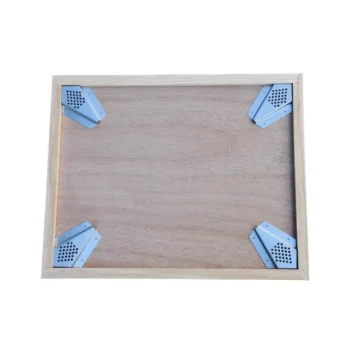
Precise frame management is a frontline defense against wax moths in Apis cerana colonies. By keeping every comb densely covered with bees and removing unguarded frames, beekeepers limit the exposed wax surfaces where greater and lesser wax moths can establish. A wooden division board helps by reducing the colony’s internal space, allowing the available bee population to patrol and protect the remaining comb more effectively.
Wax moth control begins with matching the amount of comb to the colony’s guarding capacity. Individual frame adjustment and a properly fitted wooden division board create a compact, well-defended nest that reduces pest pressure without relying solely on chemical treatments.
Why Exposed Comb Attracts Wax Moths
Uncovered comb is the primary vulnerability
Wax moths, including Galleria mellonella and Achroia grisella, are more likely to invade weak colonies and unguarded stored comb. Their larvae tunnel through wax, pollen, and brood structures while leaving silk webs and excreta behind.
When a colony cannot cover and patrol every comb surface, moth eggs and larvae can develop with less interference from worker bees. The resulting damage may destroy foundations, brood cells, and reusable frame inventory.
Strong colonies provide biological protection
Worker bees defend comb by patrolling surfaces, removing pests and debris, and maintaining hygienic behavior. This natural protection is most effective when the colony has enough bees to cover the entire comb area.
The management principle is therefore simple: do not give a colony more comb than it can defend.
How Precise Frame Management Reduces Infestations
Add or remove individual frames
Rather than adding or removing an entire super, beekeepers can adjust the hive one frame at a time. This makes the internal space closely match the current strength of the Apis cerana colony.
Removing surplus or weakly guarded frames eliminates exposed areas where wax moths can lay eggs and larvae can begin tunneling. Frames should be returned only when the colony has enough population to cover and protect them.
Maintain a “combs balanced to bees” condition
Every comb should be densely covered by bees, particularly during periods of colony weakness, after swarming, or when the population is reduced by seasonal conditions. This balance ensures that worker bees can monitor brood, wax, and hive edges continuously.
For commercial operations, accurate frame control also prevents unnecessary frame inventory from remaining inside active colonies. Unused frames should be removed, inspected, and placed in dedicated, protected storage.
Remove damaged and contaminated comb promptly
Wax moth activity can spread through neglected or previously infested equipment. Damaged comb, visible webbing, larval tunnels, and heavy wax debris should be addressed quickly rather than left inside the colony.
Clean replacement frames and standardized wooden frames make inspection and bee patrol more consistent. They also reduce hidden corners where moths, eggs, larvae, or cocoons may persist.
How Wooden Division Boards Improve Colony Defense
Reduce the area bees must protect
A wooden division board is placed at the side of the colony to restrict unused hive volume. This creates a compact internal environment in which the colony can concentrate its defensive population.
The board does not kill wax moths directly. Its value comes from improving the ratio between guarding bees and available comb, making it easier for workers to cover and patrol all remaining surfaces.
Limit neglected internal spaces
An oversized hive cavity can contain poorly occupied areas, gaps, and comb edges that receive less attention from worker bees. A properly fitted division board removes much of this unnecessary space.
This makes the nest easier for bees to defend and helps beekeepers identify whether the colony is expanding, contracting, or requiring frame adjustment.
Support hygienic behavior
A compact colony can devote more workers to cleaning, inspection, and removal of abnormal material. These hygienic activities help interrupt the early stages of wax moth establishment and reduce the opportunity for larvae to develop unnoticed.
The board therefore works as part of a broader management system, alongside strong colony maintenance, clean frames, and regular inspections.
The Equipment Practices That Complete the Protection
Seal hive bodies and fittings
Cracks, crevices, and poorly fitted hive components can provide adult moths with entry points for egg laying. Well-manufactured hive bodies, frames, and division boards with accurate dimensions help reduce these vulnerable gaps.
Sealing does not replace colony management, but it removes avoidable access points and improves the physical integrity of the hive.
Keep bottom boards free of wax debris
Wax fragments and waste on the hive floor can provide food and shelter for developing larvae. Regular bottom-board cleaning removes this breeding material and makes signs of infestation easier to detect.
This is a low-cost practice with particular value in commercial apiaries, where small sanitation failures can spread across large frame inventories.
Store surplus frames separately
Frames that bees cannot actively guard should not remain in the colony. Store surplus combs and supers in dedicated, secure equipment where they can be inspected and managed independently.
Depending on the operation and local regulations, protected storage may include exposure to light, airtight conditions, biological controls, sulfur fumigation, or thermal treatment. Stored equipment must be handled according to product instructions and applicable safety requirements.
Understanding the Trade-offs
A division board cannot compensate for a weak colony
Reducing hive space improves defensibility, but it cannot replace adequate bee population, food availability, or colony health. If the colony remains severely weakened, even a compact nest may be vulnerable.
Beekeepers should combine division-board use with routine population assessment and timely removal of unguarded comb.
Excessive restriction can delay expansion
If a colony grows rapidly and the division board remains in place too long, the available space may become restrictive. This can interfere with orderly expansion and may contribute to congestion.
The board should therefore be treated as an adjustable management tool, not a permanent fixture. Add frames progressively as the colony demonstrates that it can cover them.
Frame reduction requires disciplined storage
Removing frames reduces risk inside the colony only if the removed equipment is also protected. Unmanaged frames stored in a dark, open stack can become a concentrated source of wax moth infestation.
Inventory control, clean storage equipment, and regular inspections are essential for preventing the problem from simply moving outside the hive.
Chemical control should not be the first line
Fumigation and other treatments may be useful for stored equipment, but they do not correct poor colony-to-comb balance. Overreliance on chemicals can also create handling, residue, and safety concerns.
The most dependable foundation remains precise frame management, strong colonies, sound equipment, and good sanitation.
How to Apply This to Your Apiary
Begin with the colony’s actual bee population, then adjust the hive and equipment around its guarding capacity.
- If your primary focus is active-colony protection: Keep only enough frames for the bees to cover densely, and use a wooden division board to reduce unguarded internal space.
- If your primary focus is commercial frame inventory: Remove surplus frames promptly and store them in dedicated, protected equipment with regular inspection and appropriate pest-control procedures.
- If your primary focus is equipment quality and supply reliability: Source standardized wooden frames, accurately fitted division boards, sealed hive bodies, and cleaning and storage equipment from suppliers able to support consistent fulfillment.
- If your primary focus is early infestation prevention: Maintain clean bottom boards, inspect frames frequently, and replace damaged or contaminated comb before larvae spread.
When hive space consistently matches colony strength, Apis cerana bees can defend their comb more effectively and wax moth infestations become far easier to prevent.
Summary Table:
| Aspect | Role in Wax Moth Prevention |
|---|---|
| Precise Frame Management | Reduces exposed comb, matching colony size to guardable area, minimizing moth egg-laying sites. |
| Wooden Division Boards | Reduce internal space, concentrating bees for better patrol and defense of remaining comb. |
| Strong Bee Population | Enhances hygienic behavior and comb coverage, deterring moth establishment. |
| Regular Equipment Maintenance | Sealing cracks, cleaning bottom boards, and storing surplus frames properly prevents infestation spread. |
Protect your apiary from wax moths with HONESTBEE's premium beekeeping equipment. Our comprehensive range includes precision wooden frames and division boards that optimize hive space and strengthen colony defense. For distributors and commercial apiaries, we offer OEM/ODM support, certifications, and reliable supply chain. Ensure efficient order fulfillment and boost your customers' productivity. Contact us today for tailored wholesale solutions and rapid response services.
Related Products
- HONESTBEE Wooden Bee Escape Board with Triangle Mesh Design for Beekeeping
- HONESTBEE 4-Way Metal Corner Wooden Bee Escape Board
- Solid Bottom Board Australian Pine Wood Langstroth Bottom Board for Wholesale
- Australian Pine Wood Langstroth Screen Bottom Board for Wholesale
People Also Ask
- How is a bee escape board used to clear a hive body for honey harvesting? Optimize Your Chemical-Free Harvest
- What is a bee escape board and what problem does it solve? Simplify Your Honey Harvest with Passive Clearing
- How is a bee escape board used and how does it function? Master This Gentle Honey Harvesting Tool
- What are the proper steps for using a bee escape board for honey harvesting? Master the Passive Clearing Technique
- What tools and methods are used to clear honey bees from honey supers? Efficient Harvesting for Commercial Beekeepers