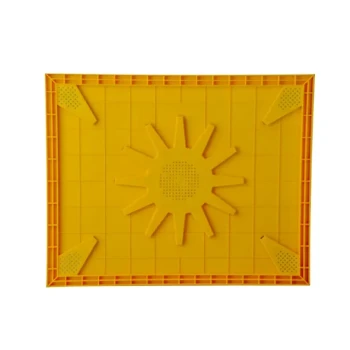
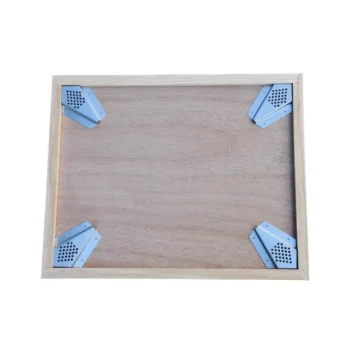
Landing boards act as the essential flight decks for your apiary, specifically designed to regulate traffic at the hive entrance. In a multi-family system, these external platforms provide a distinct physical transition zone for foraging bees to take off and land safely. Their primary technical function is to visually and spatially guide foragers back to their specific colony, segregating traffic between independent families housed within the same structure.
Core Takeaway: In multi-family setups, the landing board is a critical isolation tool; it prevents resource drain caused by drifting and minimizes fatal aggression between colonies, ensuring each family reaches peak maturity before any planned merging.
Facilitating Order in High-Density Systems
The "Runway" Function
Foraging bees often return heavy with nectar and pollen. The landing board provides a necessary mechanical platform for these bees to land securely before entering the hive.
Without this platform, bees may struggle to gain entry, reducing the overall efficiency of the foraging loop.
Visual Orientation for Independent Colonies
In systems like a two-block hive, multiple colonies live in close proximity. This creates a high risk of confusion for returning bees.
Each section is equipped with an independent landing board. This specific hardware acts as a unique marker, helping bees identify their specific entrance among the others.
Protecting Colony Integrity
Minimizing Drifting
"Drifting" occurs when bees mistakenly enter a neighboring colony. This can lead to uneven population distribution and the spread of pathogens.
By clearly delineating entrances with separate landing boards, you ensure bees return to their home colony. This keeps the population dynamics of each "family" accurate and predictable.
Reducing Inter-Colony Aggression
When a bee enters the wrong colony, guard bees will often attack. This results in unnecessary bee mortality and creates stress within the hive.
Landing boards segregate the traffic flow before the bees reach the entrance hole. This separation minimizes fighting, allowing the colony to focus energy on brood rearing rather than defense.
Critical Considerations and Trade-offs
Hardware Dependence
While landing boards significantly reduce drifting, they are not a cure-all. In very large multi-family systems, bees may still experience confusion if the boards are not distinct enough.
You cannot rely on the board alone; the positioning of the hive and the orientation of the boards relative to the sun and wind also play a role in navigation.
The Merging Context
The primary reference highlights that these boards ensure orderly development before colonies are merged.
This implies that the utility of separate landing boards changes throughout the season. They are vital during the growth phase but serve a different purpose once the partition is removed and the families are united.
Making the Right Choice for Your Goal
To maximize the effectiveness of your multi-family system, consider your specific management objectives:
- If your primary focus is rapid population growth: Ensure every colony section has a distinct, large landing board to maximize foraging efficiency and minimize the loss of bees to fighting.
- If your primary focus is preparing for a merge: Use the landing boards to maintain strict separation now, so both colonies are equally strong and healthy when the time comes to combine them.
The landing board is not just a doorstep; it is the primary control mechanism for maintaining peace and organization in a complex hive environment.
Summary Table:
| Feature | Primary Function | Impact on Colony Management |
|---|---|---|
| Mechanical Platform | Provides a secure "runway" for heavy foragers | Increases foraging efficiency and reduces bee fatigue |
| Visual Orientation | Acts as a unique marker for independent entrances | Minimizes drifting and ensures bees return to the correct family |
| Traffic Segregation | Separates bees before they reach the entrance hole | Reduces inter-colony fighting and unnecessary bee mortality |
| Growth Phase Support | Maintains colony isolation before merging | Ensures each family reaches peak maturity and health independently |
Maximize Your Apiary Productivity with HONESTBEE
Maintaining order in a multi-family system requires precision-engineered equipment. At HONESTBEE, we specialize in supporting commercial apiaries and distributors with a comprehensive range of professional beekeeping solutions. From high-durability hive components to advanced hive-making and honey-filling machinery, our portfolio is designed to enhance your operational efficiency.
Whether you are scaling a commercial operation or supplying the industry, our wholesale offering provides the essential tools and consumables you need to succeed. Contact us today to discover how our specialized hardware and industry expertise can help you achieve superior colony management and business growth.
References
- В. Р. Петровец, A. N. Shershnev. Economic and mathematical model of bee colonies housing in two-block hive with combined technological partitionEconomic and mathematical model of bee colonies housing in two-block hive with combined technological partition. DOI: 10.29235/1817-7204-2021-59-1-103-110
This article is also based on technical information from HonestBee Knowledge Base .
Related Products
- Solid Bottom Board Australian Pine Wood Langstroth Bottom Board for Wholesale
- HONESTBEE Wooden Bee Escape Board with Triangle Mesh Design for Beekeeping
- Langstroth Solid Bottom Board for Beekeeping
- HONESTBEE Multi Exit Plastic Bee Escape Board for Efficient Honey Harvesting
- Australian Pine Wood Langstroth Screen Bottom Board for Wholesale
People Also Ask
- In what conditions is a solid bottom board preferred over a screened bottom board? Maximize Hive Heat and Treatment
- What is the primary function of a solid bottom board on a beehive? Key Benefits for Hive Stability and Insulation
- What are the characteristics of a solid bottom board? A Guide to Hive Foundation & Climate Control
- What is a solid bottom board and in what climate is it most beneficial? Essential Guide for Cold Climate Beekeeping
- What is the primary function of a solid bottom board? Essential Thermal Insulation for Cold Climate Beekeeping