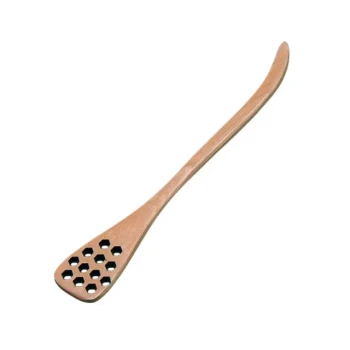
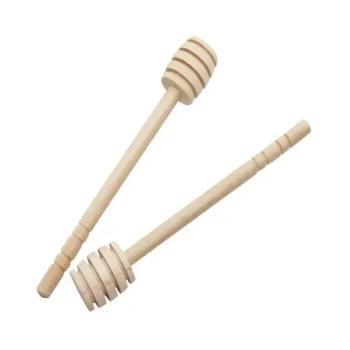
Wooden sampling sticks serve as the primary instrument for physically interacting with suspected diseased larvae during field inspections. By using a stick to stir and withdraw the internal contents of a dead larva, a beekeeper can evaluate the "ropiness" of the remains to differentiate European Foulbrood (EFB) from other conditions.
The stick reveals the definitive physical state of the larval remains. For European Foulbrood, this manifests as a short, semi-fluid rope typically measuring less than 1.5 cm, clearly distinguishing it from the long, elastic strands found in other brood diseases.
Performing the Rope Test
Macerating the Larva
The initial role of the wooden stick or toothpick is to break down the structure of the dead larva.
The beekeeper inserts the stick into the cell and stirs the internal contents. This action mixes the remains into a consistent slurry, preparing it for the elasticity test.
The Withdrawal Motion
Once the contents are stirred, the stick is slowly withdrawn from the cell.
This pulling motion is the critical step. It allows the beekeeper to observe how the larval remains adhere to the wood and stretch as they are pulled away from the cell base.
Identifying European Foulbrood Characteristics
The "Short Rope" Indicator
When testing for EFB, the primary indicator is the length of the thread created by the withdrawing stick.
The remains will stretch slightly but break quickly. A positive sign for EFB is a short rope length of less than 1.5 cm.
Consistency and Texture
Beyond length, the stick allows the beekeeper to feel and see the consistency of the material.
The diseased remains of EFB are typically semi-fluid and pasty. Unlike healthy larvae or other diseases, the material does not exhibit significant elasticity.
Diagnostic Distinctions and Limitations
Ruling Out American Foulbrood (AFB)
The most valuable function of the wooden stick test is distinguishing EFB from the more severe American Foulbrood (AFB).
While EFB produces a short, pasty rope, AFB is characterized by a long, elastic ropiness. If the stick pulls a thread significantly longer than 1.5 cm, EFB is likely not the primary diagnosis.
Physical Limitations
The test relies on the physical consistency of the remains, which implies the larvae must be in a specific stage of decay.
If the remains have dried out completely into a scale or are too fresh, the wooden stick may not be able to produce the semi-fluid rope required for this specific diagnostic metric.
Making the Right Choice for Your Goal
When performing field diagnostics on suspicious brood frames, use the following guidelines to interpret your findings:
- If your primary focus is confirming European Foulbrood: Look for a break in the thread before it stretches beyond 1.5 cm, accompanied by a pasty consistency.
- If your primary focus is ruling out American Foulbrood: Ensure the material does not stretch into a long, elastic thread, which is the hallmark of AFB.
The wooden stick converts a visual inspection into a tactile diagnosis, providing immediate evidence of the pathogen's physical signature.
Summary Table:
| Diagnostic Feature | European Foulbrood (EFB) | American Foulbrood (AFB) |
|---|---|---|
| Rope Length | Short (< 1.5 cm) | Long and elastic (> 1.5 cm) |
| Consistency | Semi-fluid and pasty | Sticky and glue-like |
| Stick Motion | Breaks quickly when pulled | Stretches significantly before breaking |
| Physical State | Moist/decaying slurry | Viscous/slimy thread |
Scale Your Apiary Operations with HONESTBEE Wholesale Solutions
Effective disease management starts with the right tools. HONESTBEE caters specifically to commercial apiaries and international distributors with a comprehensive wholesale offering designed for industry leaders.
We provide the full spectrum of professional beekeeping supplies, including:
- Essential Consumables: High-quality sampling tools and field diagnostic supplies.
- Specialized Machinery: State-of-the-art hive-making and honey-filling machines to optimize production.
- Full Equipment Range: From specialized hardware to honey-themed cultural merchandise.
Whether you are stocking a distribution network or managing thousands of colonies, our portfolio ensures you have the hardware and consumables needed for success. Contact us today to discuss your wholesale requirements and see how our global supply chain can benefit your business.
References
- Mirjana Bojanić Rašović, Igor Stojanov. SIGNIFICANCE OF EUROPEAN FOULBROOD OF HONEY BEES DIAGNOSTICS IN MONTENEGRO. DOI: 10.17707/agricultforest.68.1.20
This article is also based on technical information from HonestBee Knowledge Base .
Related Products
- Modern Honeycomb Pattern Wooden Honey Dipper for Stirring and Drizzling
- Natural Wood Honey Dipper for Tea Coffee and Desserts
People Also Ask
- What is the proper method for cleaning a honey dipper? Maintain Pure Flavor with These Easy Pro Tips
- What is a honey dipper and what is it used for? A Guide to Mess-Free Drizzling
- What is a honey dipper? Master the Art of the Perfect Drizzle with This Essential Tool
- What is a honey taking spoon called? Discover the Tool for a Perfect, Mess-Free Drizzle
- How do you clean and store a honey dipper? Simple Steps for Long-Lasting Performance