
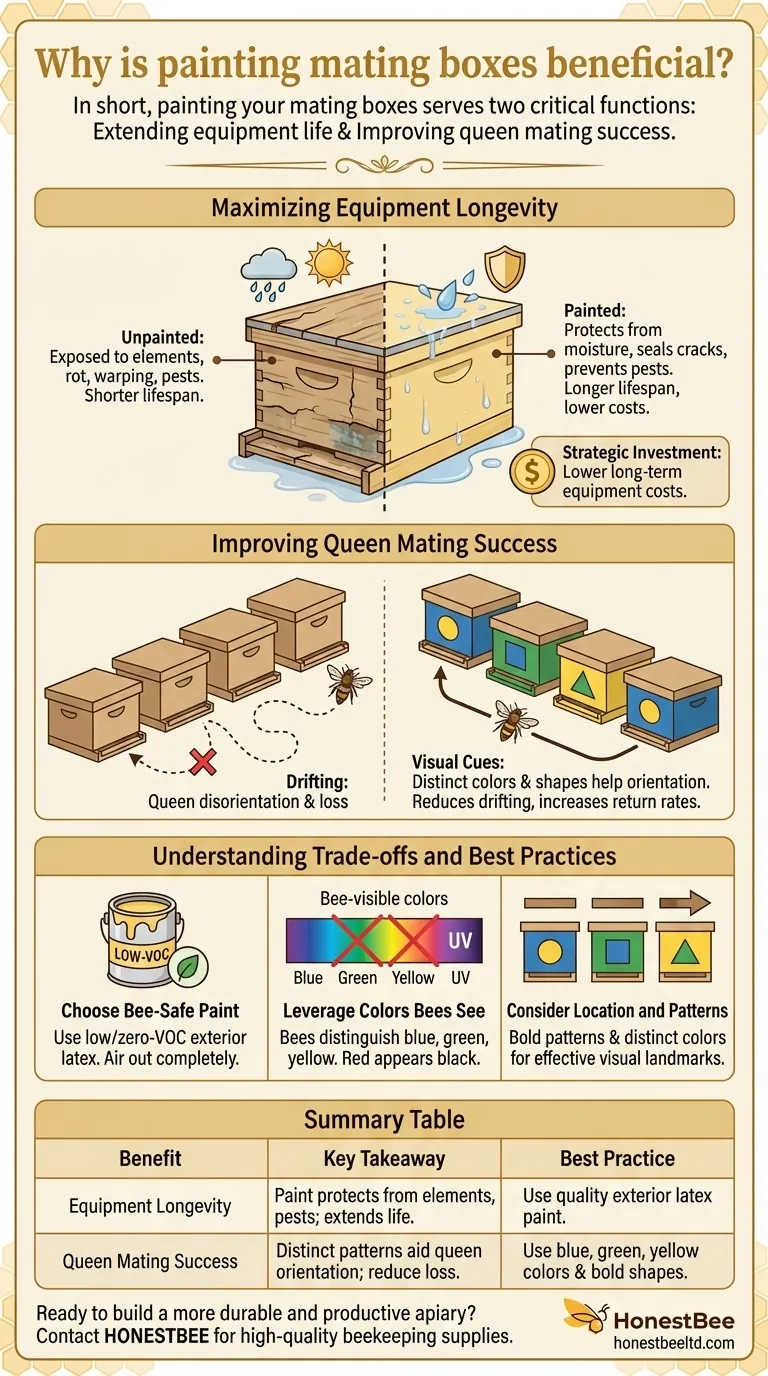
In short, painting your mating boxes serves two critical functions. It significantly extends the life of your wooden equipment by protecting it from the elements, and more importantly, it helps virgin queens orient themselves correctly, increasing their chances of returning to the right hive after a mating flight.
The decision to paint mating nucs is not merely cosmetic. It is a strategic investment in both the longevity of your equipment and the success rate of your queen rearing operation.
Maximizing Equipment Longevity
One of the most straightforward benefits of painting your mating boxes is the physical protection it provides to the wood.
Protection Against the Elements
Your mating nucs spend their entire service life outdoors, exposed to rain, sun, and temperature fluctuations. A quality coat of exterior paint acts as a crucial barrier, preventing moisture from soaking into the wood, which leads to rot, warping, and decay.
Sealing Wood and Preventing Pests
Paint helps to seal small cracks and imperfections in the wood. This not only improves insulation but also eliminates potential hiding spots for pests like wax moth larvae and small hive beetles.
The Financial Impact of Durability
Well-maintained, painted equipment can last for many seasons, while unpainted boxes may need replacement after just a few years. This simple act of maintenance directly translates into lower long-term equipment costs for your apiary.
Improving Queen Mating Success
Beyond protecting the wood, a thoughtful painting strategy is a powerful tool for improving the success of your queen rearing efforts.
The Challenge of Queen Orientation
Virgin queens leave the nuc for mating flights and must navigate back to their specific home. In a yard with many identical mating nucs placed close together, it is very easy for a queen to become disoriented and enter the wrong box—a phenomenon known as drifting.
Using Visual Cues for Recognition
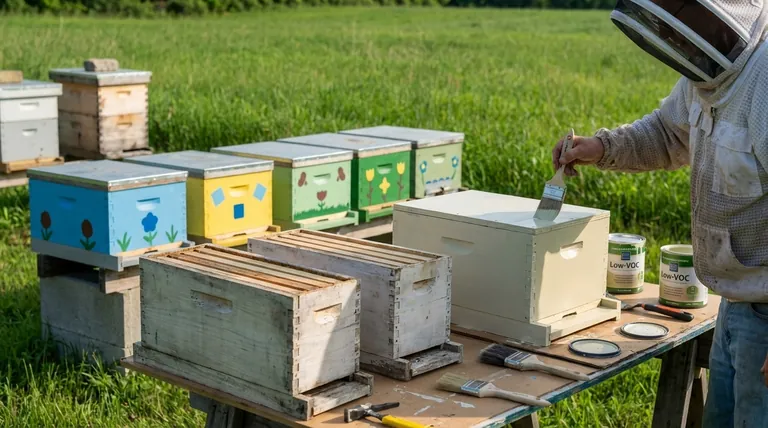
Bees do not see the world as we do, but they are adept at distinguishing between colors and shapes. By painting your mating nucs in different colors (or painting different sides of the same nuc in distinct colors), you provide strong visual landmarks for the returning queen.
Reducing Drifting and Queen Loss
When a queen drifts into the wrong nuc, she will almost certainly be killed by the resident bees or the other virgin queen. Using varied paint schemes dramatically reduces this risk, leading to higher rates of successful queen returns and a more productive operation.
Understanding the Trade-offs and Best Practices
While painting is highly beneficial, the how is just as important as the why. Following best practices ensures you achieve the benefits without harming your bees.
Choose Bee-Safe Paint
Always use a low-VOC or zero-VOC exterior latex paint. The volatile organic compounds (VOCs) in oil-based or high-VOC paints can be harmful to bees. Allow the boxes to air out completely for several days until no paint odor remains before introducing bees.
Leverage Colors Bees Can See
Bees see colors differently than humans, with a range shifted towards the ultraviolet spectrum. They can clearly distinguish between blue, green, yellow, and ultraviolet. Using bold patterns with these colors is highly effective. Bees cannot see red, which appears to them as black.
Consider Location and Patterns
For nucs placed in a line, painting the fronts with different colors and simple, bold shapes (circles, squares, triangles) provides the most effective visual cue for a returning queen.
A Practical Strategy for Your Apiary
Applying these principles is straightforward and can be adapted to the scale of your operation.
- If your primary focus is cost-efficiency: At a minimum, apply two coats of a single, light-colored exterior latex paint to all boxes to maximize their lifespan against the weather.
- If your primary focus is maximizing queen return rates: Implement a multi-color system, painting the fronts of your nucs with distinct, bold patterns using bee-visible colors like blue, yellow, and green.
Ultimately, painting your mating boxes is a simple, low-cost task that delivers a significant return on investment through healthier queens and longer-lasting equipment.
Summary Table:
| Benefit | Key Takeaway |
|---|---|
| Equipment Longevity | Paint protects wood from rot, warping, and pests, extending equipment life for years. |
| Queen Mating Success | Colorful, distinct patterns help queens orient, reducing drifting and loss. |
| Best Practice | Use low-VOC, bee-safe paint in colors bees see (blue, green, yellow) for best results. |
Ready to build a more durable and productive apiary? At HONESTBEE, we supply high-quality beekeeping supplies and equipment to commercial apiaries and distributors. Let us help you get the right equipment for your queen rearing operation. Contact our wholesale team today to discuss your needs and see how we can support your success.
Visual Guide
Related Products
- Portable Bee Mating Hive Boxes Mini Mating Nucs 8 Frames for Queen Rearing
- Styrofoam Mini Mating Nuc Box with Frames Feeder Styrofoam Bee Hives 3 Frame Nuc Box
- Twin Queen Styrofoam Honey Bee Nucs Mating and Breeding Box
- Automatic Heat Preservation 6 Frame Pro Nuc Box for Honey Bee Queen Mating
- 4 Frame Plastic Nuc Boxes for Beekeeping Bee Nuc Box
People Also Ask
- How do specialized queen-rearing frames and mating boxes boost off-season bee production? Optimize Your Apiary's Output
- What are the approximate weights of different types of 8-frame beehive boxes? Lift Smarter for Your Apiary
- What role does the structural configuration of beekeeping mating boxes play? Optimize Queen Mating Success
- What is an 8 frame box and why is it popular? A Lighter, More Ergonomic Hive Solution
- What role do portable mating nucs play in geographic isolation breeding? Secure Genetic Purity in Remote Locations


