The Queen Rearing Equation
Imagine a commercial beekeeper in early spring. The goal is to raise 1,000 queen bees. This isn't just a matter of biology; it's a matter of logistics. Every minute counts. Every percentage point of success matters. The entire operation hinges on thousands of tiny, near-identical decisions.
At the heart of this industrial-scale biological process is a deceptively simple choice: the material of the cell cup used for grafting. It’s a decision that seems minor, but it dictates workflow, scalability, and ultimately, the economic viability of the entire apiary. This isn't just about choosing between plastic and wax; it's about choosing a philosophy of operation.
The Allure of the Natural: The Wax Cup Philosophy
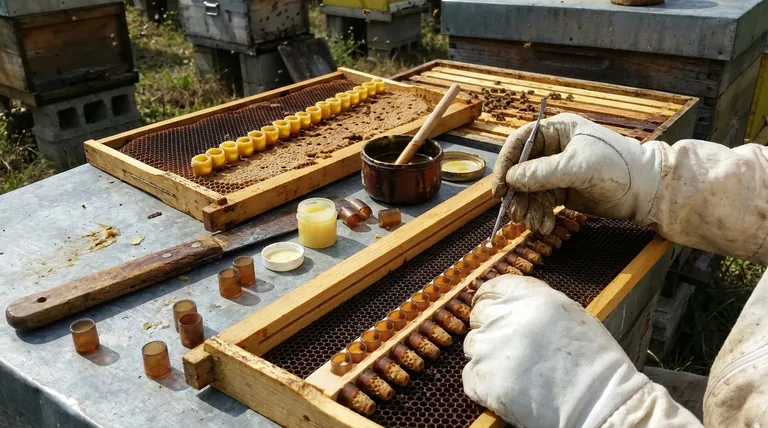
For generations, the answer was obvious: beeswax. Beekeepers would meticulously craft their own cell cups, dipping a wooden dowel into molten wax again and again.
There's a powerful psychological appeal to this. It feels right. Bees make wax, so presenting a larva in a wax cup seems like the most natural, respectful way to work with the colony. And the bees often agree. Initial acceptance rates for wax cups are typically very high, which is a comforting metric for any beekeeper.
The Craft That Becomes a Constraint
The process is a craft. Each cup is attached to the cell bar with a drop of hot wax, a manual and time-consuming task.
For a beekeeper raising a dozen queens, this is a pleasant ritual. But when the goal is a hundred, or a thousand, the ritual becomes a bottleneck. The time spent making and mounting cups is time not spent on other critical tasks. The "craft" approach, while beautiful in its naturalism, simply doesn't scale. It hits a hard ceiling where labor costs and time constraints make growth impossible.
The System's Answer: Engineered for Flow
This is where the plastic cell cup enters the story. It wasn't invented to be a "cheap" alternative. It was designed as an engineered solution to the problem of scale. It’s the embodiment of an engineer's romance with efficiency.
Plastic cell cups represent a shift in thinking: from managing individual cells to managing a system.
Designing for a System, Not a Cell
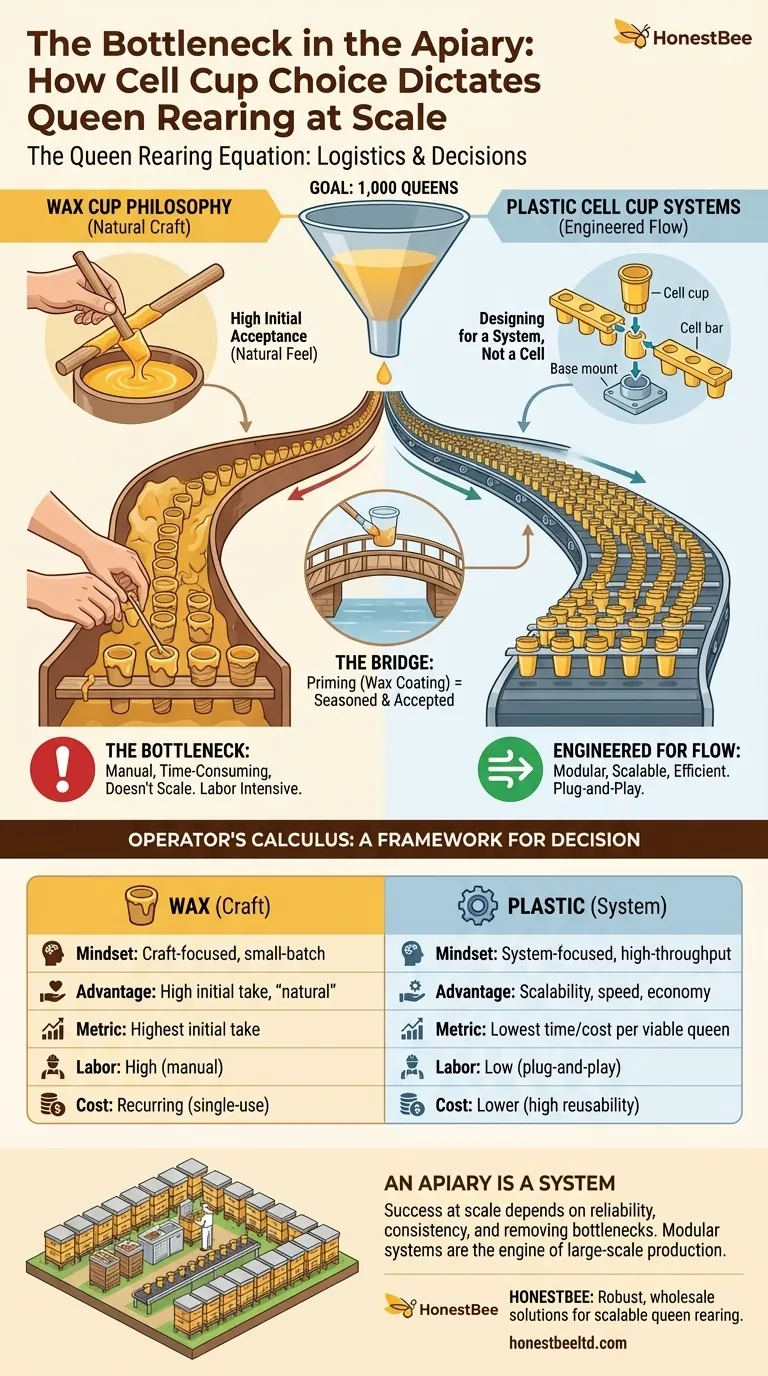
The true innovation isn't just the plastic cup itself, but the modular system it enables.
- Base Mounts: Cups plug into bases.
- Cell Bars: Bases plug into bars.
- Uniformity: Every piece is identical, ensuring a perfect fit every time.
This design transforms the workflow. A beekeeper can now prepare hundreds of bars in a fraction of the time. Inspecting or transferring a single queen cell no longer requires delicate surgery; you simply unplug the base. It’s a system designed to remove friction, reduce variables, and enable massive parallel processing.
The Psychological Hurdle of "Unnatural"
The primary objection to plastic is that it isn't natural, which can sometimes lead to lower initial acceptance by the nurse bees. This is a valid concern.
However, the solution is simple and elegant. By "priming" the plastic cups with a thin coating of beeswax or letting them sit in the hive for a day, the beekeeper bridges the gap. The cup acquires the scent and feel of the hive. After one use, the cups are seasoned, and acceptance rates become nearly identical to wax. You gain the unparalleled efficiency of a modular system without sacrificing the biological acceptance.
The Operator's Calculus: A Framework for Decision
Choosing between wax and plastic is an economic and philosophical decision. It's about how you value your time and what your goals are.
| Factor | Wax Cell Cups | Plastic Cell Cup Systems |
|---|---|---|
| Operational Mindset | Craft-focused, small-batch | System-focused, high-throughput |
| Primary Advantage | High initial acceptance, "natural" feel | Scalability, speed, and long-term economy |
| Key Metric | Highest possible initial take | Lowest time and cost per viable queen |
| Labor Input | High; each cup is made and mounted manually | Low; plug-and-play assembly |
| Long-Term Cost | Consistently recurring (single-use) | Lower; high reusability |
| Best For | Hobbyists, natural beekeeping purists | Commercial apiaries, equipment distributors |
An Apiary is a System
Ultimately, the choice reveals how you view your apiary. Is it a collection of individual hives, or is it a cohesive production system?
For commercial apiaries and the beekeeping distributors who supply them, the answer is clear. Success at scale depends on reliability, consistency, and efficiency. The bottlenecks must be engineered away. The modularity of plastic cell cup systems isn't just a convenience; it's the engine that makes large-scale queen production possible.
At HONESTBEE, we focus exclusively on providing these robust, wholesale solutions. We understand that for a commercial operation, equipment must be a reliable tool that saves time and maximizes output, season after season.
If your focus is on building a scalable, efficient, and profitable queen rearing operation, the foundation begins with the right systems. Contact Our Experts
Visual Guide
Related Products
- JZBZ Type Wide Base Plastic Queen Cell Cups for Base Mounting and Queen Rearing
- Brown Nicot Queen Cell Cups for Breeding Queen Bees Beekeeping
- JZBZ Push-In Queen Cell Cups for Beekeeping
- Clear Black Plain Polystyrene Queen Bee Grafting Cell Cups No Lug for Bee Queen Cup
- 10-Cell Silicone Beeswax Bee Queen Cups Forming Mold
Related Articles
- How to Replace Queen Cells in Nucleus Hives Without Triggering Bee Drifting
- How to Successfully Introduce Queen Cells to Beehives: A Beekeeper’s Guide
- How Beekeepers Can Maximize Queen-Rearing Success with the JZBZ System
- Harnessing the Emergency Impulse: The Biology of Commercial Queen Rearing
- Why Plastic Queen Excluders Outperform Metal and Wood: Science, Savings, and Hive Protection