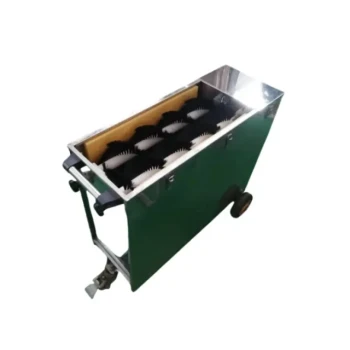
Intelligent electronic beehive scales provide critical data by continuously recording the total weight of the hive in real time. By capturing these granular fluctuations, the technology allows for the precise calculation of honey collection rates and colony food consumption levels, eliminating the human error and data gaps inherent in traditional periodic manual inspections.
The Core Insight While traditional methods provide a snapshot of hive status, intelligent scales offer a "video" of colony dynamics. This continuous data stream transforms beekeeping from a subjective art into a quantifiable science, serving as the objective baseline for evaluating foraging efficiency, environmental adaptability, and genetic potential.
Quantifying Colony Dynamics
The primary value of intelligent scales lies in their ability to capture the nuance of weight change, rather than just the gross total.
Continuous Weight Monitoring
Unlike manual weighing, which happens periodically, intelligent scales record data continuously.
This provides a complete data stream of the colony’s dynamics, capturing immediate changes during both active nectar flows and dormant overwintering periods.
Determining Nectar Flow Intensity
By analyzing daily and monthly net weight changes, technicians can accurately map the local environment.
This quantitative analysis determines the exact intensity and duration of nectar flows, identifying exactly when bees are most productive.
Monitoring Food Consumption
Performance testing is not just about production; it is also about efficiency during dearth.
Real-time monitoring calculates food consumption levels during overwintering, providing data on how resource-efficient a specific colony is when forage is unavailable.
Evaluating Production Performance
Beyond simple weight tracking, this data allows for sophisticated analysis of biological traits and management effectiveness.
Objective Genetic Selection
The data provides an objective physical basis for comparing colonies with different genetic backgrounds.
By isolating environmental factors, breeders can evaluate the specific foraging ability and production efficiency of a colony to determine breeding values.
Correlating Queen Traits to Yield
Precise weight measurement serves as core evidence for evaluating queen performance.
It allows researchers to link specific queen traits, such as birth weight, directly to economic characteristics like honey yield, facilitating the selection of superior bee lineages.
Assessing Management Impacts
Weighing precision allows for the evaluation of human intervention, such as disease control.
For example, by quantifying weight differences, managers can determine if biological measures for Varroa control have negatively impacted foraging performance, ensuring disease management does not compromise yield.
Understanding the Trade-offs
While intelligent scales provide high-value data, relying on them requires an understanding of their context within the broader testing framework.
Total Weight vs. Extractable Yield
An intelligent scale under a hive measures everything: bees, brood, wax, water content, and honey.
Real-time weight gain indicates resource accumulation, but it does not perfectly equate to "honey in the jar" until excess water is evaporated and the honey is capped.
The Role of Verification Weighing
To finalize breeding values, real-time data is often supplemented by static industrial weighing during extraction.
Weighing honey-laden combs against empty combs (or supers before and after extraction) remains the fundamental basis for calculating the exact harvestable yield to validate the sensor data.
Making the Right Choice for Your Goal
To maximize the value of intelligent weighing systems, align the data usage with your specific performance objectives.
- If your primary focus is Genetic Breeding: Prioritize the comparative daily gain data to isolate colonies that outperform peers during the exact same nectar flow window.
- If your primary focus is Environmental Adaptability: Focus on consumption rates during overwintering to identify lineages that maintain population health with minimal resource usage.
- If your primary focus is Disease Management: Use weight trend analysis immediately following treatments to detect and mitigate any subtle suppression of foraging activity.
Data-driven beekeeping transforms weight from a simple number into a diagnostic tool for colony health and productivity.
Summary Table:
| Data Category | Key Metric Measured | Value for Performance Testing |
|---|---|---|
| Nectar Flow | Daily/Monthly Net Weight Change | Maps local environment and identifies peak production periods. |
| Food Consumption | Overwintering Weight Loss | Evaluates resource efficiency and colony hardiness during dearth. |
| Genetic Potential | Comparative Daily Weight Gain | Provides an objective basis for selecting superior breeding lineages. |
| Management Impact | Post-Treatment Foraging Trends | Quantifies the effect of disease control measures on colony yield. |
| Queen Performance | Yield Correlation | Links queen traits (e.g., birth weight) to economic honey production. |
Elevate Your Beekeeping Operations with HONESTBEE
At HONESTBEE, we empower commercial apiaries and distributors with the high-precision tools needed to transform beekeeping into a data-driven science. From intelligent electronic scales that capture vital colony dynamics to advanced honey-filling and hive-making machinery, our comprehensive wholesale catalog covers the full spectrum of industry needs.
Whether you are looking to optimize your production performance or expand your inventory with professional-grade hardware and honey-themed cultural merchandise, our experts are ready to assist. Partner with us to enhance your efficiency and scale your honey production.
Ready to optimize your apiary? Contact us today to explore our wholesale solutions!
References
- Ralph Büchler, J. Wilde. Standard methods for rearing and selection of<i>Apis mellifera</i>queens. DOI: 10.3896/ibra.1.52.1.07
This article is also based on technical information from HonestBee Knowledge Base .
Related Products
- Electric Bee Smoker European Style Bee Hive Smoker for Beekeeping
- Commercial Grade Vertical Electric Bee Sweeper for Bee Removal
- Professional Large-Format Hive Number Set for Beekeeping
- Modern Flat-Mount Hive Number Set for Beekeeping
- Ergonomic Two Person Foldable Hive Lifter
People Also Ask
- What is an electric bee smoker? A Guide to Automated Hive Management
- What is the purpose of using a beekeeping smoker during hive inspections and harvesting? Enhance Apiary Safety & Control
- What are bee smokers made out of? Choose the Right Material for Your Apiary
- What preparation is required before opening a bee hive? Essential Checklist for Safe Hive Inspection
- What is the primary function of a beekeeping smoker in the context of observing honeybee development? Expert Hive Guide