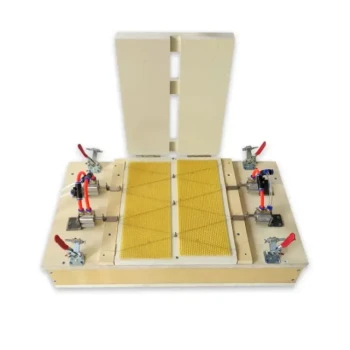
Beeswax is the colony’s construction material and comb foundation tools are its efficiency multiplier. Worker bees convert sugars from nectar into liquid wax, which is secreted through four pairs of abdominal wax glands and formed into flakes. They chew and shape this wax into hexagonal comb that supports brood rearing, pollen storage, honey storage, and daily colony life. In commercial hives, pre-formed foundation sheets and specialized frame-assembly tools reduce the energy and labor required to build usable comb.
Comb is essential biological infrastructure, but producing it from raw nectar is metabolically expensive. High-quality foundation sheets and precision tools provide bees with a structural template, helping colonies build uniform comb faster while allowing more energy to support brood development, foraging, and honey production.
Why Worker Bees Produce Beeswax
Beeswax Builds the Colony’s Infrastructure
Young worker bees produce wax from specialized glands on the underside of their abdomen. The liquid secretion hardens into thin flakes, which workers soften with their mandibles and assemble into comb.
The resulting comb provides organized space for brood rearing, pollen storage, honey storage, and worker activity. Its repeating hexagonal cells combine structural strength with efficient use of material and space.
Wax Production Requires Significant Energy
Bees must convert nectar sugars into beeswax, a process that consumes substantial metabolic energy and honey. The colony must also maintain suitable internal conditions while workers secrete and manipulate the wax.
When bees build all comb from scratch, this biological workload can slow comb construction and colony expansion. The energy committed to wax production is energy that cannot be directed immediately toward nectar collection, brood care, or honey storage.
Worker Bees Transform Wax Into Usable Cells
Wax flakes are not immediately suitable for construction. Workers chew and manipulate them until the material becomes pliable enough to form the walls and bases of hexagonal cells.
This coordinated process allows the colony to create comb with consistent geometry. However, it also requires time, labor, and a sustained supply of nectar or stored honey.
How Comb Foundation Improves Hive Efficiency
Foundation Provides a Construction Template
Comb foundation sheets contain embossed hexagonal cell bases that guide bees during construction. Instead of establishing every cell from an unstructured surface, workers extend the existing pattern into organized comb.
This template encourages uniform cell alignment and sizing, helping beekeepers maintain predictable comb across standardized hive frames.
Foundation Reduces the Bees’ Biological Workload
Pre-formed wax or plastic foundation does not eliminate all bee construction activity. Bees still add wax, reinforce the sheet, and extend the embossed bases into complete cells.
It does, however, reduce the amount of new wax the colony must synthesize. That allows workers to redirect more energy toward brood rearing, nectar foraging, and honey production.
Uniform Comb Simplifies Colony Management
Standardized comb makes it easier to inspect brood, evaluate stores, replace aging frames, and manage colony expansion. Consistent cell structure also supports more predictable use of hive equipment.
For commercial apiaries, this uniformity has operational value beyond the individual hive. It improves compatibility across frames, supers, replacement schedules, and extraction workflows.
How Specialized Foundation Tools Support Commercial Operations
Frame-Assembly Equipment Improves Consistency
Specialized machinery can support the production and assembly of hive frames, including the installation of wax or plastic foundation. Precision assembly helps maintain consistent frame dimensions and secure foundation placement.
A stable foundation is less likely to shift, bow, or detach during transport, hive handling, and comb construction. This reduces rework and improves the reliability of prepared frames supplied to apiaries.
Wiring and Embedding Tools Secure Wax Foundation
Wax foundation is commonly installed into frames using wiring and embedding equipment. These tools help connect the foundation to the frame so that it remains properly positioned as bees build and reinforce the comb.
Secure installation is particularly important when finished frames will later be handled repeatedly or placed in centrifugal honey extractors.
Foundation-Processing Machinery Supports Larger Volumes
Commercial suppliers and beekeeping operations require repeatable processing across substantial quantities of foundation and frames. Dedicated equipment increases throughput while reducing dependence on slow, inconsistent manual assembly.
For distributors and B2B resellers, a coordinated product portfolio that includes foundation sheets, frames, wiring tools, embedding tools, and processing machinery can simplify procurement for commercial customers.
Stronger, More Uniform Comb Supports Extraction
Foundation-guided comb tends to be more organized and mechanically consistent than irregularly built comb. This matters when frames are exposed to the forces of high-speed centrifugal extraction.
Better structural support can reduce comb damage, equipment interruptions, and handling losses. The result is a more predictable workflow from hive installation through honey extraction.
Understanding the Trade-offs
Foundation Does Not Replace Colony Management
Foundation is an efficiency aid, not a substitute for sound beekeeping. Bees still need suitable nutrition, temperature conditions, colony strength, and appropriate hive management to draw and maintain comb successfully.
Poor timing or weak colonies may result in slow foundation acceptance, incomplete construction, or uneven comb.
Wax and Plastic Foundation Serve Different Priorities
Wax foundation aligns closely with the material bees naturally use, while plastic foundation offers a durable, standardized substrate. The appropriate choice depends on the beekeeper’s requirements for handling, durability, maintenance, and colony acceptance.
Suppliers should present these options according to the customer’s operating conditions rather than treating one material as universally superior.
Equipment Quality Affects the Efficiency Benefit
Low-precision tools can create loose wiring, misaligned foundation, inconsistent frame dimensions, or weak attachment points. These defects can offset the labor savings that specialized equipment is intended to provide.
For commercial buyers, product compatibility, dimensional accuracy, service support, and replacement-part availability are as important as the initial purchase price.
Standardization Requires Consistent Supply
Uniform comb management depends on receiving foundation and frames with stable specifications over time. Variations in cell pattern, frame dimensions, or material quality can complicate hive management and equipment compatibility.
A dependable supplier with responsive service and efficient fulfillment therefore contributes directly to operational continuity.
Making the Right Choice for Your Goal
The most effective sourcing strategy connects the biological needs of the colony with the practical requirements of the apiary.
- If your primary focus is honey yield: Use quality foundation to reduce unnecessary wax production and help workers direct more energy toward nectar collection and honey storage.
- If your primary focus is colony expansion: Install properly prepared foundation in strong colonies to accelerate organized comb construction and support brood-rearing capacity.
- If your primary focus is standardized hive management: Select foundation and frames with consistent cell patterns and dimensions across the full equipment portfolio.
- If your primary focus is extraction efficiency: Prioritize secure foundation installation, strong frames, and comb designs capable of withstanding centrifugal extraction.
- If your primary focus is commercial procurement: Work with a supplier that can provide foundation, frames, assembly tools, processing equipment, rapid response, and reliable order fulfillment through one coordinated channel.
Understanding the biological cost of wax production makes the commercial value of standardized foundation and precision comb tools clear: they convert colony energy and equipment reliability into more efficient hive operations.
Summary Table:
| Aspect | Biological Role of Beeswax | Specialized Foundation Tools |
|---|---|---|
| Primary Function | Provides structural comb for brood, pollen, and honey storage | Provides pre-formed template for bees to build uniform comb faster |
| Energy Cost | High: bees must consume honey to produce wax | Low: reduces the amount of new wax bees need to synthesize |
| Impact on Colony | Essential but metabolically expensive | Conserves energy for brood rearing and honey production |
| Commercial Benefit | Uniform comb supports hive management and extraction | Standardized frames and secure foundation reduce labor and rework |
| Key Trade-off | Requires strong colony and good nutrition | Equipment quality and material choice affect success |
Maximize your apiary's efficiency with HONESTBEE's one-stop sourcing for premium beeswax foundation, frame assembly tools, and processing machinery. From wiring and embedding equipment to durable plastic foundation, our full-spectrum portfolio ensures consistent quality, rapid delivery, and dedicated support for distributors and commercial beekeepers. Ready to streamline your operations and boost honey yields? Contact us today to discuss your bulk requirements and discover how our OEM/ODM capabilities and professional expertise can drive your success.
Related Products
- Manual Beeswax Comb Foundation Machine Wax Foundation Mill Embossing Machine
- Notebook Style Beeswax Foundation Mould Wax Foundation Mold
- Professional Frame Comb Fork and Lifter for Efficient Handling
- Beeswax Foundation Sheets Beehive Foundation for Wholesale
- Food Grade Plastic bee Foundation for Bee Frames
People Also Ask
- What are the primary technical challenges faced by beeswax foundation production machinery? Tackling Lipophilic Residues
- What are the advantages of implementing a pulley and belt drive system in beeswax foundation machinery? Master Quality.
- What role does a foundation machine play in the recycling and resource utilization of beeswax within an apiary?
- Why is the introduction of a beeswax foundation machine considered an important step in improving honey yields?
- How do beeswax foundation machines facilitate the internal recycling of beeswax? Build a Self-Sustaining Apiary