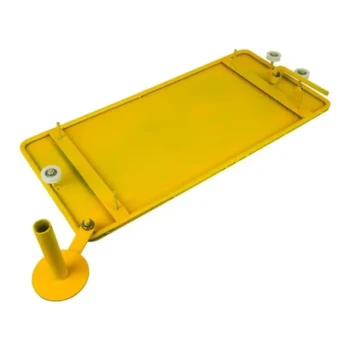
A hive division board lets one hive body function as two separate colony spaces. By creating an internal partition with an entrance for the upper colony, it enables beekeepers to split colonies, manage queens, and operate two colonies within the same hive stack. This can increase equipment utilization and support stronger seasonal honey production when colony strength, timing, and forage conditions are suitable.
A division board is both a colony-management tool and a space-efficiency solution. It can support colony splits and two-queen configurations, but it does not automatically increase honey yield; results depend on sound management, adequate forage, and healthy colonies.
How a Hive Division Board Works
Creating Two Colony Compartments
The board matches standard hive-box dimensions and separates the hive body into two distinct sections. Each section can house an independent colony while remaining within the same overall hive stack.
The lower colony uses the hive's primary entrance. The upper colony enters through the cutout built into the raised rim of the division board.
Maintaining Colony Separation
The division board acts as a physical barrier between the colonies. Its design helps prevent the two units from freely mixing while allowing the beekeeper to manage them as separate colonies.
Canvas may be secured to the board to help hold it in place. A separate canvas layer can also be positioned over the brood nest to assist with moisture management.
Supporting Standardized Hive Management
Because the board is designed to fit standard hive dimensions, it can be integrated into existing hive systems. For distributors and beekeepers, compatibility with common hive formats is important because it simplifies sourcing, inventory planning, and replacement.
What It Does for Colony Management
Facilitating Colony Splits
A division board allows a strong colony to be divided into two units. This can help beekeepers expand colony numbers, produce replacement colonies, or reduce overcrowding when a hive has substantial population growth.
The upper and lower units must still receive appropriate management, including adequate food, space, ventilation, and queen status.
Enabling Queen Management
The board creates a practical structure for managing queens separately. Beekeepers can use the two compartments to establish, preserve, or evaluate queen-right and queenless units according to their management plan.
The board itself does not control queen quality or colony performance. It provides the physical arrangement that makes more advanced queen-management methods possible.
Supporting Two-Queen Configurations
In a two-queen setup, two colonies are maintained in separate compartments within the same hive stack. The arrangement can allow the beekeeper to concentrate substantial bee populations near the honey-producing area during the active season.
This approach requires careful control of colony separation and queen status. It is an advanced management method rather than a guaranteed production shortcut.
How It Can Influence Honey Production
Improving Equipment Utilization
One hive stack can accommodate two colony units, reducing the amount of separate hive space required for certain operations. This can improve the productive use of hive bodies, covers, stands, and transport capacity.
For commercial operators and resellers, that efficiency can make compatible division boards valuable additions to a broader hive-equipment portfolio.
Building Seasonal Colony Strength
When correctly timed, colony division and two-queen management can help maintain strong bee populations during a major nectar flow. More effective population management can support honey storage, provided the colonies have sufficient forage and supering capacity.
Honey production remains dependent on weather, nectar availability, colony health, queen performance, and beekeeper timing.
Connecting Hive Capacity to Output
A hive provides the controlled physical environment in which bees reproduce, forage, and store honey. Division boards expand how that fixed space can be organized, but they do not replace the need for adequate hive capacity and properly sized honey-storage areas.
The board is therefore best understood as a management component that can improve the use of hive infrastructure, not as a standalone honey-production device.
Understanding the Trade-offs
Higher Management Complexity
Two colonies in one stack require more precise inspection and recordkeeping. The beekeeper must track each unit's queen status, population, food reserves, brood condition, and entrance activity.
Poor identification or inconsistent inspections can cause management errors that weaken one or both colonies.
Food and Energy Requirements
Divided colonies may have smaller individual populations and limited food reserves, particularly during periods of poor weather or floral gaps. Supplemental feeding may be necessary to maintain colony strength and support continued queen egg-laying.
A division board feeder is a different product from a division board. It is installed inside the hive to provide sugar syrup or other supplemental nutrition; the division board itself primarily separates colony spaces.
Moisture and Ventilation Considerations
Adding internal partitions and coverings changes air movement within the hive. Moisture-control practices must be considered alongside the board's installation, especially in cool or wet conditions.
Canvas can help secure equipment or manage the brood-nest environment, but it should be used as part of a broader ventilation and moisture-management approach.
Not Suitable for Every Operation
A division board may provide limited value when the beekeeper does not need colony splitting, queen management, or two-queen configurations. For simple single-colony management, standard hive equipment may be more appropriate.
Buyers should verify dimensions, rim design, entrance configuration, material quality, and compatibility before purchasing or reselling the product.
Choosing and Supplying the Right Product
Prioritizing Compatibility
Distributors and wholesalers should source boards that match the hive standards used by their customers. Dimensional consistency is essential because a poor fit can compromise colony separation, entrance function, and hive stability.
Product specifications should clearly identify the compatible hive format and the location of the upper entrance cutout.
Matching Products to Use Cases
A division board should be positioned for colony splitting, queen management, and two-queen systems. A division board feeder should be positioned for supplemental feeding during nectar shortages or adverse weather.
Clear product differentiation helps B2B buyers assemble a complete hive-management range without confusing structural equipment with feeding equipment.
Valuing Reliable Fulfillment
Beekeepers often need division boards alongside hive bodies, feeders, covers, frames, and other seasonal equipment. Suppliers with a full-spectrum portfolio, rapid response, technical expertise, and efficient order fulfillment can provide greater practical value than suppliers offering the board as an isolated item.
Reliable availability is particularly important before colony-splitting periods and major honey flows.
Applying This to Your Operation
A division board is most valuable when its physical separation function matches a defined colony-management objective.
- If your primary focus is colony expansion: Use a compatible division board to create separate colony units within one hive stack, while planning for independent queen, food, and population management.
- If your primary focus is seasonal honey production: Consider a two-queen configuration only when you have strong colonies, adequate forage, sufficient storage capacity, and the expertise to manage the added complexity.
- If your primary focus is nutritional support: Select a division board feeder rather than a standard division board when the immediate need is syrup feeding during floral gaps or poor weather.
- If your primary focus is distribution or resale: Source standardized boards with clear specifications and pair them with complementary hive bodies, feeders, and accessories for dependable one-stop supply.
Used with the right hive system and management plan, a division board turns internal hive space into a more flexible tool for colony growth, queen control, and productive honey operations.
Summary Table:
| Feature | Description |
|---|---|
| Colony Separation | Divides a hive body into two independent compartments with separate entrances. |
| Colony Splits | Facilitates creating new colonies from a strong hive. |
| Queen Management | Allows separate queen rearing, mating, and storage. |
| Two-Queen Configurations | Enables maintaining two colonies in one stack for stronger populations. |
| Equipment Utilization | Makes efficient use of hive components, saving space and cost. |
| Honey Production | Can support honey yield when combined with sound management and forage timing. |
| Management Complexity | Requires precise monitoring and feeding; not a standalone yield booster. |
Maximize your apiary's productivity with HONESTBEE's premium hive division boards. As a leading wholesale supplier, we offer a full spectrum of beekeeping tools and machinery, ensuring reliable supply and fast delivery for your operation. Whether you're a distributor seeking high-margin products with OEM/ODM support or a beekeeper optimizing your hive layout, our expertise and responsive service are here to support you. Contact us today to discuss your needs and get a custom quote! Get in Touch
Related Products
- Solid Bottom Board Australian Pine Wood Langstroth Bottom Board for Wholesale
- Langstroth Solid Bottom Board for Beekeeping
- HONESTBEE Wooden Bee Escape Board with Triangle Mesh Design for Beekeeping
- Australian Pine Wood Langstroth Screen Bottom Board for Wholesale
- HONESTBEE Durable Frame Wiring Board with Integrated Tensioner
People Also Ask
- In what conditions is a solid bottom board preferred over a screened bottom board? Maximize Hive Heat and Treatment
- What is the primary function of a solid bottom board on a beehive? Key Benefits for Hive Stability and Insulation
- What are the characteristics of a solid bottom board? A Guide to Hive Foundation & Climate Control
- How is the wood of the solid bottom board treated to enhance its durability? Discover the 100% Beeswax Dipping Secret
- What is a solid bottom board and in what climate is it most beneficial? Essential Guide for Cold Climate Beekeeping