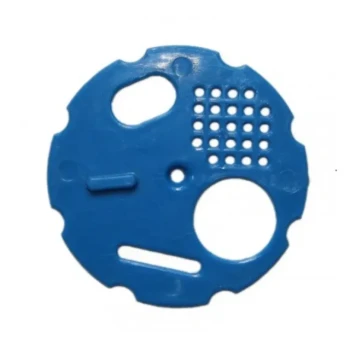
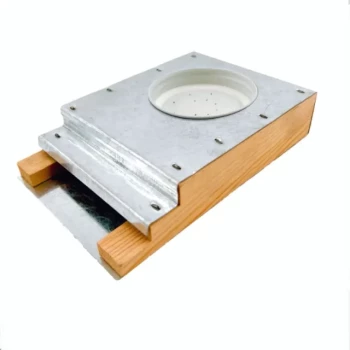
Research indicates that wild honey bees specifically prefer a hive entrance size between 10 and 15 square centimeters (approximately 1.5 to 2.5 square inches). This biological preference is significantly smaller than the standard openings found in commercial beekeeping equipment.
Wild honey bees instinctively select nest sites with small, defensible openings rather than the large gaps found in managed hives. To mimic this natural preference, the entrance area should be limited to approximately 1.5 to 2.5 square inches.
The Gap Between Standard Equipment and Natural Preference
Standard Hive Dimensions
Most commercially available hives are designed with convenience and maximum ventilation in mind, rather than the bees' natural selection criteria.
A standard 8-frame hive typically features a wide-open entrance of approximately 9 square inches.
A 10-frame hive is even larger, often presenting an opening of 10.5 square inches.
The Wild Preference
In contrast, research into wild colonies reveals a strong preference for much tighter security.
Wild bees actively seek out cavities with entrances measuring only 10 to 15 square centimeters.
Converted to imperial measurements, this is roughly 1.5 to 2.5 square inches—a fraction of the size of a man-made hive entrance.
Adjusting Your Hive Configuration
Replicating the Natural Entrance
To align a managed hive with the biological preferences of wild honey bees, you must manually alter the equipment.
Leaving a bottom board entrance wide open creates an opening far larger than a swarm would naturally choose.
The 2-to-3 Inch Rule
The most practical way to replicate the preferred surface area is by reducing the width of the opening.
You should block off the majority of the hive entrance, leaving an opening of only 2 to 3 inches in width.
This simple modification reduces the total square footage of the opening to fall within the ideal 1.5 to 2.5 square inch range.
Understanding the Trade-offs
Equipment Design vs. Bee Behavior
It is crucial to understand that standard beekeeping equipment is often designed for the beekeeper's ease of manipulation and maximum honey production, not necessarily the colony's preference.
The "Wide Open" Pitfall
Leaving a hive entrance wide open (9+ square inches) exposes the colony to a larger area to defend.
While this might theoretically increase airflow, it contradicts the specific habitat selection criteria wild bees use to survive.
Making the Right Choice for Your Goal
When setting up swarm traps or managing colonies for longevity, entrance size is a critical variable.
- If your primary focus is attracting wild swarms: Reduce the entrance opening to between 1.5 and 2.5 square inches (approx. 2-3 inches wide) to match their instinctual search criteria.
- If your primary focus is standard hive management: Be aware that standard bottom boards offer entrances 4 to 5 times larger than what bees prefer in nature, requiring you to intervene with entrance reducers.
By restricting the entrance to a mere 2 to 3 inches in width, you align your artificial hive with the deep-seated evolutionary preferences of the honey bee.
Summary Table:
| Feature | Wild Bee Preference | Standard 8-Frame Hive | Standard 10-Frame Hive |
|---|---|---|---|
| Entrance Area | 1.5 – 2.5 sq. in. | ~9.0 sq. in. | ~10.5 sq. in. |
| Entrance Width | 2 – 3 inches | Full width of hive | Full width of hive |
| Primary Benefit | Defense & Security | Maximum Ventilation | Maximum Ventilation |
| Suitability | Ideal for Swarm Traps | Commercial Production | Commercial Production |
Upgrade Your Apiary with HONESTBEE Precision Equipment
At HONESTBEE, we understand the science behind bee behavior. Whether you are a commercial apiary or a distributor, we provide the high-quality beekeeping tools and machinery needed to optimize colony health and efficiency. From hive-making machines to specialized entrance reducers and honey-filling systems, our comprehensive wholesale offering ensures you have the professional-grade hardware required for success.
Ready to scale your beekeeping operation with industry-leading equipment? Contact us today to explore our full catalog and wholesale pricing
Related Products
- Multi-Functional Sliding Hive Entrance for Beekeeping
- Multi-Functional Rotary Hive Entrance Disc for Beekeeping
- Professional Reversible Beehive Hive Entrance
- Beehive Entrance Reducer Guardian Metal Hive Entrance for Bees
- Steel Round Disc Entrance Reducer for Flexzion Bee Hive Nuc Box Gate
People Also Ask
- What roles does the hive entrance (piquera) play in beehive management and colony health? Essential Guide for Pro Apiaries
- Where is the hive entrance typically located? Optimize Your Hive's Health and Honey Production
- What role does the size of the entrance play in hive ventilation? Master Beehive Climate Control
- What is the best entrance for a bee hive? Maximize Colony Health & Honey Production
- What happens if you block the entrance to a bee hive? Avoid This Dangerous Mistake