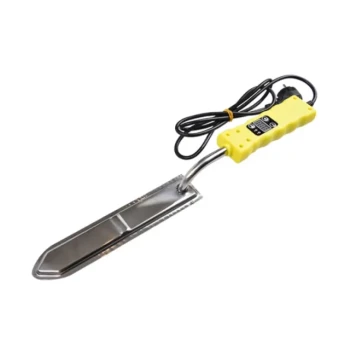
The primary mechanism of action for a thermometer in honeybee queen rearing is to function as a critical feedback device for environmental regulation. By providing accurate data on the internal hive temperature, it enables technicians to immediately adjust ventilation or insulation to stabilize the colony's microclimate.
Honeybee queen cells are highly sensitive to thermal instability, where even minor deviations can compromise development. The thermometer serves as the essential diagnostic trigger for human intervention, ensuring the environment remains within the specific range required to prevent larval death and developmental deformities.
The Biological Necessity of Thermal Stability
Sensitivity of Queen Cells
The development of a honeybee queen is a delicate biological process. Unlike adult bees, developing larvae and pupae inside queen cells lack the ability to thermoregulate effectively on their own.
The Consequence of Fluctuation
The primary reference highlights that severe temperature fluctuations are detrimental. If the hive becomes too hot or too cold, the immediate risks include larval death or permanent developmental deformities in the emerging queens.
The Role of Precision
Maintaining an ideal temperature range is not optional; it is a prerequisite for successful rearing. The thermometer provides the quantitative evidence needed to confirm that this biological requirement is being met.
The Thermometer as a Management Tool
Monitoring Internal Conditions
The thermometer acts as the technician's eyes inside the colony. It transforms the invisible variable of heat into actionable data, allowing for the continuous monitoring of the internal hive environment.
Triggering Timely Adjustments
Data without action is useless. The core function of the thermometer is to signal when to adjust ventilation. If the reading is too high, airflow must be increased to dissipate heat.
Managing Insulation Measures
Conversely, if the thermometer indicates a drop in temperature, it signals the need for insulation measures. This ensures that the colony retains the metabolic heat generated by the worker bees to warm the queen cells.
Common Pitfalls and Limitations
The Risk of Passive Reliance
A thermometer is a monitoring device, not a control device. It cannot physically alter the temperature; it relies entirely on the technician to interpret the reading and physically alter the hive setup (e.g., adding insulation).
Placement Accuracy
While not explicitly detailed in the reference, the mechanism relies on the thermometer measuring the internal temperature accurately. An incorrect reading due to poor placement could lead to misguided adjustments in ventilation or insulation, inadvertently causing the fluctuations you are trying to avoid.
Making the Right Choice for Your Goal
To effectively utilize temperature monitoring in your queen rearing operation, consider your specific objectives:
- If your primary focus is preventing deformities: Use the thermometer to detect rapid spikes in heat, prompting immediate increases in hive ventilation.
- If your primary focus is maximizing survival rates: Monitor for low-temperature dips during colder nights to determine exactly when supplementary insulation is required.
Success in queen rearing ultimately depends on using the thermometer not just to watch the temperature, but to actively maintain the stability required for life.
Summary Table:
| Feature | Function in Queen Rearing | Benefit to Colony |
|---|---|---|
| Data Monitoring | Tracks real-time internal microclimate | Prevents thermal instability and larval shock |
| Ventilation Trigger | Signals when to increase airflow | Avoids overheating and developmental deformities |
| Insulation Guide | Identifies when to add thermal barriers | Maintains metabolic heat during cold fluctuations |
| Risk Mitigation | Provides quantitative environmental data | Minimizes the risk of queen cell loss or defects |
Elevate Your Apiary's Success with HONESTBEE
Precision is the backbone of professional queen rearing. At HONESTBEE, we specialize in supporting commercial apiaries and distributors with high-grade beekeeping tools, specialized machinery, and essential consumables designed for peak performance.
Whether you need advanced hive-making equipment, honey-filling automation, or high-quality hardware to maintain your colonies, we provide the comprehensive wholesale solutions your business requires. Partner with us to secure the tools your operation deserves.
Contact HONESTBEE Today for Wholesale Inquiries
References
- Joice J.I. Rompas, R. T.D. Maramis. PENGGUNAAN METODE QUEEN REARING TERHADAP PEMBENTUKAN SEL RATU APIS MELLIFERA UNTUK PENGEMBANGAN PERLEBAHAN. DOI: 10.35792/zot.35.2.2015.8347
This article is also based on technical information from HonestBee Knowledge Base .
Related Products
- Electric Hot Honey Uncapping Knife with Thermostat
- Professional Thermostatic Conical Honey Melter
- Digital Honey Refractometer for Precision Measurement of Optimal Honey Quality
- Precision Honey Refractometer Instrument for Quality Assessment
- Professional Electric Honey Uncapping Knife with Heated Digital Temperature Control for Beekeeping
People Also Ask
- What are the drawbacks of using an electric knife for uncapping honey frames? Cost and Power Constraints Explained
- How should an electric uncapping knife be utilized? Master Efficient Honey Extraction with Heated Precision
- What is an electric uncapping knife and how is it used? Master Faster Honey Extraction with Heat
- What are the advantages and disadvantages of using an electric knife for uncapping honey frames? Boost Extraction Speed
- What are the benefits of using electric heated uncapping knives or automatic uncapping machines? Maximize Honey Yields