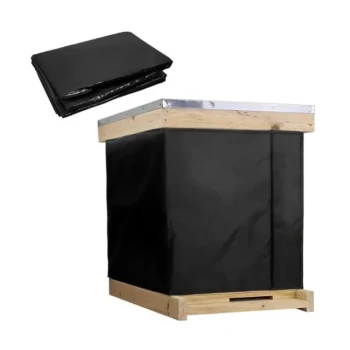
Meshed covers are a critical protective necessity for the successful long-distance transport of honeybee colonies. These consumables serve two distinct but equally vital functions: they act as a physical barrier to prevent the escape of bees and as a physiological safeguard by allowing maximum airflow. Without this specialized ventilation, the hive cannot maintain the internal micro-environment required for survival during transit.
While containment is the obvious function, the critical value of a meshed cover is thermal regulation. By allowing heat to escape, these covers prevent the internal temperature spikes that lead to honey comb collapse and colony death.
The Physiology of Hive Transport
To understand why meshed covers are necessary, one must look beyond simple containment. The primary challenge in transporting bees is managing the colony's internal climate.
Regulating the Micro-Environment
A honeybee colony is a heat-generating organism, especially when stressed by movement.
The hive relies on a specific internal micro-environment to function. Meshed covers facilitate the heavy ventilation required to stabilize this environment against external changes.
Preventing Heat-Induced Stress
As colonies are moved across different ecological regions, ambient temperatures and humidity levels fluctuate.
Without the free airflow provided by mesh, heat accumulates rapidly inside the hive. This heat-induced stress is a primary cause of mortality during transport.
Structural Integrity of the Hive
The necessity of ventilation extends to the physical structure of the hive itself, not just the biological health of the bees.
Preventing Comb Breakage
Honeycombs are made of wax, which softens significantly as temperatures rise.
If a hive overheats due to poor ventilation, the combs lose their structural integrity. Meshed covers prevent this heat buildup, thereby reducing the risk of combs breaking and collapsing during the vibration of transport.
Reducing Mortality Rates
The combination of loose bees, collapsing combs, and extreme heat is catastrophic.
By mitigating these factors through proper airflow, meshed covers directly correlate to lower mortality rates. They ensure the colony arrives intact rather than suffering mass casualties.
Risks and Considerations
While meshed covers are the standard solution, it is important to understand the specific risks they mitigate to use them effectively.
The Pitfall of Sealed Transport
A common misconception is that securing the hive is the only priority.
Using solid covers instead of mesh seals heat inside. This creates a "greenhouse effect" that can destroy a colony in a very short period, regardless of the outside temperature.
Navigating Ecological Changes
Long-distance transport often involves crossing into different climate zones.
A cover that provides insufficient ventilation may work in a cool region but will fail as the transport moves into a warmer ecological zone. Meshed covers provide a buffer against these environmental transitions.
Ensuring Safe Colony Transit
Using the correct covering material is the difference between delivering a productive colony and a dead one.
- If your primary focus is Colony Security: Use meshed covers to create an escape-proof seal that keeps the bees contained within the hive boxes.
- If your primary focus is Colony Survival: Prioritize the airflow capacity of the mesh to prevent heat accumulation, ensuring honeycombs remain solid and stress levels remain low.
The meshed cover is not just a lid; it is the life-support system that allows a hive to breathe during the stress of relocation.
Summary Table:
| Feature | Function of Meshed Cover | Risk Without Mesh (Solid Cover) |
|---|---|---|
| Temperature Control | Facilitates maximum airflow and heat dissipation | Internal heat spikes leading to colony death |
| Containment | Provides a secure, escape-proof physical barrier | Risk of loose bees during transit |
| Comb Integrity | Prevents wax softening by stabilizing the micro-climate | Honeycomb collapse and structural failure |
| Stress Management | Mitigates stress from ecological/climate changes | High mortality rates due to heat-induced stress |
| Ventilation | Constant oxygen supply and humidity regulation | Greenhouse effect and suffocation |
Secure Your Apiary's Growth with HONESTBEE
Transporting honeybee colonies across long distances requires professional-grade equipment that guarantees both security and survival. At HONESTBEE, we specialize in supporting commercial apiaries and distributors with a comprehensive range of high-quality beekeeping tools, machinery, and essential consumables.
From ventilation-optimized meshed covers and durable hive-making machinery to honey-filling systems and industry-specific hardware, our wholesale offerings are designed to enhance your operational efficiency. Whether you are scaling a commercial pollination business or supplying the beekeeping industry, HONESTBEE provides the specialized tools you need to succeed.
Ready to upgrade your beekeeping equipment? Contact us today to explore our wholesale catalog!
References
- Teweldemedhn Gebretinsae Hailu, Martin Hasselmann. Rapid transformation of traditional beekeeping and colony marketing erode genetic differentiation in Apis mellifera simensis, Ethiopia. DOI: 10.1007/s13592-022-00957-y
This article is also based on technical information from HonestBee Knowledge Base .
Related Products
- Professional Square Folding Wire Mesh Beekeeping Veil
- High-Definition Beekeeper Hat with Round Veil Mesh for Beekeeping
- Inner Beehive Cover for Beekeeping Bee Hive Inner Cover
- Telescopic Beehive Outer Cover Lid Roof with Galvanised Sheeting for Langstroth Hive and Beehive Outer Cover
- Professional Insulated Winter Hive Wrap for Beekeeping
People Also Ask
- Why is beekeeping veil mesh stiffness important? Ensure Maximum Safety with Rigid Protective Barriers
- What are the differences between round, square, and fencing veils? Choose the Right Protection for Your Apiary
- What are the different styles of beekeeping veils? A Guide to Safety & Visibility
- What types of head protection are available for beekeepers? Choose the Right Veil for Safety & Confidence
- What are the primary differences between a round beekeeping veil and a fencing veil? Choose the Right Protection