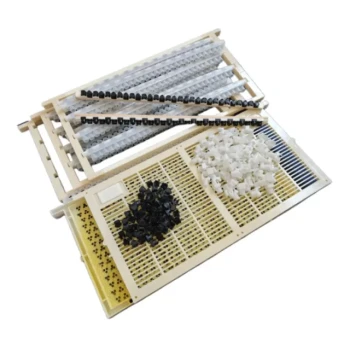
The primary function of a specialized grafting needle is the precise transfer of 1 to 2-day-old larvae from their original honeycomb cells into artificial wax cups. This tool is engineered to move both the delicate larva and a small amount of its original royal jelly simultaneously, minimizing physical trauma to ensure the bee colony accepts the new queen cell.
Core Takeaway The grafting needle is not merely a transport tool; it is a mechanism for larval survival. By preventing injury during the transfer, the needle ensures the "acceptance rate" of the colony remains high, which is the direct trigger for mass royal jelly secretion.
The Mechanics of Precision Grafting
Targeted Larval Selection
The needle is designed specifically for handling extremely young larvae, typically between 24 and 48 hours old.
At this stage, the larvae are microscopic and highly fragile. The needle's geometry allows the operator to lift them without applying crushing force.
Maintaining the Micro-Environment
According to established production protocols, the needle does not just move the larva; it also scoops a small amount of the original jelly surrounding it.
Transplanting this original jelly helps maintain the moisture balance around the larva. It also preserves the scent profile, which is critical for reducing rejection by nurse bees.
Integration with Wet Grafting
This tool is often used in conjunction with "wet grafting," where artificial cups are pre-coated with diluted royal jelly.
The needle allows for the smooth deposit of the larva onto this bed of jelly, preventing dehydration and ensuring immediate feeding capabilities.
Why Design Specificity Matters
Minimizing Physical Trauma
The tip of a specialized grafting needle—often made of flexible plastic, bamboo, or high-precision stainless steel—is designed to be smooth and pliable.
This flexibility prevents damage to the larva's delicate respiratory system or outer skin during the lifting process. Even microscopic abrasions can cause the colony to detect the larva as "defective" and remove it.
Maximizing Colony Acceptance
The ultimate goal of using this specialized tool is to increase the acceptance rate.
If the larva is injured during transfer, the worker bees will clean out the artificial cup rather than secreting royal jelly into it. A precise needle ensures the larva remains viable, triggering the nurse bees to flood the cell with royal jelly.
Understanding the Trade-offs
Skill Dependency
While the tool is specialized, it relies heavily on the manual dexterity of the operator.
A high-quality needle cannot compensate for poor technique; unsteady hands can still crush larvae or fail to pick up enough original jelly, leading to low yields.
Material Selection
There is often a trade-off between rigidity and flexibility in needle design.
Stainless steel needles offer high precision and durability for volume production but require a steeper learning curve to avoid injuring larvae compared to more flexible, albeit less durable, plastic or tongue-depressor styles.
Making the Right Choice for Your Goal
To maximize your royal jelly production, select your tools based on your specific operational scale.
- If your primary focus is maximum yield: Prioritize stainless steel needles that allow for the precise transfer of original jelly alongside the larva to boost acceptance rates.
- If your primary focus is operator training: Start with flexible tip needles, which are more forgiving and reduce the risk of accidental larval injury during the learning phase.
The success of royal jelly production is measured not by how many larvae you graft, but by how many survive to trigger secretion.
Summary Table:
| Feature | Purpose | Impact on Production |
|---|---|---|
| Precise Tip Geometry | Lift 1-2 day old larvae without trauma | Increases larval survival and acceptance rate |
| Original Jelly Scoop | Maintains moisture and scent profile | Reduces rejection by nurse bees |
| Material Flexibility | Prevents respiratory and skin damage | Minimizes colony 'cleaning' of artificial cups |
| Design Specificity | Integration with wet/dry grafting | Triggers immediate royal jelly secretion |
Elevate Your Royal Jelly Production with HONESTBEE
At HONESTBEE, we understand that commercial success in royal jelly production hinges on the survival of every larva. As a dedicated partner to commercial apiaries and distributors, we provide a comprehensive wholesale range of high-precision beekeeping tools, from advanced stainless steel grafting needles to honey-filling machinery and specialized industry consumables.
Whether you are scaling up your operations or outfitting your distribution network, our expertise in specialized hardware and bee-culture merchandise ensures you have the competitive edge. Contact us today to discover how our professional-grade equipment can enhance your colony acceptance rates and maximize your yields.
References
- Kayke Almeida Gloria, Letícia Liandra de Souza Barbos. BEEKEEPING IN THE LEGAL AMAZON: ROYAL JELLY PRODUCTION IN ARAGUAÍNA-TO. DOI: 10.22533/at.ed.813432421037
This article is also based on technical information from HonestBee Knowledge Base .
Related Products
- No Grafting Queen Rearing Kit: System for Royal Jelly Production and Queen Rearing
- Plastic Chinese Queen Grafting Tool for Bee Queen Rearing
- Stainless Steel Beekeeping Queen Grafting Tool for Honey Bee Rearing
- Black 2 Pack Beekeeper Queen Grafting Tool for Bee Queen Larva Transferring Needle
- Plastic Beekeeping Honey Bee Larvae Grafting Tools for Queen Rearing and Chinese Grafting
People Also Ask
- What is the primary function of a queen rearing kit? Eliminate Manual Grafting for Superior Bee Breeding
- How do specialized queen rearing kits and queen management tools improve the success rate of bee colony expansion?
- What are some alternative methods to grafting for queen cell production? Discover Graft-Free Queen Rearing Systems
- Are queen rearing systems generally suitable for all honeybee species? Master Efficient Breeding Methods
- Are queen rearing systems suitable for all beekeepers? Modern Tools for Every Experience Level