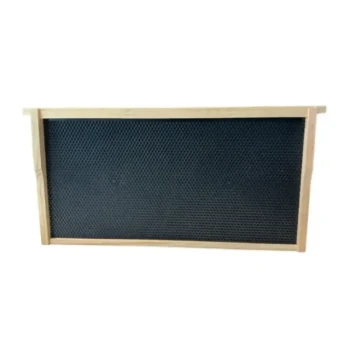
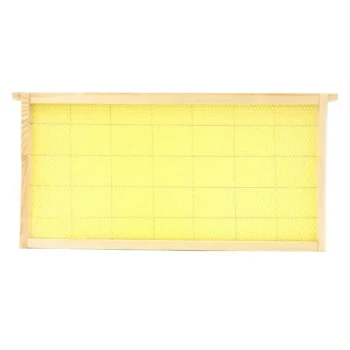
The right choice depends on whether your priority is faster comb production or lower long-term maintenance. Pure beeswax foundations are generally accepted and drawn by bees more quickly, making them attractive for rapid hive expansion, cut-comb production, and natural comb-building performance. Plastic foundations are stronger, easier to install, and better suited to repeated handling, mechanical extraction, and longer service life.
Choose pure beeswax when bee acceptance and fast comb drawing are most important. Choose plastic when durability, assembly speed, standardized handling, and long-term operational efficiency matter more.
Start With the Operating Objective
Match the foundation to the production method
Foundation thickness should reflect the intended output.
- Thin, lightly reinforced beeswax is suitable for cut-comb, chunk honey, and section honey.
- Thicker reinforced beeswax or plastic foundation is better for brood chambers, extracted honey, and frames exposed to repeated handling.
Thin foundation can sag or deform when placed under heavy loads or exposed to extractor forces.
Consider the planned service duration
For short-term or rapidly changing operations, the lower initial cost and strong bee acceptance of beeswax may be more valuable.
For commercial apiaries, rental operations, and long-term frame rotation, plastic can offer better value because it tolerates repeated installation, transport, extraction, and cleaning.
Compare Initial Cost and Assembly Labor
Plastic reduces preparation work
Snap-in plastic foundations can significantly shorten frame assembly time. They typically require less wiring, fewer support components, and less manual fitting than beeswax sheets.
This can be important for wholesalers, commercial beekeepers, and distributors managing large seasonal orders or rapid fulfillment requirements.
Beeswax requires more careful installation
Pure beeswax foundations are delicate and generally require reinforcement. Common support methods include:
- Horizontal wire, often using 28- or 30-gauge wire
- Support pins in the frame sidebars
- Wedge strips or compatible top-bar designs
- Careful embedding to prevent cracking or separation
The additional labor should be included in the total cost calculation rather than comparing material prices alone.
Evaluate total ownership cost
A practical cost comparison should include:
- Foundation and frame purchase price
- Assembly and wiring labor
- Installation tools and support materials
- Replacement frequency
- Damage during extraction and transport
- Cleaning, storage, and seasonal maintenance
A cheaper foundation may not be the lower-cost option if it requires frequent replacement or substantial preparation labor.
Evaluate Bee Acceptance and Comb-Building Speed
Beeswax usually provides faster acceptance
Natural beeswax carries familiar scents and presents embossed cell patterns that bees readily work with under normal nectar conditions.
This can help colonies draw comb more quickly, support faster hive expansion, and improve early-season productivity when timely comb construction is important.
Plastic may require stronger colony conditions
Bees can draw plastic foundation, but acceptance is often slower than with natural beeswax. Strong colonies, favorable weather, and a substantial nectar flow may be needed for efficient results.
Many beekeepers also apply an additional coating of beeswax to plastic foundation to improve acceptance.
Treat acceptance as an operational variable
Plastic foundation may perform well in an established apiary with strong colonies and reliable nectar flows. It can be less suitable where colonies are weak, the season is short, or rapid comb construction is essential.
Assess Structural Durability
Plastic performs well under repeated handling
Plastic foundations are resistant to bending, breakage, and deformation compared with unsupported or lightly reinforced beeswax.
They are particularly useful where frames are repeatedly:
- Loaded into mechanical extractors
- Transported between apiary locations
- Stored and reused
- Handled during inspections
- Processed in high-volume operations
Plastic is also rot-resistant and is not itself consumed by wax moth larvae, although surrounding wax and hive materials still require pest management.
Beeswax needs adequate reinforcement
Pure beeswax foundations can sag, crack, or detach if they are not properly supported. This risk increases in hot conditions, during transport, and when frames carry heavy honey stores.
For brood chambers and extracted-honey frames, reinforced beeswax is substantially more appropriate than thin, unreinforced sheets.
Consider the frame as a complete system
Foundation performance depends on compatibility with the frame design. Beeswax is traditionally paired with wooden wedge frames and support wiring, while plastic foundations commonly fit frames with grooved top bars or integrated mounting features.
The foundation should be evaluated together with the frame, hive box, extraction equipment, and storage system.
Account for Extraction and Handling Requirements
Mechanical extraction favors stronger foundations
Centrifugal forces in honey extractors place substantial stress on comb. Plastic foundations and properly wired, thicker beeswax sheets are better suited to repeated extraction cycles.
Thin or poorly supported beeswax may deform, break, or become detached during extraction.
Handling intensity changes the decision
Small-scale beekeepers who harvest manually may accept the greater fragility of beeswax. Commercial operators with standardized extraction, palletized transport, and frequent frame rotation generally benefit more from durable plastic systems.
Check extractor compatibility
Before standardizing a foundation, confirm that the frame dimensions and foundation structure are compatible with the extractor type and operating speed.
This is especially important for distributors and resellers, because a foundation that does not match common customer equipment can increase returns, complaints, and fulfillment complexity.
Consider Climate and Seasonal Conditions
Heat increases beeswax risk
Pure beeswax softens in high temperatures and becomes more vulnerable to sagging or distortion. Proper reinforcement, careful storage, and minimized exposure to heat are essential.
Plastic has different system-level considerations
Plastic components can withstand substantial physical abuse, but plastic hive bodies and covers may contribute to ventilation and moisture-management problems if the overall hive design is inadequate.
The foundation decision should therefore include local climate, hive ventilation, storage conditions, and transport exposure—not just the foundation material itself.
Seasonal nectar flow affects plastic performance
Plastic foundation is more dependent on strong colony conditions and adequate nectar availability for rapid drawing. In regions with short or inconsistent flows, beeswax may provide more reliable early acceptance.
Understand the Trade-offs
Plastic is not automatically the best commercial option
Plastic offers durability and faster assembly, but slower bee acceptance can delay comb construction. It may also require a beeswax coating and stronger colony management to perform efficiently.
Its business value is strongest where frames are reused frequently and handling or extraction damage is a major cost.
Beeswax is not automatically the most natural or economical option
Beeswax supports fast comb drawing, but it requires more installation skill and can suffer damage if inadequately reinforced. The labor and replacement costs may outweigh its lower material cost in a high-volume operation.
Its value is strongest where rapid acceptance, natural materials, and flexible comb production are priorities.
Avoid using one specification for every frame
A single foundation type may not be optimal across an entire apiary. Brood frames, extraction frames, and cut-comb frames have different structural requirements.
A mixed portfolio—such as beeswax for rapid expansion and cut-comb production, plus plastic or wired beeswax for extraction—may provide better operational results.
Apply the Decision to Purchasing and Supply
Standardize around customer requirements
Distributors and wholesalers should categorize products by:
- Frame size and compatibility
- Foundation thickness
- Wired or unwired construction
- Plastic or wooden frame system
- Brood, extraction, or cut-comb application
- Climate and transport conditions
- Expected order volume and delivery schedule
Clear product segmentation reduces selection errors and makes it easier to provide one-stop sourcing.
Prioritize reliable fulfillment
Commercial buyers often value consistent specifications as much as unit price. Stable supply, rapid response, technical support, and efficient order fulfillment are especially important before the peak installation and honey-production seasons.
A supplier that can provide multiple foundation types and frame systems may reduce procurement complexity and help buyers adapt to different apiary requirements.
Making the Right Choice for Your Goal
The best decision is based on the complete operating environment rather than the foundation price alone.
- If your primary focus is fast comb drawing and rapid hive expansion: Choose pure beeswax foundation, preferably in a compatible wooden frame and with appropriate reinforcement.
- If your primary focus is cut-comb or chunk honey production: Choose thinner beeswax foundation designed for the intended product and handle it carefully.
- If your primary focus is repeated mechanical extraction: Choose plastic foundation or thick, properly wired beeswax foundation that can withstand centrifugal forces.
- If your primary focus is minimal assembly labor: Choose snap-in plastic foundation and compatible frames.
- If your primary focus is long service life and low maintenance: Choose plastic foundation, while ensuring strong colony conditions and good hive ventilation.
- If your primary focus is flexible commercial supply: Source both systems and specify products by frame compatibility, foundation thickness, application, and seasonal demand.
The strongest foundation strategy matches bee acceptance, structural demands, labor availability, and total operating cost to the specific job each frame must perform.
Summary Table:
| Factor | Plastic Foundation | Pure Beeswax Foundation |
|---|---|---|
| Bee Acceptance | Slower; may need wax coating | Faster; natural scent attracts bees |
| Durability | High; resists bending and breakage | Low; requires reinforcement |
| Assembly Labor | Low; snap-in installation | High; requires wiring and support |
| Extraction Suitability | Excellent; withstands centrifugal force | Fair; thin sheets may deform |
| Cost Over Time | Lower maintenance and replacement | Higher due to fragility and labor |
| Best For | Repeated handling, mechanical extraction | Rapid comb drawing, cut-comb production |
Optimize your hive management with the right foundation choice. At HONESTBEE, we supply both plastic and pure beeswax foundations, plus compatible frames and hardware, to meet your apiary's specific needs. As a one-stop B2B partner for commercial apiaries and distributors, we offer OEM/ODM support, fast delivery, and dedicated service. Maximize your operational efficiency and profitability—contact HONESTBEE today for tailored solutions and bulk pricing.
Related Products
- Food Grade Plastic bee Foundation for Bee Frames
- Manual Beeswax Comb Foundation Machine Wax Foundation Mill Embossing Machine
- Notebook Style Beeswax Foundation Mould Wax Foundation Mold
- Beeswax Foundation Sheets Beehive Foundation for Wholesale
- Assembled Wooden Bee Frames with Plastic Foundation for Durability and Convenience by HONESTBEE
People Also Ask
- What are the advantages of using plastic foundation in a beehive? Boost Efficiency and Durability in Your Apiary
- What are the technical advantages of using bee frames with plastic foundation? Boost Hive Efficiency and Durability
- How is plastic foundation installed in a bee frame? Master the 'Bend and Pop' Technique for Better Efficiency
- How to get bees to accept plastic foundation? Apply a Wax Coating for Fast Comb Building
- What is the recommended method for re-waxing plastic bee frame foundation? Master the Foam Brush Technique