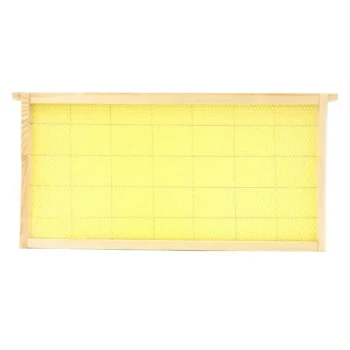
The key frame features are secure foundation anchoring, accurate frame spacing, and reinforcement against load and extraction forces. Commercial hive frames typically use a grooved top bar to hold the foundation sheet, self-spacing side bars to maintain consistent gaps, and pre-drilled wiring holes for horizontal support wires. Together, these features help bees build straight comb while allowing the finished frames to withstand the weight of honey and brood, routine handling, and mechanical extraction.
A commercially reliable frame must keep the foundation fixed, preserve uniform spacing, and prevent comb from sagging or breaking. These structural details improve colony management, harvesting efficiency, and product consistency across large orders.
What Makes a Frame Suitable for Comb Foundation
Grooved top bars anchor the foundation
A precision groove on the underside of the top bar provides a defined channel for inserting and securing the comb foundation sheet.
This prevents the foundation from shifting during installation and gives bees a centered starting point for building uniform comb. Wedge-style top bars may provide additional retention when foundation sheets include supporting hooks.
Foundation sheets provide a construction template
Wax or plastic foundation gives bees a pre-formed pattern for building straight, parallel cells within the frame.
Without this guide, colonies may build irregular or cross-connected comb that spans multiple frames, making inspection, removal, and harvesting more difficult.
Compatible bottom-bar designs accommodate expansion
A split bottom bar can be useful with deep foundation sheets because it allows limited expansion and helps reduce the risk of buckling.
The bottom-bar configuration should match the selected foundation type and the intended frame assembly method. Compatibility is especially important when supplying frames at commercial scale.
How Frames Maintain Structural Stability
Side bars provide self-spacing
Self-spacing side bars use wider upper sections—typically around 34 mm—or attached staple spacers to maintain consistent spacing between adjacent frames.
Uniform spacing helps prevent burr comb, supports predictable comb alignment, and allows beekeepers to remove and replace frames without damaging neighboring comb.
Wiring supports the wax foundation
Side bars commonly include pre-drilled wiring holes, often four holes per bar, for threading reinforcing wire through the frame.
Horizontal wire supports the foundation laterally and helps prevent sagging when the hive is exposed to heat, heavy honey loads, or the forces generated during centrifugal extraction.
Wire gauge and attachment must match the application
Commercial wired frames may use tinned wire, such as 28-gauge wire, threaded through the side-bar holes.
The wire must be tensioned and secured correctly. Loose wiring provides limited support, while excessive tension can distort the frame or damage the foundation during installation.
Frame joinery carries the overall load
Grooves and wiring cannot compensate for weak frame construction. Secure joinery and reliable fastening are necessary to keep the top bar, side bars, and bottom bar aligned under the combined weight of brood, honey, and wax.
For commercial supply, consistent assembly quality is as important as the nominal frame design. Poorly joined frames can twist during manipulation or fail under extraction loads.
Why Spacing and Alignment Matter Commercially
Straight comb improves hive handling
When foundation is centered and frames maintain consistent spacing, bees are more likely to build comb within the intended boundaries.
This makes frames easier to inspect, rotate, transport, and replace during routine hive management.
Uniform frames improve operational efficiency
Standardized frames allow beekeepers to use consistent equipment and handling procedures across multiple colonies and apiaries.
For distributors and wholesalers, dimensional consistency reduces compatibility problems and simplifies repeat ordering for commercial customers.
Stable comb supports harvesting and transport
Reinforced comb is less vulnerable to sagging, breakage, or detachment during removal from the hive and processing.
This is particularly important where frames will enter mechanical extractors or be transported through a broader supply chain before sale.
Understanding the Trade-offs
Wired frames require more assembly work
Wiring improves foundation support but adds labor, material requirements, and quality-control steps.
Suppliers should clearly specify whether frames are supplied assembled, wired, or ready for customer assembly.
Self-spacing designs reduce adjustment flexibility
Self-spacing side bars make frame positioning faster and more consistent, but they offer less flexibility than manually spaced frames when a beekeeper uses a different hive layout or spacing preference.
Product specifications should therefore identify the intended hive system and frame dimensions.
Foundation compatibility cannot be assumed
Grooved, wedge-style, and split-bottom configurations are not universally interchangeable with every wax or plastic foundation sheet.
A reliable product range should match top-bar retention, bottom-bar design, foundation depth, and wiring configuration rather than treating these components as independent options.
Comb honey requires specialized frame systems
Frames intended for comb honey production may use removable grids or other structures that encourage bees to fill defined sections with intact comb.
These systems are useful for harvesting comb and honey together, but they are a specialized product category and should not be confused with standard wired brood or super frames.
What Distributors Should Verify Before Sourcing
Structural specifications
Confirm the following details before placing a commercial order:
- Top-bar groove or wedge-retention design
- Side-bar width and self-spacing method
- Number and position of wiring holes
- Wire material, gauge, and tensioning method
- Bottom-bar configuration
- Joint construction and fastening method
- Compatibility with the intended foundation sheet
Supply and fulfillment consistency
For wholesale and reseller programs, consistent dimensions and repeatable assembly quality are essential.
A supplier with a full frame, foundation, hive-body, and accessory portfolio can reduce purchasing complexity and improve compatibility across the customer’s complete hive system.
Customer-service support
Technical product information should be available before shipment, including drawings, dimensions, assembly instructions, and compatible foundation types.
Fast response times and efficient order fulfillment matter because frame shortages can delay hive preparation, expansion, or harvest operations.
Making the Right Choice for Your Goal
Select the frame configuration according to the load, hive system, and level of handling your customers require.
- If your primary focus is straight, manageable comb: Prioritize a grooved or wedge-retained top bar, correctly centered foundation, and reliable self-spacing side bars.
- If your primary focus is heavy honey loads and extraction: Choose securely joined frames with pre-drilled holes and properly installed horizontal reinforcement wire.
- If your primary focus is high-volume distribution: Source standardized frames with documented dimensions, consistent assembly quality, compatible foundation options, and dependable fulfillment.
- If your primary focus is comb honey sales: Use specialized frames or grids designed to preserve intact comb through harvesting, packaging, and transport.
The right commercial hive frame combines precise foundation retention, controlled spacing, and reinforced construction into one dependable handling system.
Summary Table:
| Feature | Function | Benefit |
|---|---|---|
| Grooved top bar | Anchors foundation sheet | Prevents shifting, ensures centered comb |
| Self-spacing side bars | Maintains consistent frame gaps | Prevents burr comb, eases handling |
| Pre-drilled wiring holes | Allows reinforcing wire | Supports foundation, prevents sagging |
| Secure joinery | Holds frame together under load | Prevents twisting or failure during extraction |
| Compatible bottom bar | Accommodates foundation expansion | Prevents buckling, matches assembly method |
| Standardized dimensions | Ensures uniformity | Simplifies replacement and commercial consistency |
For reliable, high-volume hive frames, contact HONESTBEE today.
As a comprehensive supplier for commercial apiaries, we provide a complete range of beekeeping equipment, including frames, foundation, and hive components. Our one-stop sourcing simplifies procurement, while our rapid response and dedicated service ensure you meet your deadlines. With OEM/ODM support and certifications, we help you maintain quality and supply reliability. Partner with us for consistent supply and profitability — contact us now.
Related Products
- Manual Beeswax Comb Foundation Machine Wax Foundation Mill Embossing Machine
- Beeswax Foundation Sheets Beehive Foundation for Wholesale
- Food Grade Plastic bee Foundation for Bee Frames
- Notebook Style Beeswax Foundation Mould Wax Foundation Mold
- Colorful Silicone Beeswax Foundation Mold Mould for Beekeeping
People Also Ask
- What are the primary technical challenges faced by beeswax foundation production machinery? Tackling Lipophilic Residues
- What are the advantages of implementing a pulley and belt drive system in beeswax foundation machinery? Master Quality.
- What role does a foundation machine play in the recycling and resource utilization of beeswax within an apiary?
- Why is the introduction of a beeswax foundation machine considered an important step in improving honey yields?
- How do beeswax foundation machines facilitate the internal recycling of beeswax? Build a Self-Sustaining Apiary