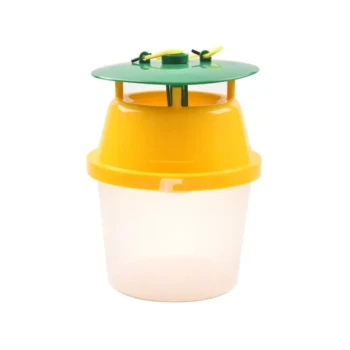
Specialized lure trays are essential engineering components designed to balance pest control efficacy with product safety. They function as physical carriers for attractants and insecticidal agents, specifically enabling the controlled release of treatments while acting as a barrier between chemical agents and the hive's sensitive environment.
The core function of these trays is to maintain the chemical stability of biological agents like Bacillus thuringiensis in humid conditions, while simultaneously preventing any physical contact with honeycomb or honey to ensure product purity.
Preserving Bait Efficacy
The environment within a beehive presents significant challenges for pest control agents. Lure trays are designed to mitigate these environmental factors to ensure the treatment remains effective against Galleria mellonella.
Maintaining Physical and Chemical Stability
The bottom of a hive is naturally humid. Without protection, baits containing biological agents can degrade rapidly.
Specialized trays stabilize the physical and chemical properties of the bait. This is particularly critical for proteins derived from Bacillus thuringiensis, which require specific conditions to maintain their insecticidal potency.
Enabling Controlled Release
Effective pest management requires a sustained defense rather than a momentary one.
The tray acts as a regulator for the controlled release of the attractant. By housing the agent within a specific physical carrier, the system ensures the lure remains active over time rather than dissipating immediately.
Ensuring Hive Product Purity
Beyond killing pests, the primary directive in beekeeping is maintaining the safety and quality of the honey and comb.
Preventing Direct Contact
The most significant risk in using chemical or biological agents in a hive is cross-contamination.
Lure trays provide a necessary physical degree of separation. They prevent the insecticidal agents from ever coming into direct contact with the honeycomb.
Safeguarding Honey Quality
Honey is a porous and absorbent product. Any contact with foreign agents can compromise its purity.
By isolating the bait within the tray, the design ensures that honey remains pure and free from residues, satisfying both safety standards and consumer expectations.
Understanding the Operational Trade-offs
While lure trays offer significant advantages, understanding the constraints of this design is vital for successful implementation.
The Necessity of Physical Barriers
You cannot simply scatter bait for Galleria mellonella as you might for other pests.
The trade-off for safety is the requirement for specific hardware. The tray forces the agent to remain in a fixed location, meaning the efficacy relies entirely on the attractant's ability to draw the pest into the tray, rather than the agent seeking out the pest.
Environmental Dependency
While the tray protects against humidity, it interacts with the hive's microclimate.
The effectiveness of the Bacillus thuringiensis proteins is linked to the tray's ability to buffer against extreme moisture. If the tray's capacity is exceeded by excessive hive moisture, the stability of the bait could theoretically be compromised, emphasizing the need for correct tray design specifications.
Making the Right Choice for Your Goal
When selecting or designing traps for Galleria mellonella, your priorities will dictate how you utilize the lure tray mechanism.
- If your primary focus is Product Safety: Prioritize trays with robust physical barriers to guarantee zero contact between the agent and the honeycomb.
- If your primary focus is Treatment Longevity: Select trays specifically engineered to stabilize Bacillus thuringiensis proteins against the high humidity found in hive bottoms.
By utilizing specialized lure trays, you ensure a targeted strike against pests without becoming a liability to the harvest.
Summary Table:
| Feature | Function & Benefit | Impact on Beekeeping |
|---|---|---|
| Chemical Stability | Protects B. thuringiensis from high hive humidity | Ensures long-lasting insecticidal potency |
| Physical Separation | Acts as a barrier between bait and honeycomb | Guarantees honey purity and residue-free products |
| Controlled Release | Regulates the dissipation of attractants | Maintains a sustained defense against pests |
| Environmental Buffering | Mitigates microclimate interference | Prevents bait degradation in moist environments |
Maximize Your Colony Health with HONESTBEE Professional Solutions
Protecting your harvest requires the perfect balance of effective pest management and uncompromising product purity. At HONESTBEE, we specialize in supporting commercial apiaries and distributors with high-performance beekeeping tools and machinery designed for professional success.
Our extensive portfolio includes:
- Advanced Pest Control Hardware: Precision-engineered traps and specialized lure trays.
- Beekeeping Machinery: From hive-making to automated honey-filling systems.
- Wholesale Consumables: A full spectrum of essential tools and industry-standard supplies.
Whether you are scaling a commercial operation or supplying the next generation of beekeepers, HONESTBEE provides the specialized equipment needed to maintain honey quality while maximizing yield.
Ready to elevate your apiary's performance? Contact us today to explore our wholesale offerings!
References
- Bo Han, Pingli Dai. Greater wax moth control in apiaries can be improved by combining Bacillus thuringiensis and entrapments. DOI: 10.1038/s41467-023-42946-4
This article is also based on technical information from HonestBee Knowledge Base .
Related Products
- Professional Bucket Style Wasp and Moth Pheromone Trap
- 30 cm Plastic Entrance Hole Bee Pollen Trap and Collector
People Also Ask
- What is the function of Pheromone Traps in the biosecurity monitoring of apiaries? Precision Tools for Pest Control
- What role do Pheromone Traps play in the IPM for Large African Hive Beetles? Essential Surveillance & Control Tips
- How do professional wasp traps function? Master Physical Control of Oriental Hornets to Protect Your Apiary
- What are the practical advantages of using professional wasp traps and protective equipment in apiary management? Scale Up
- Why replace sugar syrup bait in wasp traps every three days? Ensure Maximum Attraction and Catch Rates