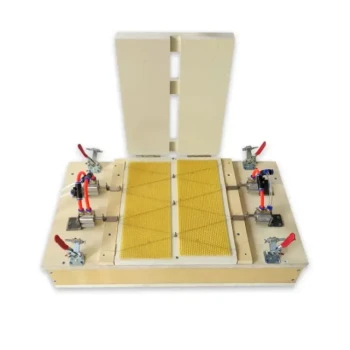
The preference for embedded wax foundation is a strategic sanitation measure. When performing a single Shaking Technique, using foundation forces the colony to construct new comb from scratch. This requirement triggers a specific physiological chain reaction necessary for disease elimination, whereas providing drawn comb would bypass this critical cleansing step.
By forcing bees to build new comb rather than occupying existing cells, the colony consumes the honey stored in their stomachs—which may contain pathogen spores—to fuel wax production, effectively filtering out disease before it enters the new hive structure.
The Physiological Mechanics of Decontamination
To understand why drawn comb is avoided, one must understand how bees carry pathogens and how they produce wax.
The Vector: The Honey Stomach
When bees are shaken into a new environment, they carry a reserve of honey in their honey stomachs.
In a diseased colony, this stored honey often acts as a carrier for pathogen spores (such as Paenibacillus larvae, the cause of American Foulbrood).
If bees are allowed to immediately deposit this honey into ready-made cells, the new hive is instantly re-infected.
The Solution: Wax Secretion
Embedded wax foundation presents the bees with a workload: they must build out the cells.
To accomplish this, adult worker bees are forced to initiate the physiological process of secreting beeswax.
Wax secretion is metabolically expensive; it requires the consumption of large amounts of sugar and energy.
Eliminating the Spores
To fuel the comb-building process, the bees are compelled to consume the honey stored in their honey stomachs.
By metabolizing this honey for energy rather than regurgitating it for storage, the transmission cycle is broken.
This consumption significantly reduces the clinical incidence of disease and prevents pathogen spores from re-accumulating in the new cells.
The Risks of Using Drawn Comb
While drawn comb offers a "head start" in healthy hives, it undermines the objective of the Shaking Technique.
Immediate Re-contamination
If you provide drawn comb, the bees have no need to secrete wax immediately.
Instead, they will empty their honey stomachs directly into the open cells.
This deposits the spore-laden honey into the new environment, rendering the shaking procedure ineffective.
Bypassing the Metabolic Filter
The efficacy of the Shaking Technique relies on the bees processing the contaminated food internally.
Drawn comb allows them to bypass this metabolic filter.
Without the energy demand of building foundation, the pathogen load remains active and infectious within the food stores.
Making the Right Choice for Your Goal
The Shaking Technique is a specific intervention designed for disease management, not rapid expansion.
- If your primary focus is Disease Elimination: You must use embedded wax foundation to force the consumption of spore-laden honey reserves.
- If your primary focus is Colony Establishment Speed: You might typically choose drawn comb, but never do so when performing a Shaking Technique to control pathogens.
Success in this procedure relies on trading the speed of drawn comb for the biological sanitation provided by wax foundation.
Summary Table:
| Feature | Embedded Wax Foundation | Drawn Comb |
|---|---|---|
| Immediate Action | Forces bees to secrete new wax | Bees deposit honey immediately |
| Metabolic Filter | Activated (consumes honey stores) | Bypassed (regurgitates honey) |
| Pathogen Risk | Significantly reduced via consumption | High (re-infects new hive) |
| Best Use Case | Disease management & sanitation | Rapid colony expansion (healthy only) |
| Energy Demand | High (metabolizes spores) | Low (preserves spores) |
Secure Your Apiary's Health with HONESTBEE
Success in disease management requires the right strategy and the right tools. At HONESTBEE, we specialize in supporting commercial apiaries and distributors with high-quality beekeeping essentials. Whether you need premium embedded wax foundation for sanitation procedures or industrial-grade honey-filling and hive-making machinery, we provide the comprehensive wholesale solutions your business demands.
Protect your investment and scale your operations with industry-leading equipment and consumables. Contact HONESTBEE today to discuss our bulk pricing and specialized hardware tailored for large-scale beekeeping.
References
- Stephen F. Pernal, Andony Melathopoulos. Evaluation of the Shaking Technique for the Economic Management of American Foulbrood Disease of Honey Bees (Hymenoptera: Apidae). DOI: 10.1603/0022-0493(2008)101[1095:eotstf]2.0.co;2
This article is also based on technical information from HonestBee Knowledge Base .
Related Products
- Assembled Wooden Bee Frames with Beeswax Foundation Ready to Use by HONESTBEE
- Professional Frame Preparation: The HONESTBEE Electric Wire Embedder
- Economy Manual Beeswax Embossing Mill Wax Foundation Machine Roller
- Manual Beeswax Comb Foundation Machine Wax Foundation Mill Embossing Machine
- Beeswax Machine Press Embosser Wax Foundation Mold Printer Bee Hive Equipment Making Sheet
People Also Ask
- Do bee frames need foundation? Choose the Right Approach for Your Apiary
- How should frames be rearranged as a bee colony grows? Master Hive Expansion and Nest Management
- Under what circumstances should bee frames be destroyed? Protect Your Apiary from American Foulbrood
- What types of bee frames can be cleaned and returned to service? A Guide to Safe Apiary Refurbishment
- What are bee frames and how are they sized? A Professional Guide to Standardization & Material Choice