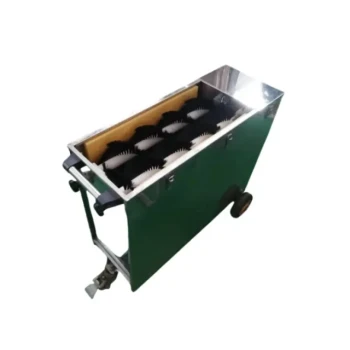
The precise removal of brood discs is required to preserve the structural integrity of the developing bees during the creation of a daughter colony. This process involves carefully extracting 50-70% of the discs containing mature pupae to ensure the new colony has sufficient biomass to generate a new workforce and queen immediately.
The success of Melipona subnitida colony division relies on the physical preservation of viable pupae. Maintaining disc integrity during transfer is the single most important factor in shortening the establishment period and ensuring the survival of the new hive.
The Biological Necessity of Precision
Preserving Critical Biomass
The brood discs represent the colony's future labor force and leadership.
You must transfer 50-70% of these discs to the new wooden hive. This specific volume of biomass provides the critical mass necessary for the colony to function independently.
Facilitating Rapid Development
The goal of division is not just separation, but regeneration.
By transferring intact discs with mature pupae, you allow for the immediate emergence of new workers and queens. This accelerates the colony's ability to defend itself and forage.
Shortening the Establishment Period
Time is a critical factor in the survival of a daughter colony.
Precise removal ensures that the bees do not waste energy repairing damaged brood structures. This allows the colony to bypass a recovery phase and move directly into an establishment phase.
Risks of Improper Handling
The Consequence of Structural Damage
If the integrity of the brood discs is compromised during removal, the pupae inside may perish.
The primary reference emphasizes the use of specialized tools to mitigate this risk. Clumsy extraction leads to a loss of viable bees, crippling the new colony before it begins.
Impact on Survival Rates
A colony that starts with damaged resources faces a significantly lower survival rate.
The correlation is direct: the higher the physical integrity of the transferred discs, the higher the likelihood the daughter colony will survive the transition.
Making the Right Choice for Your Goal
To ensure the successful propagation of Melipona subnitida, align your division strategy with these priorities:
- If your primary focus is colony survival: Use specialized tools to ensure zero structural damage occurs to the brood discs during the transfer.
- If your primary focus is rapid establishment: strictly adhere to the 50-70% transfer ratio, prioritizing discs that contain clearly mature pupae.
Treat the brood discs not as raw material, but as a living organ that must be transplanted whole to function correctly.
Summary Table:
| Key Factor | Requirement/Detail | Impact on Success |
|---|---|---|
| Transfer Volume | 50-70% of brood discs | Provides critical biomass for independent function |
| Disc Maturity | Prioritize mature pupae | Enables immediate emergence of workers and queens |
| Physical Integrity | Zero structural damage | Shortens establishment period; prevents energy waste |
| Primary Goal | Biomass preservation | Directly correlates to higher daughter colony survival rates |
Elevate Your Beekeeping Operation with HONESTBEE Precision Tools
At HONESTBEE, we understand that the survival of your Melipona subnitida colonies depends on the quality of your equipment. We cater specifically to commercial apiaries and distributors, providing the professional-grade tools and machinery needed to handle delicate brood discs with surgical precision.
Whether you are scaling up with our honey-filling machines, manufacturing custom hives with our specialized hardware, or stocking up on essential consumables, our comprehensive wholesale offering is designed to boost your efficiency and success.
Ready to optimize your colony division process? Contact HONESTBEE today to discover how our high-performance beekeeping equipment and industry expertise can grow your business.
References
- Sheina Koffler, Rodolfo Jaffé. Temporal Variation in Honey Production by the Stingless Bee Melipona subnitida (Hymenoptera: Apidae): Long-Term Management Reveals its Potential as a Commercial Species in Northeastern Brazil. DOI: 10.1093/jee/tov055
This article is also based on technical information from HonestBee Knowledge Base .
Related Products
People Also Ask
- What are the advantages of using professional bee sweepers? Boost Honey Harvesting Efficiency and Protect Your Hive
- How do standardized frames and professional bee-sweeping equipment contribute to apiary efficiency? Scale Your Harvest
- What are the specific functions of dedicated feeding systems and physical bee removal equipment in organic production?
- What are the benefits of using professional bee removal equipment during honey harvesting? Boost Purity and Efficiency
- What techniques and tools are used to clear bees from supers during honey harvesting? Efficient Solutions for Every Apiary