The Beekeeper's Dilemma: From Sticky Resin to Valuable Product
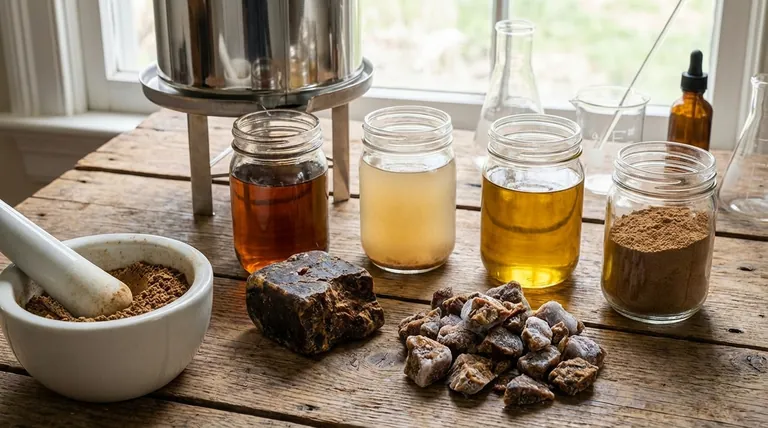
A beekeeper holds a piece of raw propolis. At room temperature, it's a sticky, frustratingly difficult resin, seemingly more of a nuisance than a treasure. Yet, locked within that gummy matrix is a complex array of powerful compounds.
The challenge is not in recognizing its potential, but in unlocking it.
This process of transformation is a form of alchemy. The single most important decision you'll make is not what you're making, but how. The extraction method you choose directly dictates the chemical profile, potency, and purpose of your final product. It is a choice of chemistry and intent.
The Universal First Step: Engineering Brittleness
Before any extraction can begin, you must solve a fundamental physical problem. Raw propolis is unworkable.
The solution is elegant in its simplicity: freezing.
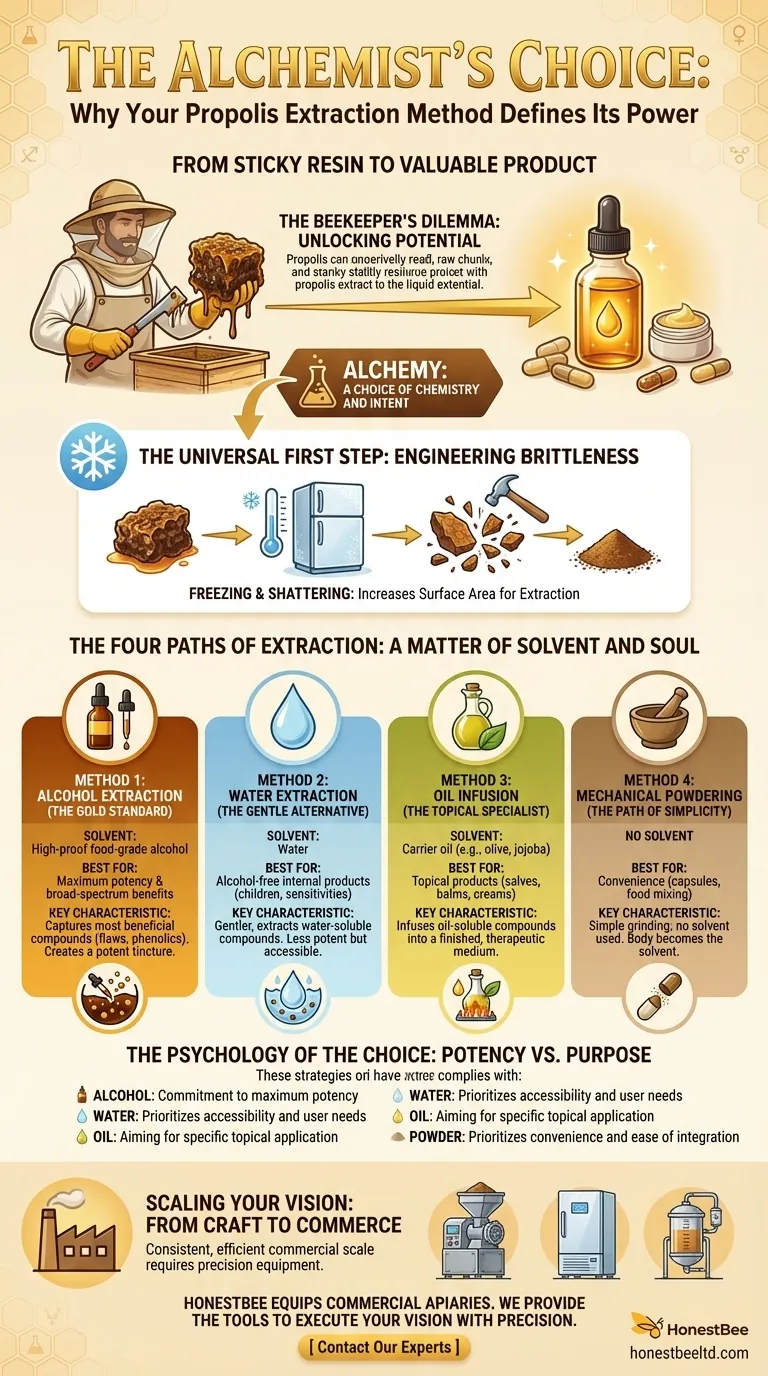
By freezing the resin for several hours, you fundamentally change its physical state from pliable to brittle. This allows it to be easily shattered or ground into a fine powder. This isn't just for convenience; it's a critical engineering step that dramatically increases the material's surface area, making it receptive to the extraction that follows.
The Four Paths of Extraction: A Matter of Solvent and Soul
Once prepared, the propolis is ready. The path you choose next depends entirely on your goal. The solvent—be it alcohol, water, or oil—acts as a discerning editor, selecting which compounds to draw out and carry into the final solution.
Method 1: The Gold Standard — Alcohol Extraction
This is the most common and scientifically validated method for a reason. Using high-proof, food-grade alcohol as a solvent creates a potent, broad-spectrum tincture.
Alcohol is uniquely effective at dissolving the vast majority of beneficial flavonoids and phenolic compounds in propolis. The process involves a patient steep, allowing the alcohol to pull the resin's most powerful elements into solution. This is the path of maximum potency.
Method 2: The Gentle Alternative — Water Extraction
For applications where alcohol is not an option—whether for children, those with sensitivities, or for religious reasons—water provides an alternative.
The process is similar, but the solvent is different, and therefore so is the result. Water is a gentler solvent, primarily extracting water-soluble compounds. The resulting aqueous solution is less potent but serves a critical role for specific users. This is the path of accessibility.
Method 3: The Topical Specialist — Oil Infusion
When the goal is a salve, balm, or cream, oil extraction is the only logical choice.
Here, crushed propolis is gently heated in a carrier oil like olive or jojoba. The oil acts as both the solvent and the final delivery medium, pulling out oil-soluble compounds perfect for topical applications. The result is not just an extract, but a finished, therapeutic ingredient. This is the path of targeted application.
Method 4: The Path of Simplicity — Mechanical Powdering
The most direct method involves no solvent at all. After freezing, the brittle propolis is simply pulverized into a fine powder.
This isn't a true extraction; rather, it prepares the propolis for encapsulation or mixing into foods. The body itself becomes the solvent during digestion. This is the path of convenience.
The Psychology of the Choice: Potency vs. Purpose
Choosing a method is less a technical question and more a strategic one. Your decision reveals your understanding of your end goal and your customer.
- Alcohol signals a commitment to maximum potency, targeting a user seeking the strongest possible therapeutic benefit.
- Water shows an awareness of user needs and limitations, prioritizing accessibility over raw power.
- Oil demonstrates a clear product vision, aiming for a specific external application.
- Powder prioritizes convenience and ease of integration into a daily routine.
The core principle is absolute: the solvent determines the result.
| Processing Method | Best For | Key Characteristic |
|---|---|---|
| Alcohol Extraction | Maximum potency & broad-spectrum benefits | Captures most beneficial compounds; creates a tincture. |
| Water Extraction | Alcohol-free internal products | Gentler, less potent; uses water as the solvent. |
| Oil Extraction | Topical products (salves, balms) | Infuses oil-soluble compounds into a carrier oil. |
| Powdered Propolis | Convenience (capsules, food mixing) | Simple mechanical grinding; no solvent used. |
Scaling Your Vision: From Craft to Commerce
Understanding the alchemy is the first step. Reproducing it consistently and efficiently at a commercial scale is the true challenge. Scaling up requires precision equipment—from industrial grinders and freezers to controlled extraction vessels that ensure quality and consistency in every batch.
At HONESTBEE, we equip commercial apiaries and distributors with the robust, wholesale-focused supplies needed to turn that raw, sticky resin into a valuable, market-ready product. We provide the tools you need to execute your vision with precision.
If you're ready to scale your propolis production, we can help you select the right equipment for your chosen method. Contact Our Experts
Visual Guide
Related Products
- 8 Frame and 10 Frame Propolis Trap Collector Screen for Propolis Collection
- Heavy Duty Stainless Steel Frame Cleaner with Plastic Handle
- 10L Stainless Steel Honey Wax Press Extractor for Wax Cappings
Related Articles
- Systematic Agitation: The Engineering of a Propolis Harvest
- From Raw Resin to Potent Extract: The Engineering Behind Propolis Forms
- The Secret Weapon of Hive Survival: How Bees Transform Resin into Propolis
- How Propolis Reinvents Hive Entrances: Nature’s Blueprint for Survival
- How to Safely Harvest Propolis Without Stressing Your Hive