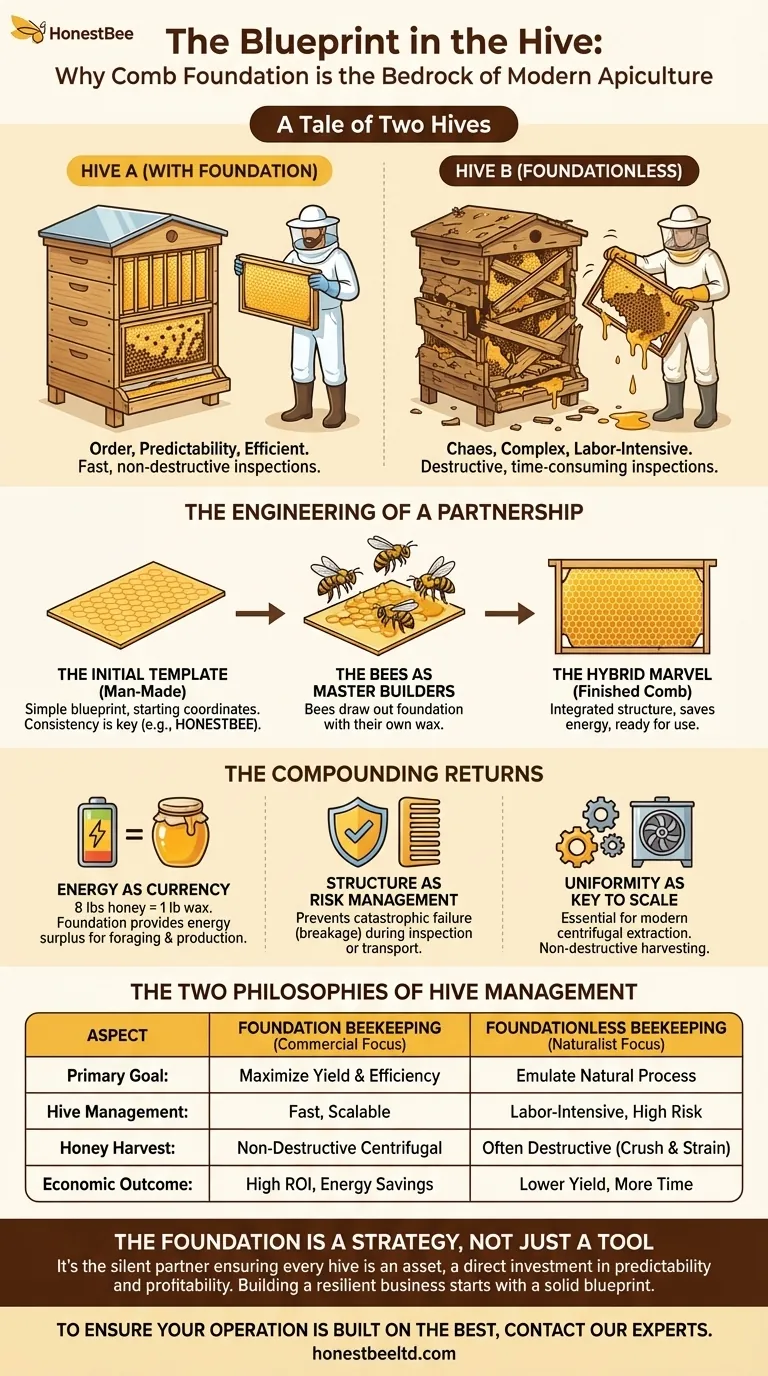
A Tale of Two Hives
Imagine a commercial beekeeper, let’s call her Maria, inspecting her apiary on a warm afternoon.
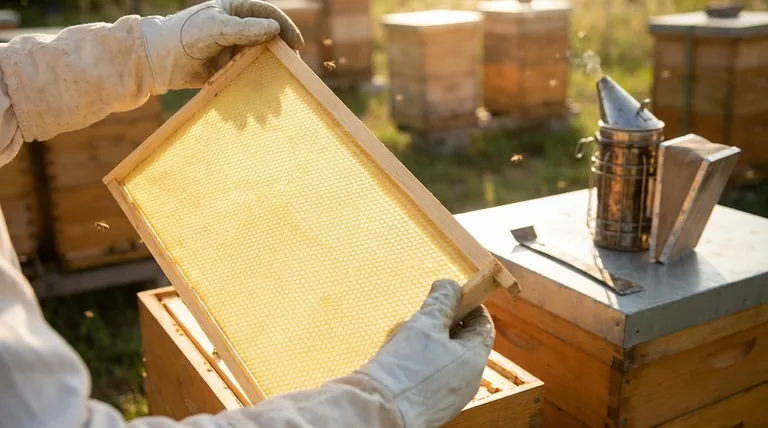
She opens Hive A. Frame by frame, she pulls out perfect, straight slabs of honeycomb. The brood pattern is a tight, beautiful spiral. The honey-filled cells are capped in pristine white wax. Each frame slides out smoothly, a neat page in a well-organized book. Her inspection is done in minutes.
Next, she opens Hive B. Lifting the lid reveals a chaotic lattice. The bees have built their comb sideways, welding three frames into an inseparable, dripping mass. To check the queen, Maria has to break their work, crushing brood cells and spilling precious honey. The inspection is a destructive, time-consuming mess.
The difference? Hive A was built on a simple, man-made blueprint: the comb foundation.
The Human Instinct for Order vs. The Bee's Instinct for Survival
A beehive is a marvel of decentralized, complex engineering. But to the human mind, which craves patterns and predictability, it can feel like chaos.
The core challenge of beekeeping isn't just keeping bees alive; it's managing this complexity at scale. The comb foundation is the primary psychological tool we use to do this. It’s an elegant imposition of order on a wild system.
It acts as a guide, a clear template that channels the bees' incredible construction instincts into a structure that is legible and manageable for the beekeeper. It transforms a wild nest into a system of interchangeable, predictable parts—the very foundation of modern agriculture.
The Engineering of a Partnership
A foundation is not a pre-built home. It's a strategic collaboration between human and bee.
The Initial Template
The beekeeper provides a thin sheet of beeswax or plastic, imprinted with the hexagonal base of a honeycomb cell. This is the architectural drawing. It doesn't replace the bees' work; it simply provides the starting coordinates. For commercial operations, the quality and consistency of this template are paramount, which is why sourcing from dedicated suppliers like HONESTBEE is a non-negotiable part of the process.
The Bees as Master Builders
Receiving this guide, the bees get to work. They consume nectar, secrete their own pure beeswax, and "draw out" the foundation, building up the cell walls with their own materials.
The finished product is a hybrid marvel—a man-made spine integrated seamlessly with natural, bee-crafted wax. The bees are saved the immense energy of building the core structure from scratch, and the beekeeper gets the strong, straight comb they need.
The Compounding Returns of a Good Foundation
Choosing to use high-quality foundation is an economic decision with compounding returns. The initial investment pays dividends in energy, time, and security.
-
Energy as Currency: Bees must consume roughly eight pounds of honey to produce one pound of wax. By providing a foundation, the beekeeper gifts the colony a massive energy surplus. This energy is directly reinvested into what matters most for a commercial apiary: foraging and honey production.
-
Structure as Risk Management: A wild, foundationless comb, heavy with honey, can easily break during an inspection or transport. This is a catastrophic failure, resulting in lost honey, brood, and a massive setback for the colony. A properly installed foundation provides the structural integrity needed to prevent this.
-
Uniformity as the Key to Scale: You cannot run a 1,000-hive operation with the methods of a backyard hobbyist. Uniform combs that fit into modern centrifugal extractors are essential for efficient harvesting. This process removes the honey without destroying the comb, allowing the expensive, energy-intensive drawn comb to be returned to the hive for immediate refilling. This cycle is the engine of commercial honey production.
The Two Philosophies of Hive Management
The decision to use foundation represents a clear understanding of one's goals.
Some beekeepers prefer a "foundationless" approach, valuing a more naturalistic process and allowing bees to build as they please. This can be a rewarding experience but comes with significant management challenges.
For the commercial operator, however, the choice is clear. The goals are yield, efficiency, and hive health at scale.
| Aspect | Foundation Beekeeping (Commercial Focus) | Foundationless Beekeeping (Naturalist Focus) |
|---|---|---|
| Primary Goal | Maximize honey yield & operational efficiency | Emulate a wild colony's natural process |
| Hive Management | Fast, predictable, scalable inspections | Labor-intensive, high risk of cross-comb |
| Honey Harvest | Non-destructive centrifugal extraction | Often requires destructive "crush and strain" |
| Economic Outcome | High ROI through energy savings and speed | Lower yield, more time per hive |
The Foundation is a Strategy, Not Just a Tool
The simple wax sheet inside a beehive is one of the most important innovations in modern agriculture. It’s the interface between human intention and natural instinct.
For commercial apiaries and beekeeping equipment distributors, the quality of that foundation is a direct investment in the predictability and profitability of the operation. It's the silent partner ensuring that every hive is an asset, not a liability. Building a resilient, productive business starts with a solid blueprint.
To ensure your operation is built on the best, Contact Our Experts.
Visual Guide
Related Products
- Manual Beeswax Comb Foundation Machine Wax Foundation Mill Embossing Machine
- Beeswax Foundation Sheets Beehive Foundation for Wholesale
- Food Grade Plastic bee Foundation for Bee Frames
- Notebook Style Beeswax Foundation Mould Wax Foundation Mold
- Colorful Silicone Beeswax Foundation Mold Mould for Beekeeping
Related Articles
- Beyond the Embosser: The Systems Thinking Behind Perfect Beeswax Foundation
- How Beeswax Foundation Machines Transform Beekeeping Efficiency
- How Beeswax Foundation Machines and Smart Equipment Transform Beekeeping Efficiency
- Engineering Symbiosis: The Unseen Role of the Beeswax Embossing Machine
- Why Your Beeswax Foundation Fails: The Hidden Physics Behind Embossing


