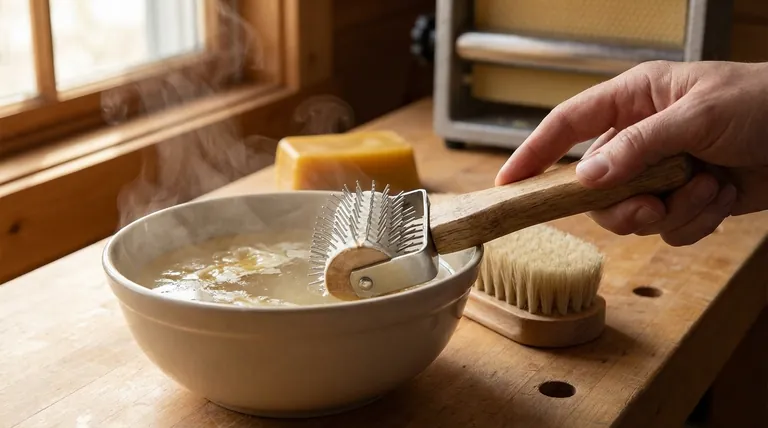
The Moment of Decision
Every beekeeper with a foundation mill knows the feeling. Production halts. A sheet has fed incorrectly, and now a thick, stubborn layer of wax clings to the intricate pattern of the rollers.
In that moment of frustration, the impulse is to fix it now. The nearest metal tool—a scraper, a screwdriver, a hive tool—looks like the perfect solution. It promises speed. It promises a quick return to work.
This is the most expensive mistake you can make. The real problem isn't the stuck wax; it's the choice you are about to make.
The Allure of the Quick Fix
Our minds are wired to solve immediate problems. The wax is there; the scraper will remove it. This is first-order thinking. It's effective for simple tasks, but disastrous when dealing with precision equipment.
The metal scraper feels satisfying. It offers tangible, immediate progress. But it ignores the second-order consequence: the unseen, permanent damage being inflicted on the heart of your operation.
This isn't a failure of skill, but of perspective. It's the triumph of impatience over investment.
The Scars of Haste
A foundation mill roller is a piece of precision engineering. Its surface is engraved with a perfect hexagonal pattern designed to be imprinted onto wax.
When a metal scraper gouges that surface, it doesn't just remove wax. It carves a permanent flaw into the steel. Every single foundation sheet that passes through those rollers from that moment on will carry an imprint of that mistake.
You aren't just cleaning wax. You are deciding the quality of every honeycomb you will produce for the life of the mill.
The Craftsman's Approach: Heat and Finesse
The professional solution is counter-intuitive. It requires less force, not more. It relies on principles of physics, not brute strength. It's a method of persuasion.
The goal is to convince the wax to let go, not to tear it away.
The Correct Procedure
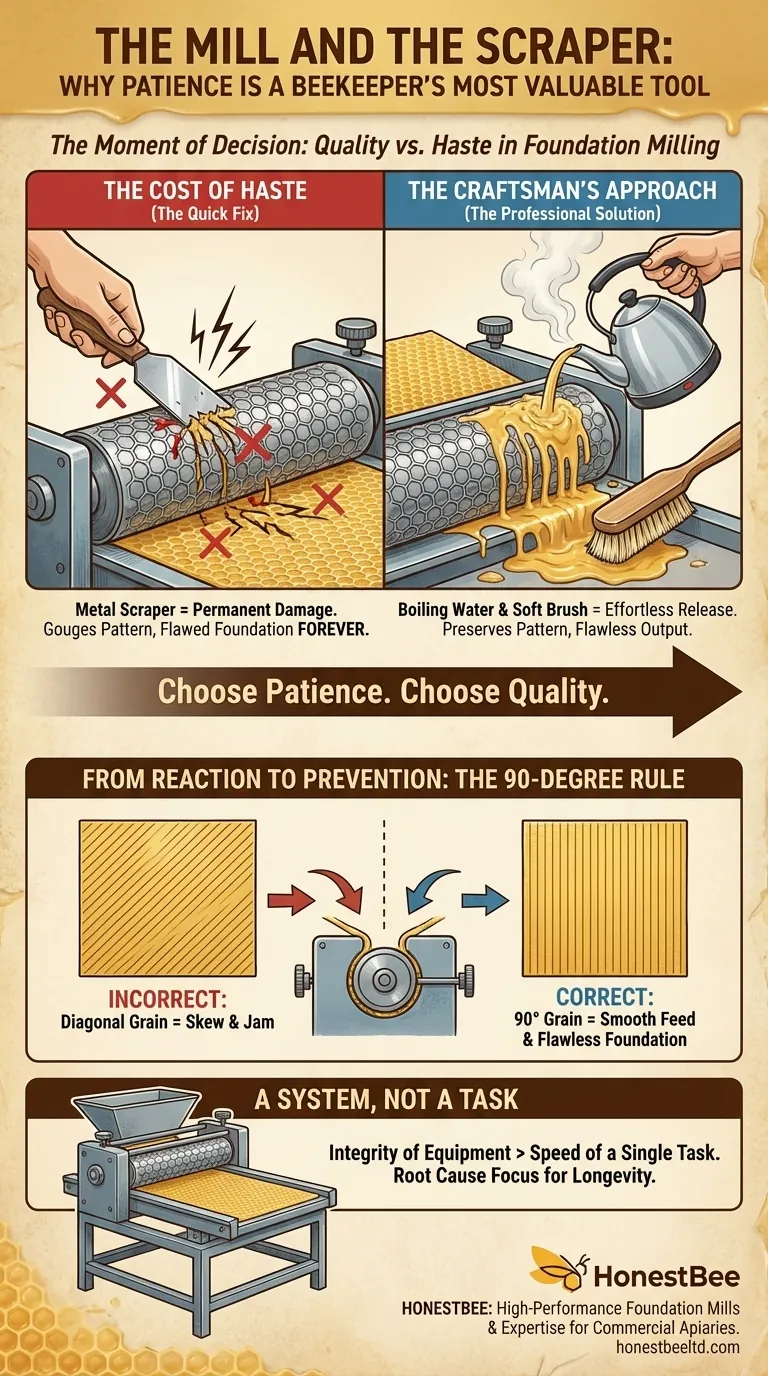
- Apply Boiling Water: Heat is your primary tool. Pouring boiling water over the rollers instantly transfers thermal energy into the wax, melting it from a stubborn solid into a compliant liquid. Its bond with the metal breaks effortlessly.
- Use a Soft Brush: While the wax is liquid, a gentle brush with plastic or natural animal bristles is all that's needed. The bristles get into the fine grooves of the pattern, wiping the residue away without harming the underlying steel.
A hard rule for a long-lasting mill: Never let a metal tool touch the patterned roller surface.
Moving Upstream: From Reaction to Prevention
Stuck wax is rarely a random event. More often, it is a symptom of a flaw earlier in the process. Constantly cleaning your rollers is a sign that you are treating the symptom, not the cause.
The true cause often lies in the preparation of the raw wax sheets themselves.
The 90-Degree Rule
When a sheet of wax is dipped and cooled, it forms a "grain," much like wood. These are tiny, almost invisible ripples in the solidified wax.
- For flawless feeding: The grain must run at a perfect 90-degree angle to the sides of the sheet. This ensures it travels straight through the rollers.
- The primary cause of failure: If the grain runs diagonally, the sheet will inevitably skew, buckle, and jam as it enters the mill, causing the buildup you're trying to fix.
By mastering the dipping process, you don't just make better sheets. You make the problem of stuck wax almost disappear.
A System, Not a Task
Your foundation mill isn't just a machine; it's the heart of a system. Its health determines the quality of your output and the efficiency of your operation. The temptation to use a scraper is a decision to sacrifice the entire system for the sake of one frustrating moment.
Protecting that system requires discipline and a focus on root causes. It means valuing the integrity of your equipment over the speed of a single task. This philosophy is the foundation of any successful commercial apiary. High-quality, durable equipment is the starting point for producing flawless foundation sheets consistently.
At HONESTBEE, we supply commercial apiaries with the robust, high-performance foundation mills that a professional operation demands. We believe that the right equipment, combined with the right knowledge, is the key to longevity and success. Contact Our Experts
Visual Guide
Related Products
- Fully Automatic Beeswax Embossing Machine Foundation Mill
- Electric Flatting and Embossing Machine with Tray for Beekeeping
- Manual Beeswax Comb Foundation Machine Wax Foundation Mill Embossing Machine
- Economy Manual Beeswax Embossing Mill Wax Foundation Machine Roller
- Notebook Style Beeswax Foundation Mould Wax Foundation Mold
Related Articles
- Beyond the Embosser: The Systems Thinking Behind Perfect Beeswax Foundation
- How Beeswax Foundation Machines Transform Beekeeping Efficiency
- How Beeswax Foundation Machines and Smart Equipment Transform Beekeeping Efficiency
- Are You Choosing the Right Beeswax Embossing Tool? Avoid Common Pitfalls in Foundation Production
- Why Your In-House Beeswax Foundation is Failing Your Business—And How to Fix It






