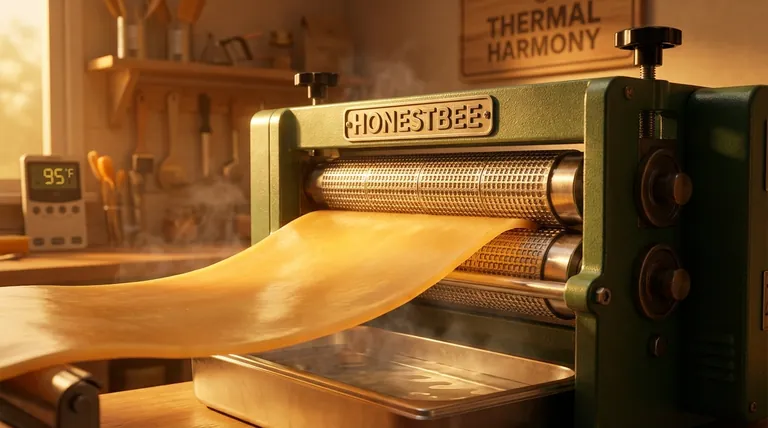
The Silent Failure of a Perfect Machine
Imagine the scene. A beekeeper feeds a pristine, decontaminated sheet of beeswax into a high-quality foundation mill. The gears turn smoothly. Yet, what emerges on the other side is a disaster: a torn, warped sheet with uneven cells, clinging stubbornly to the metal rollers.
The machine isn't broken. The wax isn't bad. The failure is invisible. It’s a failure of physics, a miscalculation in the delicate dance of heat and pressure.
The success of milling beeswax foundation doesn't hinge on the force applied or the speed of the rollers. It hinges entirely on mastering a single, elusive variable: temperature.
A Material on the Edge
Beeswax is a fascinating, almost paradoxical material. At room temperature, it is solid and brittle. Heat it too much, and it becomes a sticky liquid. The window for perfect pliability—where it can accept the deep, precise emboss of a foundation cell without tearing or sticking—is incredibly narrow.
The human mind tends to focus on what it can see: the gears, the wax sheet, the handle turning. We underestimate the invisible forces of thermodynamics. The entire milling process is a battle against thermal inconsistency. Every failure, from a tear to a shallow impression, can almost always be traced back to a temperature mismatch.
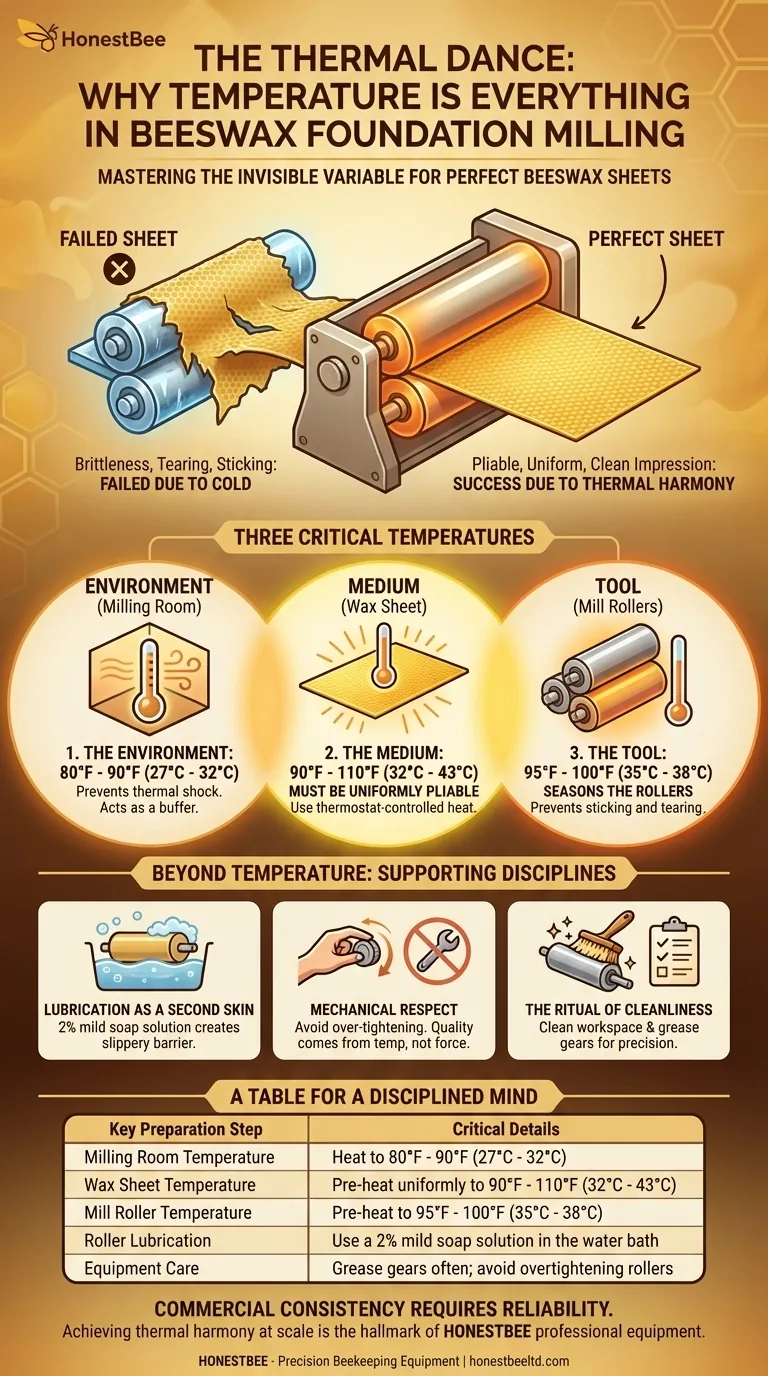
A System of Heat: The Three Critical Temperatures
To succeed, you must stop thinking about heating just the wax. You must create a complete thermal system where the room, the wax, and the mill exist in a state of carefully managed harmony.
1. The Environment: Your First Line of Defense
The process begins before the wax even approaches the mill. The milling room itself must be heated to a stable 80°F to 90°F (27°C - 32°C).
Why? A warm room acts as a buffer. It prevents the pre-heated wax sheets from experiencing thermal shock, where the outer layers cool and contract faster than the core. This simple environmental control is the first step to preventing brittleness and ensuring consistency.
2. The Medium: Uniformly Pliable Wax
The wax sheets themselves must be heated to between 90°F and 110°F (32°C - 43°C). The key word here is uniformly.
A common mistake is uneven heating. If one part of the sheet is 110°F while another is 90°F, it will stretch and tear as it hits the rollers. Using a thermostat-controlled water bath or a dedicated hot box ensures every square inch of the sheet is equally pliable and ready for milling.
3. The Tool: Seasoning the Mill Rollers
Finally, the mill rollers must be brought up to 95°F to 100°F (35°C - 38°C). Cold metal is the enemy of warm wax.
Feeding a perfectly heated wax sheet into cold rollers causes the wax to instantly harden on contact, leading to sticking and tearing. Pre-heating the rollers with warm water or a heating pad "seasons" them, making them receptive to the wax and ensuring a clean release.
Beyond Temperature: The Supporting Disciplines
Once the thermal system is stable, a few supporting disciplines ensure the process is not just successful, but efficient and repeatable.
Lubrication as a Second Skin
A water bath containing a 2% solution of mild, biodegradable soap is not just for cleaning. It creates a microscopic, slippery barrier on the rollers. This prevents the warm, slightly adhesive wax from forming a direct bond with the metal, ensuring a clean and perfect impression.
Mechanical Respect
An adjustable mill is a precision instrument, not a vise. The temptation to screw the rollers down tightly for a deeper impression is a costly error. This act of force doesn't improve the foundation; it permanently damages the delicate embossing heads. True quality comes from perfect temperature and pliability, not brute force.
The Ritual of Cleanliness
A clean workspace is non-negotiable. Any debris—dust, stray bits of wax, dirt—can become embedded in the sheet, creating weak points. Likewise, the mill's gears require frequent lubrication with a heavy gear grease to prevent wear and ensure tight, precise operation for years to come.
A Table for a Disciplined Mind
For a process so sensitive, a checklist is essential. These parameters are not guidelines; they are the rules of the thermal dance.
| Key Preparation Step | Critical Details |
|---|---|
| Milling Room Temperature | Heat to 80°F - 90°F (27°C - 32°C) |
| Wax Sheet Temperature | Pre-heat uniformly to 90°F - 110°F (32°C - 43°C) |
| Mill Roller Temperature | Pre-heat to 95°F - 100°F (35°C - 38°C) |
| Roller Lubrication | Use a 2% mild soap solution in the water bath |
| Equipment Care | Grease gears often; avoid overtightening rollers |
From Craft to Commercial Operation
For a hobbyist, a few failed sheets are a learning experience. For a commercial apiary or equipment distributor, inconsistency is a direct blow to the bottom line. Reproducing this perfect thermal balance at scale, day after day, demands equipment that is not just functional, but exceptionally reliable and durable.
At HONESTBEE, we focus on supplying commercial operations with the robust, precision-engineered beekeeping equipment necessary to turn this delicate craft into a predictable, profitable process. Our tools are built to maintain the tight tolerances required for consistent, high-quality foundation production.
Achieving thermal harmony is the hallmark of a professional. If you're ready to elevate your foundation production with equipment built for reliability at scale, we can help. Contact Our Experts
Visual Guide
Related Products
- Fully Automatic Beeswax Embossing Machine Foundation Mill
- Electric Flatting and Embossing Machine with Tray for Beekeeping
- Manual Beeswax Comb Foundation Machine Wax Foundation Mill Embossing Machine
- Economy Manual Beeswax Embossing Mill Wax Foundation Machine Roller
- Manual Beeswax Flat Sheet Machine for Beeswax Processing
Related Articles
- Beyond the Embosser: The Systems Thinking Behind Perfect Beeswax Foundation
- How Beeswax Foundation Machines Transform Beekeeping Efficiency
- How Beeswax Foundation Machines and Smart Equipment Transform Beekeeping Efficiency
- Are You Choosing the Right Beeswax Embossing Tool? Avoid Common Pitfalls in Foundation Production
- Why Your In-House Beeswax Foundation is Failing Your Business—And How to Fix It