The Moment of Failure
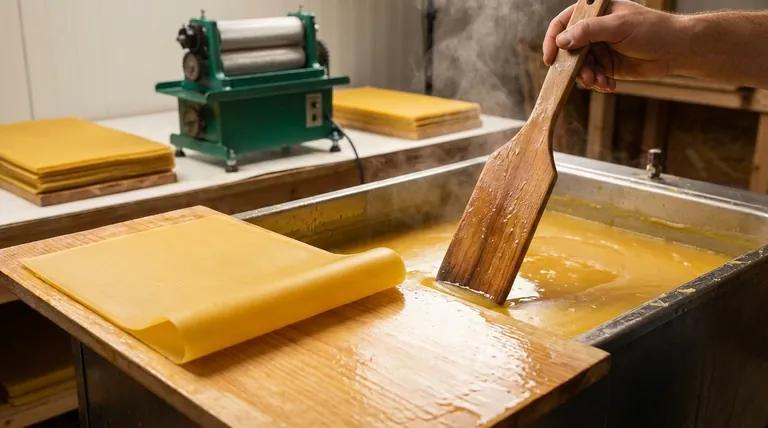
Imagine the scene. The air is thick with the sweet, earthy scent of molten beeswax, heated to the perfect temperature. You’ve prepared everything. You dip a smooth wooden board into the golden liquid, pull it out, and watch a delicate, uniform sheet form as it cools.
Then, you try to remove it.
Instead of peeling off cleanly, the wax sheet tears. A section remains fused to the board, a stubborn flaw that ruins the sheet and forces you to stop, scrape, and start over. This small, frustrating failure isn't a problem of technique. It's a problem of physics.
The core challenge is a battle against adhesion at a microscopic level. Hot wax wants to bond with the porous fibers of a dry board. The solution, elegantly simple, lies not in force, but in creating a barrier the wax cannot cross.
A Solution Forged in Steam
The secret to a perfect release is water. Specifically, a wooden dipping board that has been completely saturated with water.
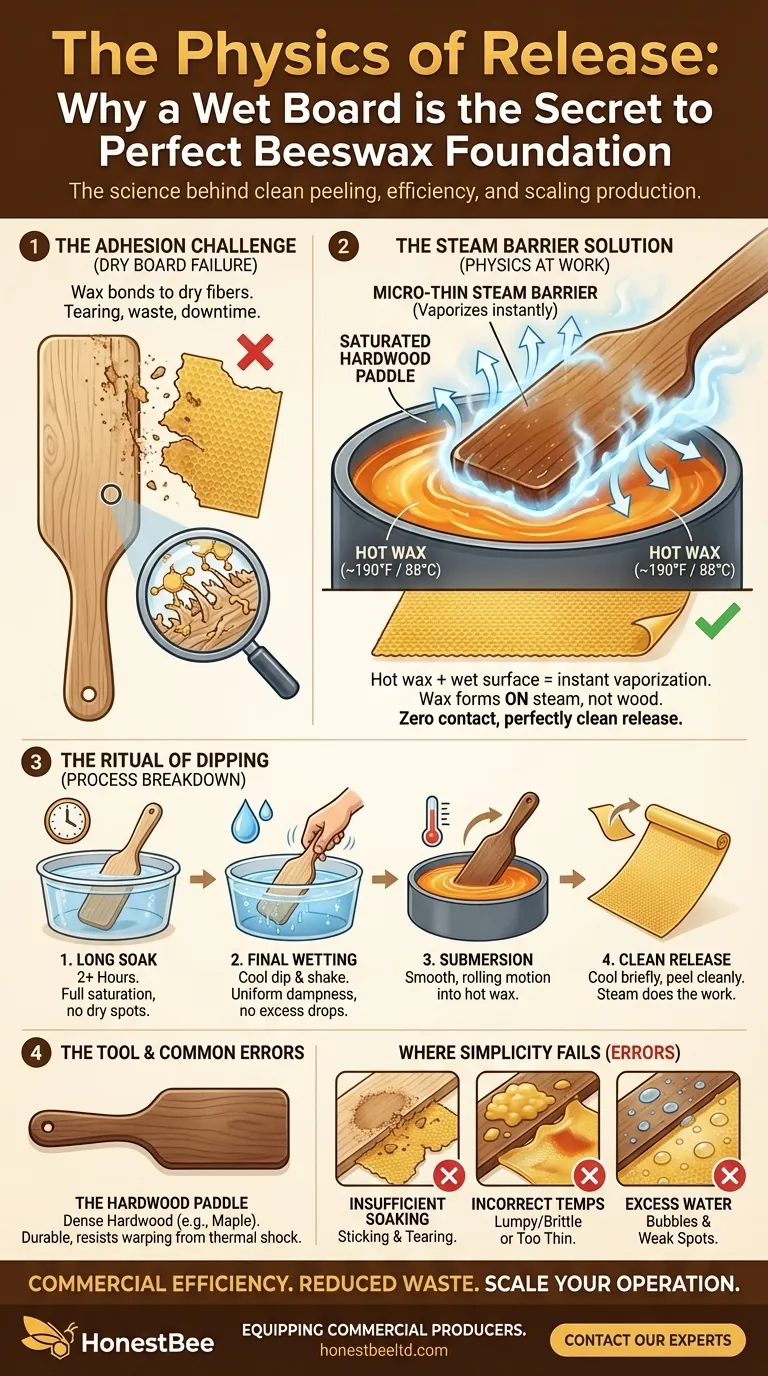
When the cool, wet board is submerged in hot wax (around 190°F or 88°C), the water on its surface instantly vaporizes. This creates a micro-thin layer of steam between the wood and the wax.
This vapor barrier acts as a perfect, natural release agent. The wax sheet forms on top of the steam, never making direct contact with the wood grain. It’s the same principle that allows you to handle sticky rice with wet hands. It’s a beautifully simple, non-chemical solution to a physical problem.
The Dipping Board: A Tool of Precision
The board itself is more than just a template; it's a critical component of a thermal process. Its preparation is everything.
Why Hardwood Matters
Paddles for foundation making are made from dense hardwood for a reason. Hardwood is durable and less porous than softwood, but most importantly, it's far more resistant to warping and cracking after repeated cycles of thermal shock—moving from hot wax to cool water and back again. A stable tool creates a consistent product.
The Psychology of Soaking
The most critical step is also the most mundane: soaking the board in water for several hours. It’s tempting to rush this. It feels like unproductive waiting time.
But this patience is what ensures success. A board that is only superficially wet will have dry spots. These spots are points of failure, where the wax will penetrate the fibers and fuse to the wood. The long soak isn't just about getting the board wet; it's about achieving full saturation, leaving no room for the wax to grip.
The Ritual of Dipping: A Process Breakdown
Mastering the process transforms it from a task into a repeatable ritual, where each step has a clear purpose.
- Preparation: The beeswax is melted, and the hardwood board has been soaked for hours.
- The Final Wetting: Just before dipping, the board is submerged in cool water and given a quick shake to remove dripping droplets. This ensures a uniform, damp surface.
- The Submersion: The board is dipped into the hot wax with a smooth, rolling motion to ensure an even coat.
- The Release: After a brief cooling in a water bath, the solidified wax sheet peels away cleanly, leaving no residue. The steam barrier has done its job.
Where Simplicity Fails: Common Errors
Success hinges on respecting the interplay of material and temperature. Failure usually comes from three places:
- Insufficient Soaking: An impatient operator with a partially dry board will always get sticking.
- Incorrect Temperatures: Wax that is too cool creates a lumpy, brittle sheet. Wax that is too hot creates a sheet that is too thin. The temperature difference between the wet board and the hot wax is what drives the process.
- Excess Water: A dripping board introduces water droplets into the molten wax, causing bubbles and weak spots in the final foundation sheet.
Key Preparation Steps at a Glance
| Preparation Step | Key Action | Purpose |
|---|---|---|
| Material Selection | Use a dense hardwood paddle. | Durability and resistance to warping from thermal shock. |
| Initial Soaking | Submerge the paddle in water for at least 2 hours. | Fully saturates wood fibers to prevent wax adhesion. |
| Final Wetting | Dip in cool water and shake off excess just before use. | Creates a steam barrier for a clean release from hot wax. |
For a hobbyist, a torn sheet is a learning experience. For a commercial apiary, process failures represent lost time, wasted material, and reduced efficiency. Scaling up production requires not just understanding the craft, but equipping your operation with durable, reliable tools designed for high-volume work. At HONESTBEE, we provide high-quality beekeeping supplies engineered to meet the demands of commercial producers.
If you're ready to turn your craft into a seamless operation, we can help. Contact Our Experts
Visual Guide
Related Products
- Beeswax Foundation Sheets Beehive Foundation for Wholesale
- Colorful Silicone Beeswax Foundation Mold Mould for Beekeeping
- Notebook Style Beeswax Foundation Mould Wax Foundation Mold
- Beeswax Machine Press Embosser Wax Foundation Mold Printer Bee Hive Equipment Making Sheet
- Fully Automatic Beeswax Embossing Machine Foundation Mill
Related Articles
- How Beeswax Foundations Enhance Colony Health and Beekeeping Efficiency
- How to Choose and Use Budget-Friendly Tools for Durable Beeswax Foundations
- From Liquid to Lattice: Mastering Thermal Control in Beeswax Foundation Stacking
- Why Your Beeswax Foundation Sheets Keep Cracking—And How to Stop It for Good
- Why Your Beeswax Foundation Fails: A Guide to Preventing Costly Warping and Breakage