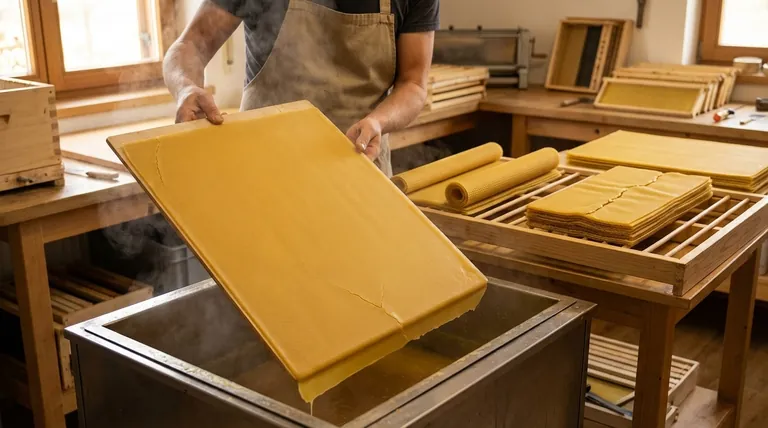
You pull the dipping board from the water, holding what should be a perfect sheet of beeswax foundation. For a moment, it’s flawless. But as it cools, you see it—the familiar, frustrating hairline crack spreading across the surface. Or maybe this batch is a wavy, rippled mess, completely useless for your hives.
Another sheet for the scrap pile. Another hour wasted. If you run a commercial apiary or distribution business, this isn't just an annoyance; it’s a direct hit to your bottom line.
The Vicious Cycle: Why "Trying Harder" Doesn't Work
This scene plays out in workshops everywhere. You’ve likely tried all the common fixes: dipping faster, dipping slower, adjusting the water temperature, or even blaming a "bad batch" of wax. You might get one or two good sheets, but the inconsistency remains, making it impossible to scale production or guarantee quality.
This isn't just a technical problem. The business consequences are significant:
- Wasted Materials: Every failed sheet is wax and money that has to be re-melted and re-processed.
- Wasted Labor: Your time, or your staff's, is spent wrestling with production flaws instead of managing hives or fulfilling orders.
- Production Bottlenecks: Inconsistent results make it impossible to forecast output, delaying apiary expansion or leaving your distributor customers empty-handed.
- Compromised Colony Health: Poorly formed foundation with uneven cells can lead to inefficient comb, skewed brood patterns, and ultimately, lower honey production.
When you're stuck in this cycle, it's easy to think the process is an unpredictable art form. It's not. The failures are predictable, and they are rooted in science.
The Real Culprit: It's Not Bad Luck, It's Physics
The persistent flaws in your foundation sheets aren't random. They are the direct, predictable results of failing to control a few key physical principles. The common "solutions" fail because they are just guesswork, treating a symptom without diagnosing the disease.
Let's break down the real causes.
Why Wax Ripples: The Problem of Viscosity
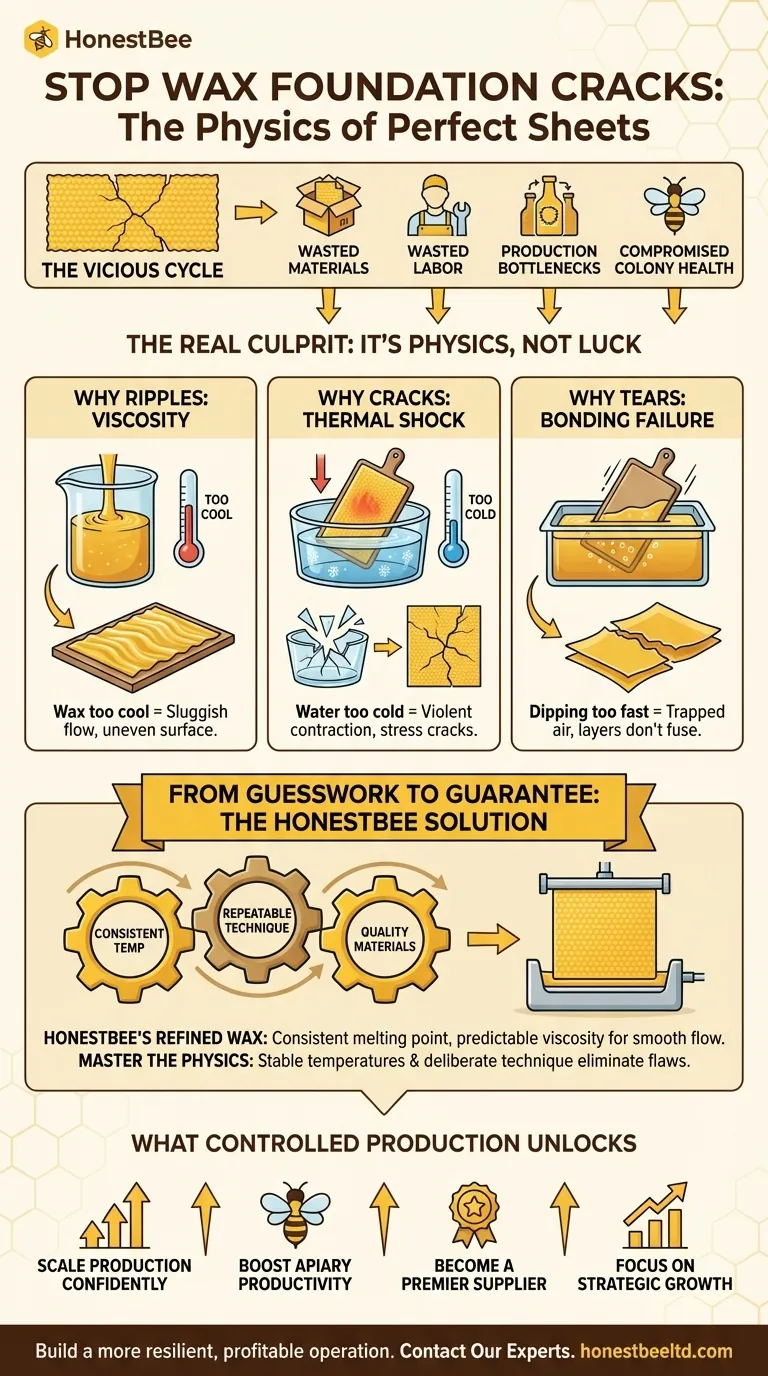
Think of the difference between pouring cold honey and warm honey. When your molten wax is too cool, its viscosity increases. It becomes thick and sluggish. As you dip the board, this thick liquid can't flow smoothly, creating the waves and ripples you see on the finished sheet. The result is an uneven surface with inconsistent thickness.
Why Wax Cracks: The Danger of Thermal Shock
When you submerge a hot, expanded board of wax into a vat of cool water, you force it to cool and contract. If the water is too cold, this contraction happens violently and instantly. This creates immense stress within the wax structure. With nowhere to go, that stress is released in the form of cracks. It’s the same principle as a hot glass dish shattering when you pour cold water on it.
Why Wax Tears or Delaminates: The Failure to Bond
Technique is the final piece of the puzzle. If you plunge the board into the wax too quickly, you can trap a microscopic layer of air between the existing coat and the new molten layer. These layers never fully fuse. When you handle the sheet, or as it hangs under its own weight, these unbonded layers simply pull apart, causing the sheet to "explode" or tear.
Trying to fix one of these issues in isolation is why you end up trading one problem for another. You raise the water temperature to stop cracking, but now your wax is cooling too slowly and your wax vat temperature drops, leading to ripples. The cycle continues because you're fighting the physics instead of working with it.
From Guesswork to Guarantee: The Tools for Control
To escape this loop, you must shift from guesswork to control. You need to create a system where temperature is consistent and technique is repeatable. This is not about finding a "magic trick," but about using the right materials and equipment designed for consistency.
A truly reliable process starts with a foundation of quality. The properties of your wax are a critical variable. HONESTBEE’s wholesale wax is refined for a consistent melting point and predictable viscosity. This removes a major unknown from your process. You’re no longer fighting your primary material; you know exactly how it will behave at a given temperature, allowing you to dial in your system to prevent ripples and ensure a smooth, even flow.
When this high-grade wax is paired with reliable dipping equipment—tanks that hold a stable temperature and accurate thermometers—you can finally master the physics of the process.
- Tackle Ripples: By maintaining the optimal wax temperature, our wax ensures a low-viscosity state for a glassy, smooth finish on every dip.
- Eliminate Cracks: With a consistent starting point, you can fine-tune your water bath for a gentle cooling gradient, preventing the thermal shock that shatters sheets.
- Prevent Tearing: When temperature is stable, you can focus entirely on a slow, deliberate technique, ensuring a perfect bond between layers, dip after dip.
Our supplies are not just products; they are the components of a repeatable, scientific system, designed from a deep understanding of the problems you face.
Beyond Perfect Sheets: What Controlled Production Unlocks
Once you stop fighting your materials and start producing perfect foundation sheets every time, your entire operation changes. The time and capital once lost to waste are now freed up, opening new possibilities for growth.
Instead of re-melting scrap, you can:
- Scale Production Confidently: Train new staff on a scientific, repeatable process, not an obscure art. Meet seasonal demand without the stress of unpredictable output.
- Boost Apiary Productivity: Provide your colonies with flawless foundation, encouraging rapid, perfect comb construction. This leads to stronger brood patterns, healthier hives, and maximized honey yields.
- Become a Premier Supplier: If you're a distributor, build a reputation for selling the most reliable, uniform foundation on the market, making you the go-to source for serious beekeepers.
- Focus on Strategic Growth: Shift your energy from troubleshooting to expanding your business—whether that means adding more hives, developing new products, or finding new markets.
Solving your wax foundation issues is about more than just making better sheets. It's about building a more resilient, profitable, and scalable beekeeping business. Your operational challenges are unique, and a one-size-fits-all solution isn't the answer. We can help you implement a systematic approach to your supplies that removes production headaches and fuels your growth. To build a more predictable and profitable operation, Contact Our Experts.
Visual Guide
Related Products
- Beeswax Foundation Sheets Beehive Foundation for Wholesale
- Beeswax Machine Press Embosser Wax Foundation Mold Printer Bee Hive Equipment Making Sheet
- Notebook Style Beeswax Foundation Mould Wax Foundation Mold
- Colorful Silicone Beeswax Foundation Mold Mould for Beekeeping
- Electric Beeswax Foundation Machine With Operating Tray and Wax Foundation Roller
Related Articles
- How to Choose and Use Budget-Friendly Tools for Durable Beeswax Foundations
- How Beeswax Foundations Enhance Colony Health and Beekeeping Efficiency
- From Liquid to Lattice: Mastering Thermal Control in Beeswax Foundation Stacking
- Why Your Beeswax Foundation Fails: A Guide to Preventing Costly Warping and Breakage
- Stop Blaming Your Rollers: The Real Source of Flawed Beeswax Foundation






