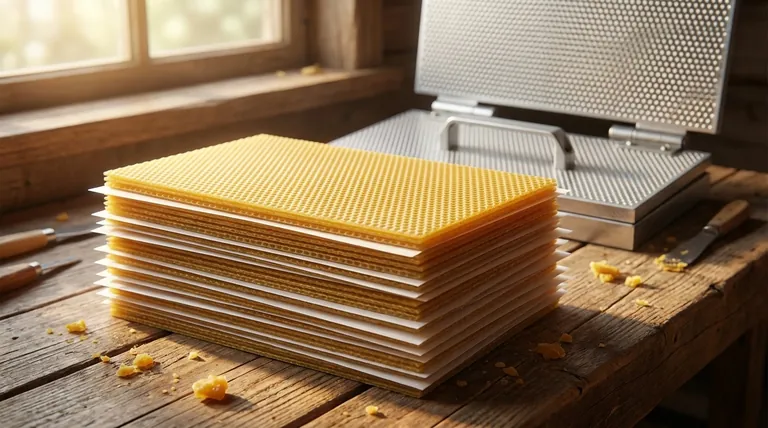
The Moment of Failure
Imagine the scene: hours spent carefully melting wax and dipping boards, resulting in dozens of perfectly formed, golden sheets. But in a rush to finish, they are piled directly on top of one another.
When you return, you don't have a stack of individual sheets. You have a single, useless block—a monument to wasted time and material.
This isn't just a simple mistake. It's a failure to understand a fundamental conflict at the heart of foundation production.
The Paradox of Perfect Wax
Freshly dipped beeswax exists in a state of perfect paradox.
It is warm, pliable, and ductile—the ideal condition for being milled or embossed with the crisp, hexagonal pattern of a honeycomb.
Simultaneously, it is tacky and adhesive. This warmth that makes it workable also makes it desperately want to fuse with any other wax surface it touches. The very property that enables quality is the same one that threatens total failure.
The process of stacking, therefore, is not about storage. It is a system designed to solve this paradox.
A System for Thermal and Structural Integrity
Proper stacking is an act of engineering. You are manipulating thermodynamics and structure to preserve the wax in its ideal state for the next step: milling. This system has two core components.
The Paper Barrier: Preventing Catastrophic Fusion
The most obvious element is the separation paper. Placed between each sheet, it acts as a simple, non-negotiable barrier.
Its function is absolute: to prevent adhesion. Without it, the warm sheets will fuse, and the batch is ruined. It is the single most critical control point in the workflow between dipping and embossing.
The Aligned Stack: A Thermal Battery
The second, more subtle element is the stack itself. A neat, perfectly aligned stack does more than look professional; it creates a thermal battery.
By minimizing the surface area exposed to the cooler ambient air, the stack traps residual heat from the dipping process. This retained warmth is distributed evenly throughout the layers, keeping the entire batch of wax pliable and ready for the mill.
A messy, haphazard pile allows heat to escape unevenly, creating cool, brittle spots that will crack or take a poor impression during embossing.
The Protocol for Perfection
The procedure is a masterclass in efficiency and control.
- Isolate and Prepare: After peeling the sheet from the dipping board, trim the edges. This creates a uniform unit, ready for the system.
- Encapsulate and Insulate: Place the trimmed sheet onto a piece of separation paper, then immediately cover it with another. The wax is now structurally and thermally insulated.
- Construct the Core: Continue layering wax and paper, focusing on creating a straight, uniform stack. You are building the thermal core that will keep your entire run at the optimal temperature.
The Psychology of Process Decay
The reasons this process fails are almost always psychological, stemming from a misunderstanding of risk and reward.
The Siren Call of the Shortcut
Skipping the separation paper is the most common failure. It’s a decision driven by a desire for speed, a belief that a small shortcut won't matter. But it's a bet against the fundamental physics of warm wax—a bet you will always lose. The result is not a minor defect; it is a catastrophic and total loss of the product.
The Cost of "Good Enough"
Creating messy stacks is a subtler error. It comes from an "it's good enough" mindset. While it won't cause the instant failure of a fused block, it degrades the system's thermal efficiency. The result is inconsistent quality—some sheets are perfect, others are brittle. This inconsistency is the enemy of any commercial-scale operation.
Scaling Quality with Professional Equipment
For a hobbyist, a single ruined batch is a frustration. For a commercial apiary or a distributor, it's a direct hit to the bottom line.
Scaling production from a craft to a reliable commercial operation requires transforming these principles into an unbreakable workflow. This means having durable, appropriately sized dipping tanks, boards, and a ready supply of pre-cut separation paper. The process must be repeatable, predictable, and efficient.
At HONESTBEE, we equip commercial beekeeping operations with the wholesale supplies needed to build these robust systems. Our focus is on providing durable, reliable equipment that turns best-practice principles into tangible, high-yield results.
For any operation looking to turn craft into consistent, high-yield production, having the right foundation is everything. Contact Our Experts
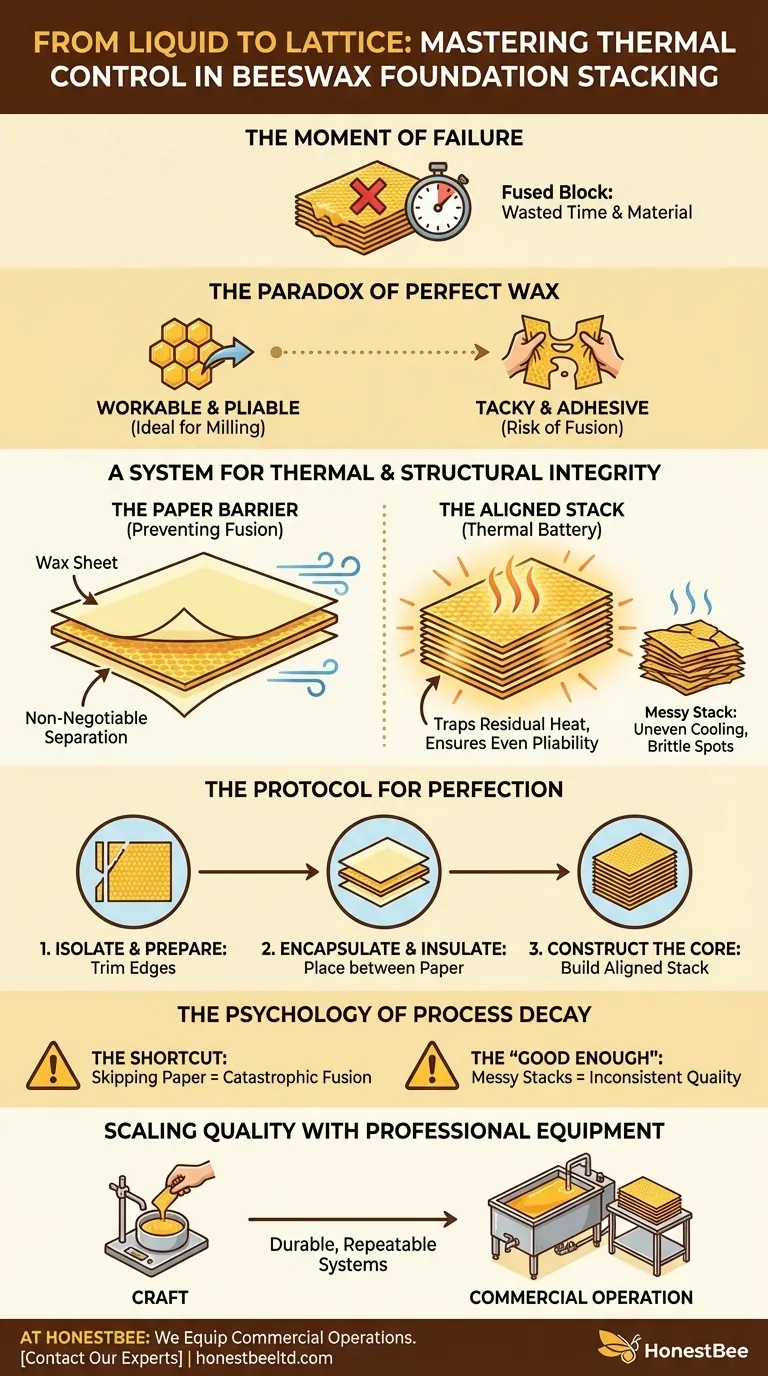
Visual Guide
Related Products
- Beeswax Foundation Sheets Beehive Foundation for Wholesale
- Beeswax Machine Press Embosser Wax Foundation Mold Printer Bee Hive Equipment Making Sheet
- Notebook Style Beeswax Foundation Mould Wax Foundation Mold
- Colorful Silicone Beeswax Foundation Mold Mould for Beekeeping
- Electric Beeswax Foundation Machine With Operating Tray and Wax Foundation Roller
Related Articles
- How to Choose and Use Budget-Friendly Tools for Durable Beeswax Foundations
- How Beeswax Foundations Enhance Colony Health and Beekeeping Efficiency
- Why Your Beeswax Foundation Sheets Keep Cracking—And How to Stop It for Good
- Why Your Beeswax Foundation Fails: A Guide to Preventing Costly Warping and Breakage
- Stop Blaming Your Rollers: The Real Source of Flawed Beeswax Foundation






