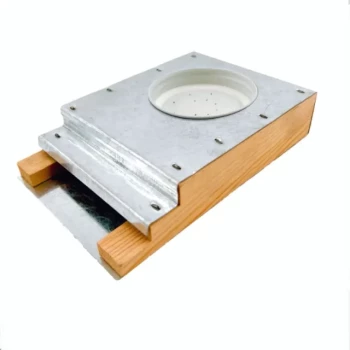
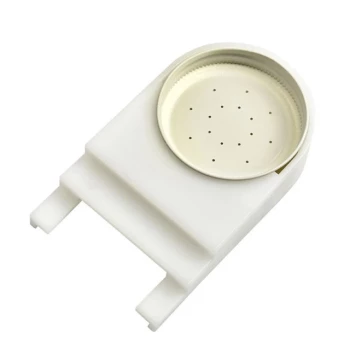
Boardman entrance feeders are utilized by securing a syrup-filled reservoir directly into the hive’s entrance, a design specifically intended to support nucleus colonies (nucs) and smaller hives. This configuration allows bees to access supplemental food easily without requiring the beekeeper to open the main hive body, which helps maintain the internal temperature during cooler fall days.
While Boardman feeders offer a convenient method for feeding small colonies without disrupting the hive, they introduce significant risks during the fall season. Their location at the hive entrance can attract robber bees from stronger colonies, potentially leading to the collapse of the vulnerable hive they are meant to aid.
Operational Mechanics
External Placement
The defining feature of a Boardman feeder is its placement at the hive entrance.
A jar or reservoir is inverted into a holder that slides into the entrance reducer.
This allows the bees to draw down sugar syrup from the base of the unit without leaving the safety of the hive.
Preservation of Hive Climate
One of the primary utilities of this feeder is the ability to refill food without breaking the propolis seal or opening the hive cover.
In fall strategies, preserving the hive's internal heat is critical.
By keeping the hive body closed, the colony does not have to expend extra energy re-heating the cluster after a feeding.
The Security Risks in Fall Strategies
The Threat of Robbing
Fall is a period of resource scarcity, making stronger colonies more aggressive in searching for food.
Entrance feeders place the food source at the colony's front door.
This scent can attract "robber bees" from other hives, who may overwhelm the smaller colony to steal the syrup.
Vulnerability of Weak Colonies
Small colonies and nucs typically have a smaller workforce available to guard the entrance.
When a feeder is placed at the entrance, it forces the guard bees to defend both the hive and the food source simultaneously.
If the colony is already weak, they may be unable to repel intruders, leading to the exploitation and eventual collapse of the hive.
Understanding the Trade-offs
Convenience vs. Security
The Boardman feeder is highly visible, allowing beekeepers to monitor syrup levels at a glance.
However, this convenience comes at the cost of hive security.
While effective in times of high nectar flow, the risk profile changes drastically in the fall when forage is limited.
Alternative Options
To mitigate the risk of robbing, many fall strategies pivot toward hive top feeders.
These are placed on top of the inner cover, fully enclosed within the hive.
Top feeders keep the syrup away from the entrance and foreign bees, offering a much higher degree of protection for the colony.
Making the Right Choice for Your Goal
Before deploying Boardman feeders in the fall, assess the strength of your colony and the pressure from surrounding hives.
- If your primary focus is rapid monitoring: Boardman feeders allow you to check food levels instantly, but require vigilant observation for signs of robbing.
- If your primary focus is colony survival: Switch to a top feeder or internal frame feeder to secure the food source and minimize the risk of robbing.
Choose the feeding method that balances nutritional support with the colony's ability to defend itself.
Summary Table:
| Feature | Boardman Entrance Feeder Impact | Fall Strategy Consideration |
|---|---|---|
| Access | Placed at hive entrance for easy bee access | High risk of attracting robber bees |
| Thermoregulation | No need to open the hive cover to refill | Preserves internal heat during cool weather |
| Monitoring | External visibility of syrup levels | Quick checks without disturbing the cluster |
| Security | Requires guard bees to defend the entrance | Risky for weak colonies/nucs in nectar dearth |
| Best Use Case | Small colonies during high nectar flow | Consider internal feeders for late-season security |
Scaling Your Beekeeping Success with HONESTBEE
Are you a commercial apiary or a distributor looking to provide high-quality solutions for colony survival? HONESTBEE is your premier partner for the full spectrum of beekeeping tools. From durable feeders and specialized hive-making machinery to essential consumables and honey-themed cultural merchandise, we offer a comprehensive wholesale portfolio designed to meet the demands of large-scale operations.
Ready to elevate your inventory and support healthy hives? Contact us today to explore our wholesale offerings and see how our expertise in beekeeping equipment can add value to your business.
Related Products
- Boardman Entrance Bee Feeder Durable Galvanized Steel and Wood Construction for Beekeeping
- Classic Boardman Entrance Bee Feeder Hive Front Feeding Solution
- Professional Hive Front Entrance Bee Feeder
- HONESTBEE Entrance Bee Feeder Efficient Hive Front Liquid Feeding Solution for Beekeeping
- HONESTBEE Entrance Bee Feeder Professional Hive Nutrition Solution for Beekeeping
People Also Ask
- What types of bee feeders are available for beginners? Start with the Simple Entrance Feeder
- How does a bee entrance feeder work? A Simple Guide to Convenient Hive Feeding
- What is a bee entrance feeder and what are its drawbacks? Essential Guide to Hive Security and Feeding Efficiency
- What are the advantages and disadvantages of using an entrance feeder for bees? Balance Convenience and Hive Security.
- How to make an entrance feeder for bees? A DIY Guide for Safe & Effective Feeding