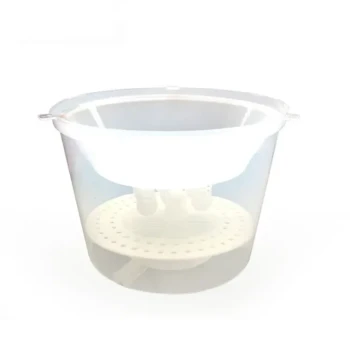
Tipping bucket rain gauges operate on a fundamental principle of gravity combined with magnetic sensing. Rainwater collects in a calibrated bucket until it reaches a specific volume, causing the mechanism to become top-heavy and tip over. This physical movement swings a magnet past a stationary switch—typically a reed switch or Hall effect sensor—generating a digital pulse that is counted by a microcontroller to calculate total rainfall.
The greatest advantage of this system for apiaries is its ability to remain in a deep "sleep" mode, waking only when the magnetic switch triggers an interrupt. This results in ultra-low power consumption, essential for remote, battery-operated hive monitoring systems.
The Mechanics of Measurement
Gravity-Based Collection
The core of the system is a balanced mechanical seesaw or "bucket." As rain falls, it is funneled into one side of this mechanism.
The Tipping Point
The bucket is calibrated to hold a precise volume of water. Once that specific limit is reached, gravity overcomes the balance point, forcing the bucket to tip and empty its contents.
Resetting the Cycle
This tipping action usually positions a second bucket under the funnel (in dual-bucket designs) or resets the mechanism, preparing it to measure the next increment of rainfall immediately.
Signal Generation via Magnetism
The Moving Magnet
A small magnet is physically attached to the tipping bucket mechanism. Because the bucket only moves when it tips, the magnet remains stationary during dry periods or while the bucket is filling.
Triggering the Pulse
When the bucket tips, the magnet swings past a sensor fixed to the device housing.
Sensor Options
This sensor is usually a reed switch or a Hall effect sensor. The passing magnetic field momentarily closes the circuit (or changes voltage), creating a distinct electronic pulse.
Optimizing for Remote Apiary Power
The Challenge of Remote Monitoring
Apiaries are often located off-grid, relying on batteries or small solar panels. Continuous electronic monitoring drains power quickly, making standard sensors inefficient.
Interrupt-Driven Logic
The tipping bucket solves this by utilizing interrupt-driven signals. The microcontroller does not need to stay awake to "watch" for rain.
Maximizing Battery Life
Instead, the system stays in a low-power sleep mode. The pulse generated by the magnetic switch acts as a hardware "wake-up call." The system wakes up solely to count the tip, saves the data, and immediately returns to sleep, drastically reducing average power consumption.
Understanding the Limitations
Mechanical Vulnerabilities
Because this system relies on moving parts, it is susceptible to physical jamming. Debris, such as leaves or dead insects, can prevent the bucket from tipping.
The Trade-off of Sensitivity
The system counts in discrete increments (steps). It cannot measure rainfall smaller than the volume required to tip the bucket one time, potentially missing trace amounts of precipitation.
Making the Right Choice for Your Apiary
When integrating rain monitoring into your hive management system, consider these configuration goals:
- If your primary focus is maximum battery life: Prioritize reed switches over Hall effect sensors, as reed switches are passive components that consume zero power until activated.
- If your primary focus is data accuracy: Ensure your code utilizes hardware interrupts rather than polling loops to guarantee no bucket tips are missed during heavy downpours.
By leveraging gravity and magnetic interrupts, you turn a mechanical action into a highly efficient digital metric.
Summary Table:
| Feature | Mechanism | Benefit for Apiaries |
|---|---|---|
| Measurement | Calibrated Tipping Bucket | Precise volume-based increments |
| Sensing | Magnet + Reed/Hall Switch | Zero-power standby; digital pulse generation |
| Power Logic | Interrupt-Driven Wakeup | Maximizes battery life in off-grid locations |
| Maintenance | Mechanical Seesaw | Simple operation but requires debris clearing |
Optimize Your Apiary with HONESTBEE Precision Tools
Are you looking to enhance your beekeeping operations with smarter data? HONESTBEE specializes in serving commercial apiaries and distributors with high-quality, professional-grade equipment. From specialized hive-making and honey-filling machinery to a full spectrum of beekeeping tools and essential consumables, we provide the hardware you need to scale.
Our team understands the unique challenges of remote monitoring and hive management. Whether you are stocking your distribution business or upgrading a commercial apiary, our wholesale offerings ensure you get durable, efficient tools at competitive prices.
Ready to elevate your production? Contact us today to explore our comprehensive product catalog and find the right solutions for your beekeeping enterprise.
References
- Martin Magdin, Zoltán Balogh. Design and Realization of Interconnection of Multifunctional Weighing Device with Sigfox Data Network. DOI: 10.7160/aol.2020.120209
This article is also based on technical information from HonestBee Knowledge Base .
Related Products
- 5 Gallon Pail Opener Bucket Opener Tool for Honey Bucket
- Precision Honey Refractometer Instrument for Quality Assessment
- Professional Plastic Honey Dipper for Easy Honey Drizzling
- Heavy-Duty Ergonomic Grip Galvanized Pollen Shovel
- Stainless Steel Pail Perch Bucket Bench
People Also Ask
- What is a bucket opener? The Essential Tool for Safe and Efficient Lid Removal
- Is it advisable to use a screwdriver instead of a bucket opener? Avoid Injury and Container Damage
- What are the benefits of using a bucket opener? Boost Safety & Efficiency in Your Operations
- What are the main benefits of using a bucket opener? Enhancing Safety and Preservation
- How does a bucket opener contribute to food safety and product quality? Ensure a Clean, Contaminant-Free Seal Break