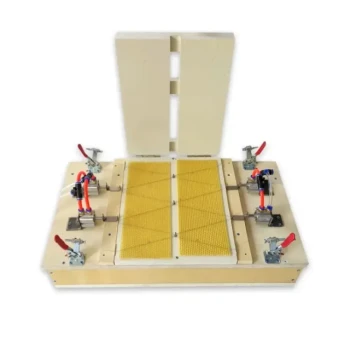
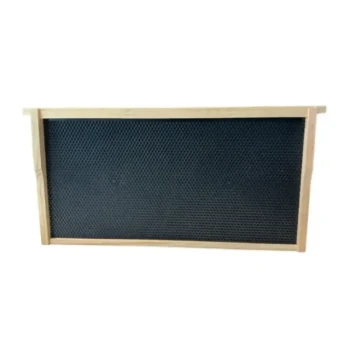
Standard honeybee comb foundation should provide approximately 25 worker cells per square inch and 16 drone cells per square inch. This corresponds to about 5 worker cells per linear inch, with individual cells near 5 mm (0.20 in) wide, and about 4 drone cells per linear inch, with cells near 6 mm (0.25 in) wide. Commercial comb foundation equipment is critical because consistent cell geometry helps maintain the target balance of approximately 95% worker cells and 5% drone cells, supporting productive colony populations and efficient apiary operations.
The key specification is not simply cell count—it is dimensional consistency. Accurate foundation sheets and forming machinery help bees build straight, uniform comb, guide brood production toward the desired worker-to-drone balance, and reduce operational problems during inspection, handling, and extraction.
The Standard Cell Density Specifications
Worker-cell density
Standard worker comb contains approximately 25 cells per square inch. These cells are generally about 5 mm in diameter, or approximately 5 cells per linear inch.
Worker cells accommodate fertilized eggs, which develop into female worker bees. Workers perform the activities most directly associated with commercial output, including foraging, brood care, comb construction, hive cleaning, and honey processing.
Drone-cell density
Drone comb contains approximately 16 cells per square inch. The larger cells are about 6 mm in diameter, or approximately 4 cells per linear inch.
These larger cells are associated with unfertilized eggs and produce male drones. Drones are essential to colony reproduction, but excessive drone comb can consume resources without increasing the workforce available for nectar collection or brood care.
The typical worker-to-drone ratio
A standard commercial comb profile is approximately 95% worker cells and 5% drone cells. This is a practical production target rather than an absolute biological rule, since colonies can modify comb and brood patterns according to season, genetics, nutrition, and colony condition.
The objective is to provide predominantly worker-sized foundation while retaining an appropriate level of drone production for colony health and mating requirements.
Why Cell Size Influences Hive Productivity
The queen responds to cell dimensions
A queen uses tactile cues, including contact with her front legs, to assess cell openings before laying. Smaller worker-sized cells generally prompt the laying of fertilized eggs, while larger drone-sized cells are associated with unfertilized eggs.
Foundation therefore acts as a physical production guide. It does not mechanically guarantee a specific brood ratio, but it strongly influences the comb structure available to the queen.
More worker cells support a larger labor force
A higher proportion of correctly formed worker cells gives the colony more space to raise female workers. This can increase the population available for nectar collection, brood care, hive maintenance, and pollination activity.
For commercial apiaries, the result is better alignment between comb design and the colony’s economic purpose: producing honey, supporting pollination contracts, or building strong replacement colonies.
Cell size also affects brood-cycle planning
Worker bees develop over approximately 21 days, while drones develop over approximately 24 days. Uniform cell sizing and consistent frame layouts make brood patterns easier to evaluate and help operators plan inspections, splits, queen management, and seasonal production work.
Why Precision Comb Foundation Equipment Matters
It maintains dimensional accuracy
Comb foundation machinery must form cell impressions with consistent dimensions, depth, spacing, and alignment. Poorly controlled equipment can produce undersized, oversized, distorted, or uneven cells.
When cell dimensions vary significantly, bees may redraw sections of the foundation, construct additional drone comb, or create irregular comb that reduces usable brood area.
It supports straight, uniform comb construction
Accurate foundation gives bees a reliable starting structure. This helps frames develop in straight, parallel sheets rather than producing excessive burr comb, cross-comb, or uneven extensions.
Uniform comb is especially valuable in commercial operations because it improves frame inspection, simplifies hive manipulation, and reduces damage during transport and extraction.
It improves equipment compatibility
Commercial foundation must match the dimensions of the frames, molds, presses, rollers, and downstream handling systems used by the apiary. Consistent manufacturing reduces fitting problems and supports predictable installation across large numbers of hives.
For distributors and wholesalers, dimensional compatibility is a critical product requirement. Foundation that performs consistently across common frame systems creates fewer service issues and improves customer confidence.
It supports efficient labor and order fulfillment
Standardized foundation reduces the time required for installation, correction, comb straightening, and frame replacement. At scale, small quality differences can become significant labor and productivity costs.
Reliable suppliers should therefore provide more than a nominal cell specification. Buyers also need consistent production quality, responsive technical support, dependable stock, and rapid fulfillment.
What Commercial Apiaries Should Specify
Cell count and diameter
A practical specification should identify both cell density and cell diameter:
- Worker cells: approximately 25 cells per square inch, near 5 mm in diameter.
- Drone cells: approximately 16 cells per square inch, near 6 mm in diameter.
Stating only “standard foundation” is insufficient for quality control. Cell measurements should be tied to the intended bee type, frame format, and operating conditions.
Foundation material and construction
Commercial foundation may be produced from wax or plastic, depending on the apiary’s equipment and management preferences. The material should provide stable cell impressions, adequate strength, and compatibility with the chosen frames and installation method.
The foundation should also remain structurally consistent during handling, transport, hive installation, and honey extraction.
Surface and structural uniformity
Buyers should evaluate whether the foundation has:
- Uniform cell impressions.
- Straight rows and consistent alignment.
- Adequate rigidity for the intended frame system.
- Minimal warping, cracking, or deformation.
- Reliable fit with frame wires, grooves, or support systems.
These characteristics affect both bee acceptance and mechanical handling efficiency.
Understanding the Trade-offs
Worker optimization is not drone elimination
Increasing worker-cell foundation can support a productive workforce, but eliminating drone comb is not the objective. Colonies require drones for reproduction, and inappropriate drone suppression can interfere with normal colony biology.
Commercial management should seek a controlled and functional worker-to-drone balance, not an artificially drone-free hive.
Foundation does not control every brood outcome
Cell size is an important cue, but brood production also depends on queen quality, colony strength, nutrition, genetics, season, and environmental conditions. A precision foundation sheet cannot compensate for poor queen management or inadequate forage.
The 95% worker and 5% drone profile should therefore be treated as a design target, not a guaranteed result in every frame.
Excessive dimensional tolerances create hidden costs
Low-precision machinery may appear less expensive at purchase, but irregular foundation can increase labor through comb correction, frame rejection, burr-comb removal, and damaged extraction equipment.
For commercial users, the relevant comparison is total operating cost rather than the initial price of the machine or foundation sheet.
Queen cells require separate equipment
Queen cells are not simply enlarged worker or drone cells. They are large, vertically oriented, peanut- or thimble-shaped structures used for queen rearing.
Apiaries conducting queen production need dedicated queen cups, grafting tools, and suitable rearing systems in addition to standard worker-cell foundation machinery.
Making the Right Choice for Your Goal
Choose specifications and suppliers according to the operational result you need.
- If your primary focus is honey yield: Prioritize foundation with approximately 5 mm worker cells, a predominantly worker-cell layout, and tight dimensional tolerances to support a strong foraging workforce.
- If your primary focus is pollination capacity: Select consistent worker-cell foundation that promotes reliable colony population growth and supports efficient brood-area management.
- If your primary focus is drone management: Use predominantly worker-sized foundation while retaining an intentional, biologically appropriate area for larger drone cells.
- If your primary focus is wholesale or distribution reliability: Source from suppliers offering a full product range, verified specifications, rapid technical response, dependable inventory, and fast, efficient order fulfillment.
- If your primary focus is queen rearing: Treat queen-cell cups and grafting equipment as a separate product category rather than relying on standard brood-comb foundation.
Accurate cell specifications combined with dependable equipment and supply support give commercial apiaries better control over comb quality, colony development, and productive capacity.
Summary Table:
| Specification | Worker Cells | Drone Cells |
|---|---|---|
| Cells per square inch | ~25 | ~16 |
| Cells per linear inch | ~5 | ~4 |
| Cell diameter | ~5 mm | ~6 mm |
Ensure your apiary's productivity with HONESTBEE's precision comb foundation equipment. Our one-stop wholesale solutions cover all your beekeeping needs, from foundation machinery to full hive systems. With rapid response, dedicated support, and ultra-fast delivery, we help commercial apiaries and distributors achieve consistent cell quality and efficient operations. Contact us today to discuss your requirements:Get in Touch.
Related Products
- Manual Beeswax Comb Foundation Machine Wax Foundation Mill Embossing Machine
- Food Grade Plastic bee Foundation for Bee Frames
- Notebook Style Beeswax Foundation Mould Wax Foundation Mold
- Beeswax Foundation Sheets Beehive Foundation for Wholesale
- Beeswax Machine Press Embosser Wax Foundation Mold Printer Bee Hive Equipment Making Sheet
People Also Ask
- What are the primary technical challenges faced by beeswax foundation production machinery? Tackling Lipophilic Residues
- What are the advantages of implementing a pulley and belt drive system in beeswax foundation machinery? Master Quality.
- What role does a foundation machine play in the recycling and resource utilization of beeswax within an apiary?
- Why is the introduction of a beeswax foundation machine considered an important step in improving honey yields?
- How do beeswax foundation machines facilitate the internal recycling of beeswax? Build a Self-Sustaining Apiary