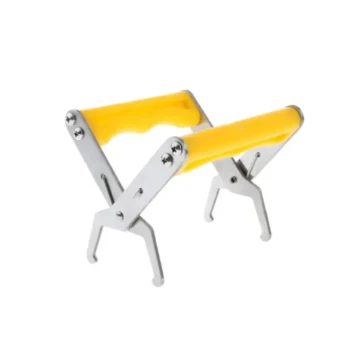
The primary purpose of a plastic measuring frame with a 1 dm² grid is to facilitate the Liebefeld method of colony assessment. By overlaying this standardized grid on a honeycomb, technicians can convert irregular biological variables—specifically adult bee populations and brood areas—into precise, quantifiable units of measurement.
Core Takeaway The 1 dm² grid acts as a translation layer between visual observation and hard data. It replaces subjective estimation with objective area measurement, allowing beekeepers to accurately calculate colony size and scientifically validate the effectiveness of treatments on colony vitality.
The Mechanics of Objective Assessment
Implementing the Liebefeld Method
The plastic grid is the essential hardware required to execute the Liebefeld method. This methodology relies on breaking down the complex surface of a hive frame into manageable, standardized units (square decimeters).
Converting Chaos to Units
A honeycomb surface is visually complex, containing a mix of honey, pollen, brood, and adult bees. The grid creates a fixed reference point, allowing the technician to count exactly how many "squares" are occupied by specific elements.
From Area to Population
Once the area is measured in dm², it allows for the derivation of biological totals. While the grid measures surface area, this data is used to calculate adult bee populations and total brood areas, providing a clear numeric picture of the colony's standing.
Why Precision Matters in Management
Evaluating Treatment Efficacy
The primary value of this precision is determining "recovery effects." When testing treatments (such as organic acids or probiotics), vague visual estimates are insufficient. The grid provides the objective data needed to prove whether a colony has statistically improved in vitality following an intervention.
Tracking Colony Changes
Colony size fluctuates naturally. The 1 dm² grid allows for the precise calculation of these changes over time. By comparing grid counts from different dates, managers can spot trends in growth or decline that might be missed by simple visual inspection.
Understanding the Trade-offs
Time vs. Accuracy
Using a measuring grid offers significantly higher accuracy than a standard "frame count" or visual guess. However, it requires more time per hive to physically overlay the grid and record the specific square decimeter counts for each frame.
The Reliance on Algorithms
The grid provides raw area data, not a direct head count. To convert this into a total population (e.g., total adult bees), the user must rely on specific technical algorithms or standard conversion factors (e.g., correlating area to biomass). The accuracy of the final count depends on the accuracy of these conversion standards.
Making the Right Choice for Your Goal
To determine if the 1 dm² grid is the right tool for your apiary management, consider your specific objectives:
- If your primary focus is scientific validation: Use the 1 dm² grid to obtain defensible, objective data on how specific treatments impact colony recovery.
- If your primary focus is rapid commercial inspection: A standard visual estimation of "frames covered" may be faster, though significantly less precise than the Liebefeld method.
By standardizing the assessment process, the measuring frame transforms beekeeping from an art of estimation into a science of measurement.
Summary Table:
| Feature | Visual Estimation | 1 dm² Grid (Liebefeld Method) |
|---|---|---|
| Primary Goal | Rapid commercial inspection | Scientific validation & precise monitoring |
| Data Type | Subjective / Estimated | Objective / Quantifiable Area (dm²) |
| Metric Measured | Frames covered by bees | Square decimeters of bees/brood |
| Accuracy | Low to Moderate | High |
| Time Required | Minimal | Moderate (requires frame-by-frame overlay) |
| Best Use Case | Routine apiary checks | Research, treatment testing, & colony tracking |
Elevate Your Apiary Management with HONESTBEE
Precision in colony assessment is the first step toward commercial success. At HONESTBEE, we empower commercial apiaries and distributors with the professional-grade tools needed to transform beekeeping into a precise science. From standardized measuring frames and specialized hardware to high-capacity honey-filling machines and hive-making equipment, we provide a comprehensive wholesale portfolio tailored to your growth.
Whether you are scaling your own colonies or supplying the industry with essential consumables and honey-themed merchandise, our expertise ensures you have the competitive edge. Contact HONESTBEE today to explore our full spectrum of beekeeping machinery and wholesale solutions—let's build a more productive future for your apiary together.
References
- Ivana Tlak Gajger, Predrag Sikirić. Stable gastric pentadecapeptide<scp>BPC</scp>157 in honeybee (<i>Apis mellifera</i>) therapy, to control<i>Nosema ceranae</i>invasions in apiary conditions. DOI: 10.1111/jvp.12509
This article is also based on technical information from HonestBee Knowledge Base .
Related Products
- Durable Plastic Frame Spacer
- Ergonomic Plastic Frame Spacer Tool for Rapid Hive Management Beekeeping
- Plastic Bee Frame Beekeeping Hive Frames for Wholesale
- Assembled Wooden Bee Frames with Plastic Foundation for Durability and Convenience by HONESTBEE
- Ergonomic High Visibility Plastic Frame Grip Handles
People Also Ask
- Are plastic bee hive frames good? A Guide to Modern Durability vs. Natural Appeal
- Are plastic bee frames good? A Guide to Durability, Efficiency & Bee Acceptance
- What are the advantages of using Standard Langstroth 10-frame equipment? Scale Your Commercial Apiary Efficiency
- How do you clean plastic frames? A Gentle Guide to Preserving Your Frames
- How must plastic frames be prepared for bees? Expert Tips for 100% Acceptance & Success