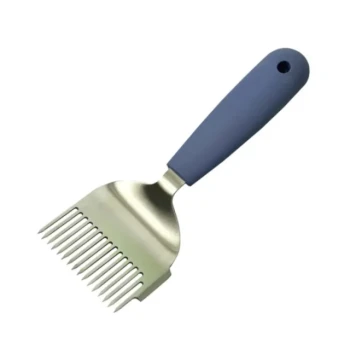
The precision of biological data determines the success of commercial apiaries. Utilizing standardized tools to measure capped brood area, specifically through techniques like the PUCHTA measurement method, allows beekeepers to scientifically quantify the developmental scale of larvae on hive frames. This transforms colony management from a reactive process into a predictive science by accurately forecasting future forager population density.
By quantifying the capped brood area, you move beyond simple observation to establish a direct correlation between biological growth and honey yield, creating a data-driven foundation for high-efficiency operations.
Transforming Biological Data into Yield Metrics
Forecasting Workforce Capacity
The capped brood area serves as a precise leading indicator for the colony's future labor force.
By measuring this area with standardized tools, you are effectively counting the number of bees that will soon emerge as foragers.
This allows you to predict the population density available during peak nectar flows, rather than reacting to population levels after the fact.
The Correlation to Production
There is a direct, positive contribution between the size of the brood area and the total honey yield.
Primary data indicates that a larger, healthy brood area during the buildup phase translates directly to higher productivity.
Standardized measurement provides the hard numbers needed to verify this growth, removing guesswork from yield estimation.
Optimizing Operational Efficiency
Identifying Elite Colonies
Precise measurement allows for the identification of high-productivity colonies during the critical buildup phase.
By comparing standardized data across the apiary, you can isolate superior genetic lines or queen performance.
This enables you to focus resources on the most productive hives, maximizing the return on your infrastructure investment.
Enabling Automation
Modern beekeeping increasingly relies on mechanized systems.
Accurate brood measurement provides the data-driven foundation required for the deployment of automated honey harvesting equipment.
Knowing the developmental stage of the colony ensures that machinery is deployed only when the biological conditions support efficient extraction.
Understanding the Trade-offs
Dependence on Infrastructure
Standardized measurement tools are only effective when paired with standardized infrastructure.
As noted in broader beekeeping principles, these tools rely on the uniformity of the hive environment, such as the movable frames found in Langstroth-type hives.
If your operation uses mixed or non-standard hive specifications, the data collected by these tools may become inconsistent or difficult to compare.
The Cost of Precision
Implementing standardized measurement adds a layer of technical process to routine inspections.
While it offers superior data, it requires a shift from rapid visual checks to quantitative analysis.
Operators must balance the time invested in measurement against the value of the predictive data it provides.
Making the Right Choice for Your Apiary
To effectively integrate brood measurement into your workflow, consider your immediate operational objectives:
- If your primary focus is maximizing yield prediction: Prioritize the use of PUCHTA-style measurement tools during the spring buildup to forecast forager strength.
- If your primary focus is efficiency via automation: Use brood area data to schedule mechanical harvesting, ensuring equipment is only used on colonies that have reached biological maturity.
Standardized measurement is the bridge between maintaining a colony and engineering a production system.
Summary Table:
| Metric Category | Key Benefit | Operational Impact |
|---|---|---|
| Population Forecast | Accurate forager density prediction | Optimizes labor for peak nectar flow |
| Yield Optimization | Quantitative correlation to honey output | Increases ROI through data-driven decisions |
| Genetic Selection | Identification of elite queen performance | Focuses resources on high-productivity hives |
| Mechanization | Data foundation for automation | Enables efficient use of honey-filling & harvesting machines |
Maximize Your Apiary’s Yield with HONESTBEE Precision Tools
As a commercial apiary or distributor, your success depends on transitioning from reactive management to predictive, data-driven operations. HONESTBEE is your strategic partner, offering a comprehensive wholesale portfolio designed to enhance every stage of the beekeeping lifecycle.
From high-precision tools for biological measurement to advanced honey-filling machines and specialized hive-making equipment, we provide the industrial-grade solutions you need to scale efficiently. Our full spectrum of beekeeping hardware and essential consumables ensures that your colonies reach their peak biological potential.
Ready to elevate your production efficiency?
Contact HONESTBEE today to explore our wholesale equipment solutions and see how our expertise can drive your commercial growth.
References
- Melis Çelik Güney, Gökhan Tamer Kayaalp. Bal Verimini Etkileyen Bazı Faktörlerin Path Analizi Yöntemi ile İncelenmesi. DOI: 10.24925/turjaf.v4i10.903-906.915
This article is also based on technical information from HonestBee Knowledge Base .
Related Products
- Professional Multi-Function Uncapping Fork with Ergonomic Rubber Grip
- Ergonomic Plastic Frame Spacer Tool for Rapid Hive Management Beekeeping
- Wide Adjustable Stainless Steel Honey Uncapping Fork with Scraper
- Digital Honey Refractometer for Precision Measurement of Optimal Honey Quality
- All-Stainless Steel Pivoting Honey Uncapping Fork for Beekeeping
People Also Ask
- What is the primary use of an uncapping fork in beekeeping? A Guide to Precision Honey Harvesting
- What is the use of an uncapping fork? A Precision Tool for Hive Management and Honey Harvesting
- What is the original purpose of an uncapping fork? Mastering Precision Honey Extraction and Comb Preservation
- How is an uncapping fork used to uncap honey frames? Precision Techniques for Perfect Honey Extraction
- What is an uncapping fork? A Precision Tool for Efficient Honey Harvesting